
Peer Prediction: Solving the Crisis of Trust in Social Service Ratings
Peer Prediction-Based Trustworthiness Evaluation and Trustworthy Service Rating in Social Networks
The paper proposes a private-prior peer prediction-based trustworthy service rating system for social networks. It introduces a mechanism to evaluate user trustworthiness and report reliability, achieving high-accuracy service ratings (validated on Flickr datasets) while effectively filtering out malicious and unreliable feedback.
TL;DR
In the era of social-driven commerce, ratings (like those on Yelp or App Stores) are easily gamed by malicious bots or biased users. This paper introduces a private-prior peer prediction framework that uses mathematical scoring rules to force honesty. By combining a "Trustworthiness" score with a new "Unreliability Index," it creates a system where malicious actors are caught in a strategic trap: they can't lie without being detected as either a liar or incompetent.
The Core Challenge: The "Dishonesty Payoff"
Current rating systems assume users are mostly honest. However, malicious users often have incentives to boost or trash a service's reputation. The fundamental difficulty is that ground truth is often private. If a user says a download was slow, the platform can't always verify if they are lying or if their connection actually failed. Prior works often relied on "common priors" (assuming everyone shares the same statistical baseline), which is unrealistic in diverse social networks.
Methodology: The Double-Filter Defense
1. Peer Prediction & Strictly Proper Scoring
Instead of just asking "Is this service good?", the system asks users to predict how their peers will rate the service.
- Prior Belief: What you think your peer will say before you use the service.
- Posterior Belief: What you think they will say after you've experienced the quality.
By applying Strictly Proper Scoring Rules (Logarithmic or Quadratic), the system ensures that a user’s expected "score" (trustworthiness) is mathematically maximized if and only if they report their true beliefs.
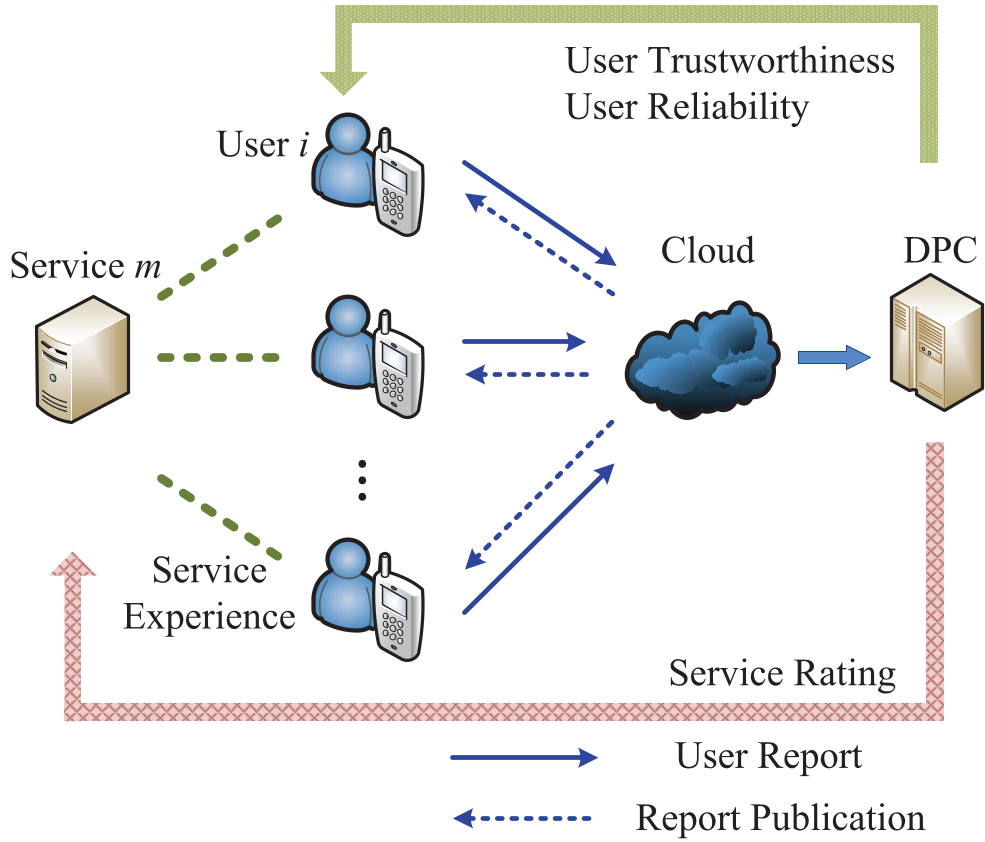 Figure 1: The proposed service rating framework where DPC processes user beliefs to filter feedback.
2. The Unreliability Index ()
The authors recognize that some users are honest but simply "bad judges" (e.g., they have a high error rate due to poor hardware). They introduced an index to measure the statistical deviation of reports:
- If a user tries to "cheat" by reporting a narrow gap between their prior and posterior beliefs to avoid scoring penalties, their Unreliability Index spikes.
- This creates a Dilemma: To keep high trustworthiness, you must be honest; if you try to lie "safely," you are flagged as unreliable and your vote is discarded.
Experimental Insights
Tested against the Flickr social network topology (80,000+ nodes), the results show a clear divergence in performance over time.
- Time Accumulation: While a malicious user might "get lucky" in a single interaction, their cumulative trustworthiness inevitably crashes into negative territory over multiple service encounters.
- Robustness: The service rating accuracy remains significantly higher than traditional majority-voting systems, even when the population of malicious users is high.
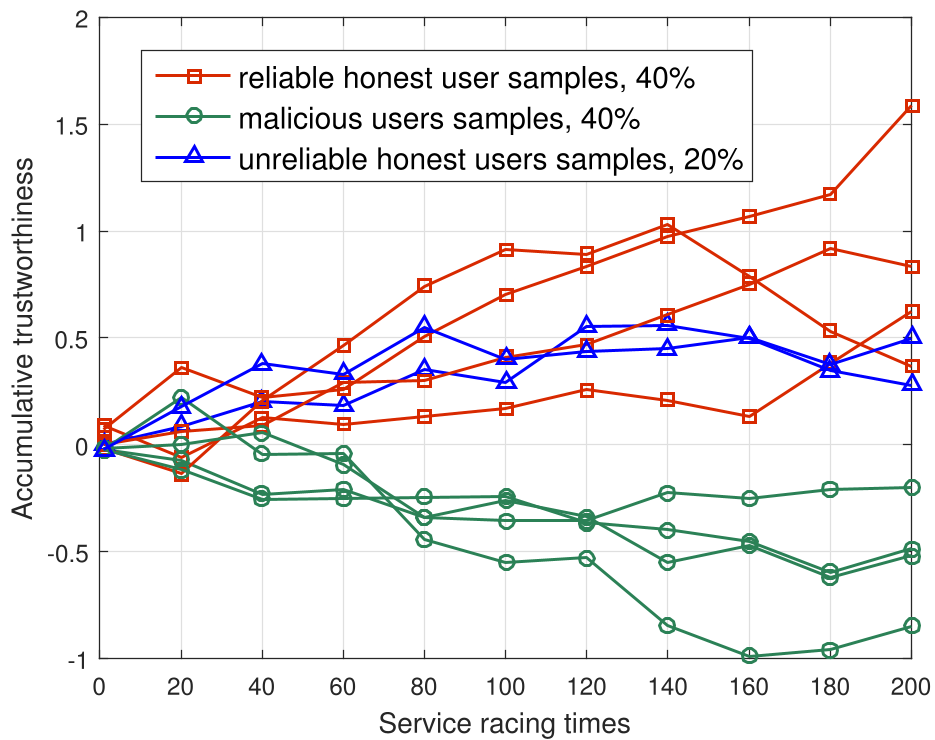 Figure 3: Accumulative Trustworthiness showing the clear separation between reliable (honest) and malicious users.
Final Verdict: Why This Matters
The brilliance of this work lies in its Incentive Compatibility. It doesn't just "detect" fraud; it makes fraud mathematically unprofitable. In an age of AI-generated reviews and sybil attacks, shifting from "validating reports" to "scoring beliefs" provides a robust theoretical foundation for the next generation of trustworthy digital platforms.
Limitations: The model assumes users are rational and motivated by the scoring reward. In ecosystems where malicious actors are motivated by external "real-world" payoffs (like a competitor paying them to destroy a business), the internal scoring rewards must be significant enough to offset those external incentives.