
Peer-Sensitive ObjectRank: Injecting Trust into Social Resource Discovery
Peer-Sensitive ObjectRank – Valuing Contextual Information in Social Networks
This paper introduces Peer-Sensitive ObjectRank, a novel ranking algorithm designed for desktop search within social networks. It generalizes PageRank/ObjectRank by incorporating personalized trust values for different peers, enabling a system that weights resources based on the reliability and authority of their source.
TL;DR
Searching your desktop shouldn't just be about keywords; it should be about who you trust. Peer-Sensitive ObjectRank adapts the logic of Google's PageRank to the personal desktop by utilizing social context. By weighting human relationships—trusting a professor more than a classmate—it ensures that shared resources are ranked not just by content, but by the reliability of their origin.
Problem & Motivation: The "Linkless" Desktop
Web search is powerful because the internet is a web of links. The desktop, however, is often an island of disconnected files. While recent efforts have used RDF metadata to create "semantic links" between documents, people, and projects, they face a new challenge in social networks: Source Heterogeneity.
If Alice receives a paper from a world-renowned professor (Bob) and another from a new student (Tom), her search ranking should reflect that Bob’s recommendation carries more weight. Current algorithms treat all incoming data as equal, losing the nuanced "social authority" inherent in human collaboration.
Methodology: Biasing the Random Surfer
The core of the paper lies in modifying the standard PageRank formula:
In standard PageRank, is a uniform vector allowing a "random jump" to any page. Peer-Sensitive ObjectRank transforms into a Peer-Sensitive Jumping Vector.
The Mechanism
- Provenance Tracking: The system tracks the origin of every resource () among peers ().
- Trust Assignment: Each user defines a trust value for their peers.
- Dynamic Vector : The probability of jumping to a resource is determined by the highest trust value of the peers it originated from:
This ensures that the "random surfer" is much more likely to land on a document shared by a highly trusted colleague than an unknown source.
 The modified jump vector formulation representing trust-based biasing.
Experiments & Results: Consultancy Resistance
The authors tested two main hypotheses using linear and powerlaw trust distributions.
1. The "Consultancy Resistant" Effect
When peers use a Powerlaw distribution (trusting themselves 100% and others very little), they become "consultancy resistant." Their top 10 ranked items rarely change even after receiving a flood of new data. The system only integrates external items if they are exceptionally well-connected to the user's existing local network.
2. The Influence of Scale
The experiments showed that "Bigger peers influence smaller peers." A user with only 5 papers will see their entire ranking hierarchy overhauled by high-authority resources from a peer with 300 papers. However, this influence is moderated by the choice of trust distribution.
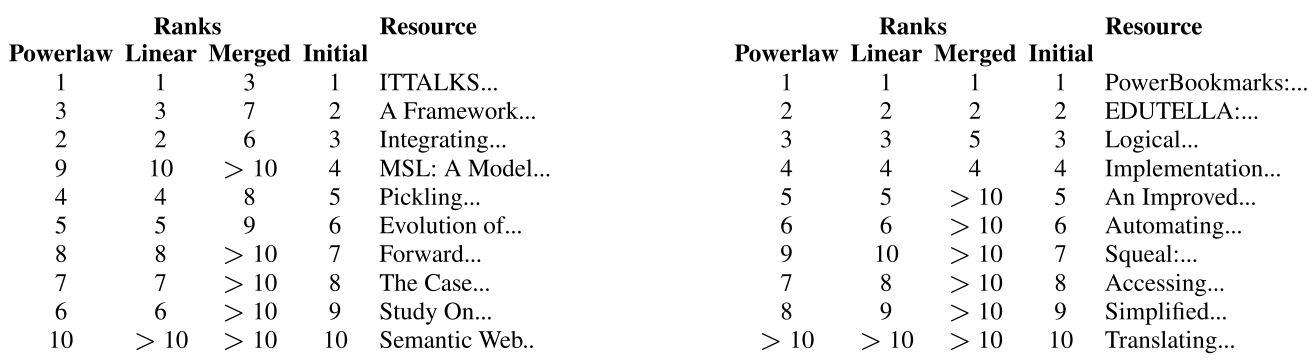 Table showing how different trust distributions (Powerlaw vs. Linear) affect the final ranking of resources compared to a simple merged rank.
Deep Insight & Conclusion
Peer-Sensitive ObjectRank proves that Trust is a metadata property. By mathematically encoding human relationships into the ranking vector, we can create search systems that feel more "natural"—prioritizing deep local knowledge while remaining open to high-quality external influence.
Limitations: The current model assumes trust is static and global per peer. In reality, trust is topic-specific (I trust Bob for ranking algorithms, but not for cooking recipes). Future work involving multi-dimensional trust based on RDF class types could further refine this social discovery mechanism.
Takeaway
For developers of decentralized search or social recommendation engines, this paper provides a robust mathematical framework for balancing local relevance with social authority, preventing information overload by filtering the social graph through the lens of personalized trust.