
Decentralized Horizons: Building Social Networks on P2P Virtual Home Platforms
11957_Service Platform and Social Networking Service Based on Peer-to-Peer Networking.
This paper introduces a P2P-based Virtual Home Platform and a corresponding Social Networking Service (SNS) framework. By leveraging the JXTA (Juxtapose) middleware, the authors propose a decentralized architecture that allows cross-device resource sharing and social interaction without relying on centralized servers.
TL;DR
This paper presents a paradigm shift in how we perceive domestic and social connectivity. By moving away from centralized servers, the authors developed a P2P Virtual Home Platform that integrates varied devices into a single virtual space. Utilizing JXTA middleware, it provides a blueprint for a Social Networking Service (SNS) where security-peer groups replace centralized authority, allowing for seamless, trusted resource sharing across smartphones, PDAs, and PCs.
Problem & Motivation: The Loneliness of Devices
In a ubiquitous computing environment, our devices often operate in silos. While the physical number of terminals (smartphones, office PCs, home servers) has grown, creating a "seamless connection" between them typically requires a middleman—a central server. This architecture introduces two major pain points:
- Physical Limitations: Accessing indoor devices from outdoor locations remains clunky without complex cloud routing.
- Information Reliability: The open internet is flooded with low-veracity data. Centralized SNS often struggle to define small, trusted "circles of trust" without massive overhead.
The authors' intuition was to treat the "Home" not as a physical location, but as a Virtual Space defined by peer relationships rather than geographic proximity.
Methodology: The Architecture of Trust
The core of this work lies in the abstraction of physical devices into a P2P Virtual Network. The implementation relies on JXTA (Juxtapose), an open-source P2P infrastructure that allows peers to discover, communicate, and group regardless of their underlying network topology (WiFi, GPRS, etc.).
1. The Virtual Home Platform
By implementing a virtual mapping layer, the platform integrates various terminals into one logical space. This allows a user in an office to "see" their home hard drive as if it were a local resource.
2. Social Grouping and Rendezvous Peers
To facilitate SNS, the system employs a hierarchical P2P model:
- Peer Groups: Users form "Security-Peer Groups" to ensure that data sharing remains private and trusted.
- Rendezvous Peers: These act as hubs for uploading and delivering specific information across the network, ensuring that "news" or "requests" propagate even if some peers are occasionally offline.
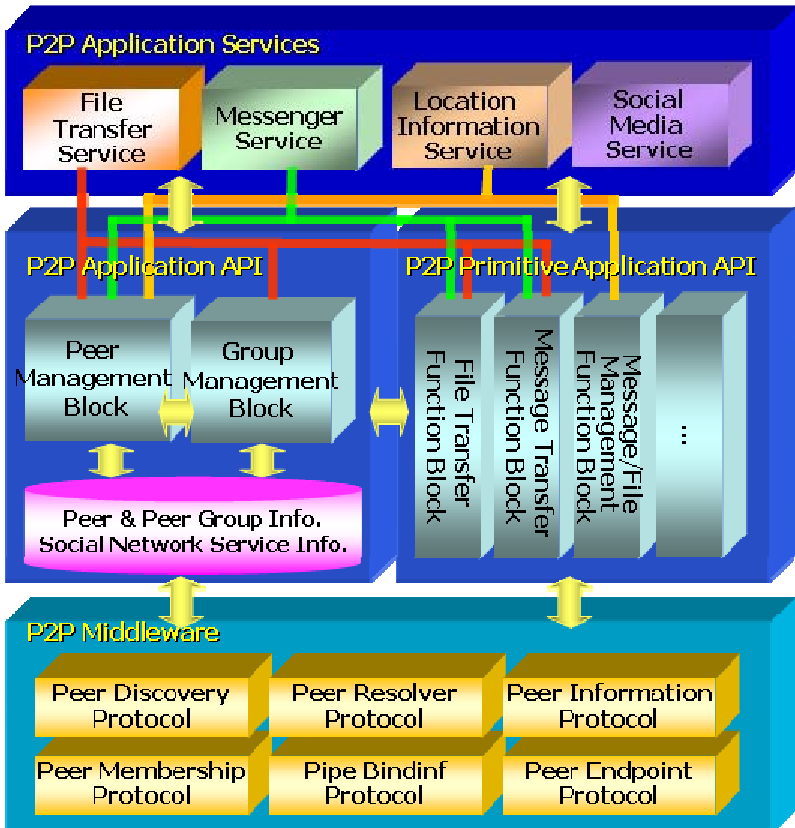 Figure 1: The S/W Development Module showcases the interaction between P2P Middleware and the Application Layer.
Experiments & Implementations: Cross-Device Synergy
The researchers successfully implemented the platform on multiple form factors, moving beyond theoretical models to functional PDA and smartphone integrations.
- Virtual Mapping: The study demonstrated that terminals in diverse physical locations (Office, Home, Ad-hoc) could be mapped into a cohesive virtual network.
- Content Sharing: Tests on handheld devices proved that the P2P middleware could handle content synchronization efficiently enough for real-time social interaction.
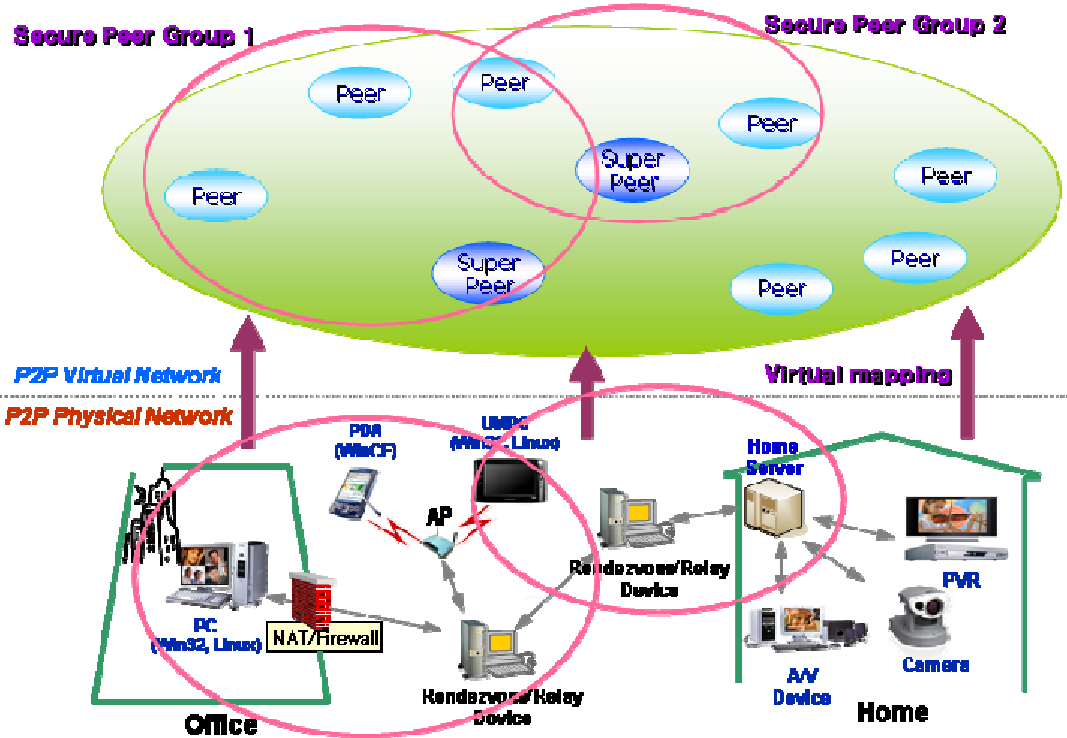 Figure 3: Mapping physical terminals into an organized virtual peer group.
Critical Analysis & Conclusion
The value of this research lies in its Universal API approach. By creating an SNS API that is "irrelevant to application characteristics," the authors provided a foundation for developers to build decentralized communities without reinventing the communication wheel.
Limitations & Future Outlook
While the P2P approach solves centralization issues, it introduces challenges in Data Persistence—if all peers in a group go offline, data may become temporarily unavailable. The authors address this via "Rendezvous Peers," but future work in Data-driven Live Streaming and Service Composition will be necessary to make the P2P Virtual Home as robust as today's cloud services.
This work serves as a precursor to the modern "Self-Sovereign Identity" and "Edge Computing" movements, proving that the home of the future isn't just a place—it's a network.