
Beehive: Reimagining the Corporate Directory as a Social Engine
People Sensemaking and Relationship Building on an Enterprise Social Network Site
This paper introduces "Beehive," an enterprise social network site (ESNS) designed for IBM employees to foster "people sensemaking" and relationship building. It documents the platform's architecture and a three-month field study with nearly 300 users, demonstrating how internal social networking differs from public platforms like Facebook or LinkedIn.
TL;DR
In the mid-2000s, IBM Research launched Beehive, an internal social network designed to bridge the gap between "what people do" and "who people are." Unlike static company directories, Beehive encouraged employees to share personal photos, lists, and status updates. The result? A massive surge in "people sensemaking"—the process of forming mental models of colleagues—leading to increased team cohesion and unexpected serendipity across a global enterprise.
The "Who is This?" Problem: Motivation and Insight
Most large companies suffer from the "Corporate Cube" syndrome: you know a colleague's job title and extension, but you have no idea if they are approachable, what their expertise truly is, or if you share common interests. Prior work on corporate blogs and wikis helped with information discovery, but they didn't help with relationship building.
The authors' core insight was that the Enterprise Intranet is a "Walled Garden." Because users are authenticated and share a common employer, the "Social Contract" is different. People are willing to be more vulnerable and personal inside the firewall than they would be on a public-facing site like Facebook.
Methodology: Designing for Connection
Beehive was designed with several social artifacts intended to stimulate conversation:
- "About You" (Self-Authored Identity): Instead of rigid HR categories, users created their own Q&A pairs.
- "Hive Fives" (Micro-Lists): A unique content type where users shared 5 items—ranging from "Projects I've worked on" to "My favorite travel spots."
- The Buzz: A real-time activity stream and commenting system that promoted serendipitous discovery.
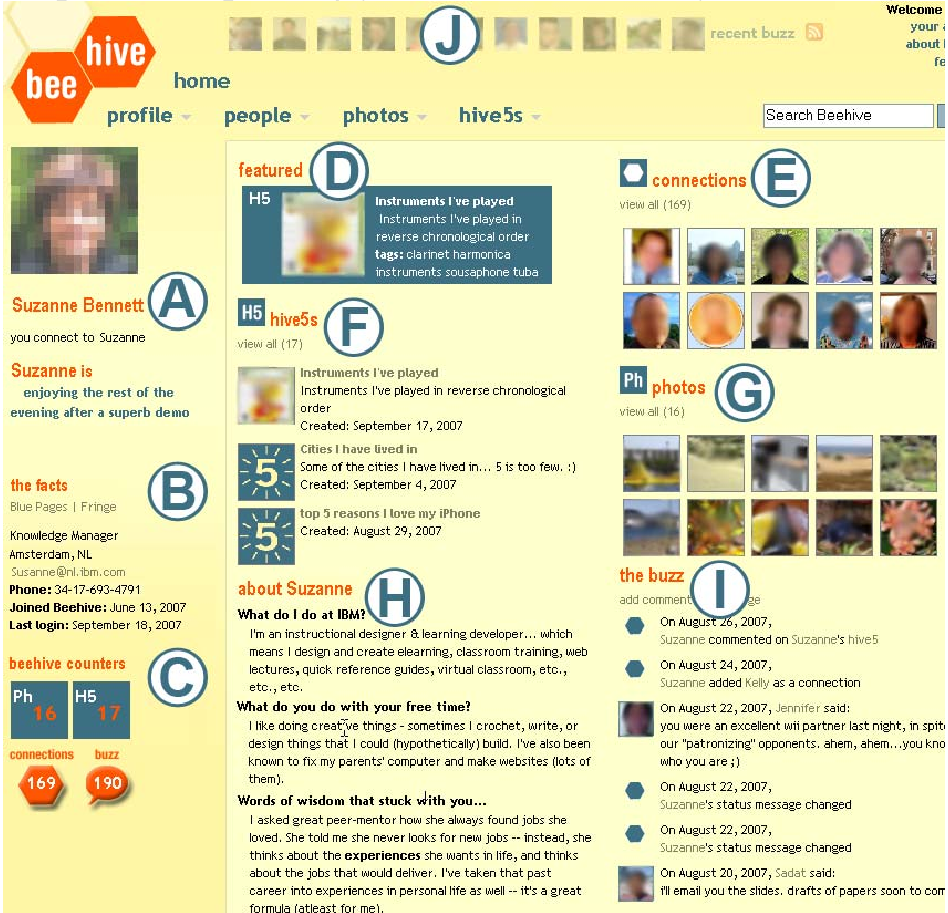 Figure 1: The Beehive Profile. Notice the blend of corporate directory data (A, B) with social counters (C) and user-generated "About You" content (H).
Experimental Analysis: Personal vs. Professional
The field study tracked 285 early adopters over three months. The data debunked the myth that employees only want to talk about work.
- Content Blending: While 70% of photos and lists were personal (scenery, family, hobbies), they were "tailored for the audience." Employees weren't just dumping family albums; they were choosing images that signaled their personality to colleagues.
- The Privacy Paradox: Even though privacy controls were available, 97% of content was shared publicly with the entire company. This suggests a high level of implicit trust within the corporate firewall.
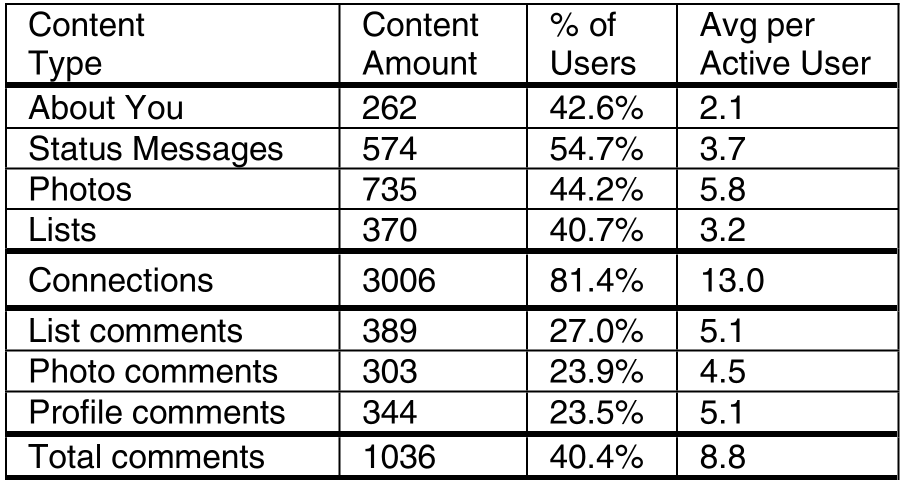 Table 1: User participation metrics. Note the high average of 13.0 connections per user and the significant volume of comments.
Deep Insight: Breadth vs. Depth
The most fascinating finding was how users browsed the site. The researchers found a distinct pattern:
- Depth with Friends: Users spent the most time looking deeply at the content of people they already knew (68% of page views).
- Breadth with Strangers: However, when it came to who they looked at, users explored more unique non-friends (54%) than friends.
This proves that Beehive wasn't just an "echo chamber" for existing teams; it served as a discovery engine for the broader organizational network.
Conclusion & Legacy
The Beehive study proves that Social Capital in the workplace is built on the "gist" of a person. By allowing employees to reveal their "whole selves," Beehive facilitated "People Sensemaking"—turning a names-and-titles list into a vibrant community.
While modern tools like Slack and Teams have inherited some of this DNA, the specific "profile-centric" sensemaking highlighted here remains a challenge for companies trying to maintain culture in a remote-first world. The lesson from Beehive is clear: don't just give people a place to work; give them a place to be seen.