
"Living with a Friendly Stranger": The Paradox of Personality in the Smart Home
"It's like living with a friendly stranger": perceptions of personality traits in a smart home
This paper explores the design space of agent-based smart home interfaces by manipulating perceived personality traits. The authors developed two distinct prototypes—"Conscientious, Kind, and Calm" (CKC) and "Extroverted and Cheerful" (EC)—to evaluate inhabitant preferences and the impact of proactive versus passive home behaviors.
TL;DR
Can a house have a "soul"? This study explores whether smart home agents should be bubbly and proactive or quiet and organized. By testing two distinct personalities—one extroverted and one conscientious—researchers found that users overwhelmingly prefer a home that acts like a reliable assistant (CKC) rather than an assertive social companion (EC), revealing that human-like "creativity" in AI often feels like a privacy violation in our most private spaces.
Problem & Motivation: The Complexity of the Connected Home
As our homes fill up with smart bulbs, robot vacuums, and connected appliances, we face a fragmented user experience. The "Smart Home" often feels like a collection of apps rather than a cohesive environment.
To solve this, researchers are turning to Agent-Based Interfaces. If we can talk to our home as a single entity (like Alexa or Siri), the complexity disappears. However, when a machine speaks, it naturally exhibits personality traits. The authors pose a critical question: What kind of "person" should your house be?
Methodology: Designing "Electronic Personalities"
The researchers didn't just change the voice; they mapped the Big Five personality model to a multi-system environment.
The Two Contenders:
- EC (Extroverted and Cheerful): High Extroversion and Openness. It takes the initiative, makes social suggestions, uses bright lights, and playful robot movements.
- CKC (Conscientious, Kind, and Calm): High Agreeableness and Conscientiousness. It is task-oriented, subtle, asks for permission, and uses gentle lighting.
 Figure 1: The study walkthrough where participants experienced the home's behavior during daily routines.
The researchers used a Wizard-of-Oz style lab setup, simulating a bedroom, bathroom, and living room. They controlled the output of Philips Hue lights, Roomba vacuums, and synthesized speech to ensure the personality was felt across all channels.
Key Insights: Why "Smart" Can Be "Creepy"
The results were a wake-up call for designers of proactive AI:
- The Struggle for Control: High proactivity in the "Extroverted" home was often seen as "bossy." When the home suggested social activities or told the user to go to bed, it felt like living with a patronizing parent.
- The Mood Tracking Backfire: One of the most polarising features was mood detection in the bathroom mirror. Participants found it "creepy" and redundant. As one participant noted: "It reinforced my bad feelings."
- Trust vs. Intelligence: Participants valued "Trustworthy" and "Organized" traits above all else. Interestingly, they were okay with the home asking "boring" confirmation questions because it made them feel in control.
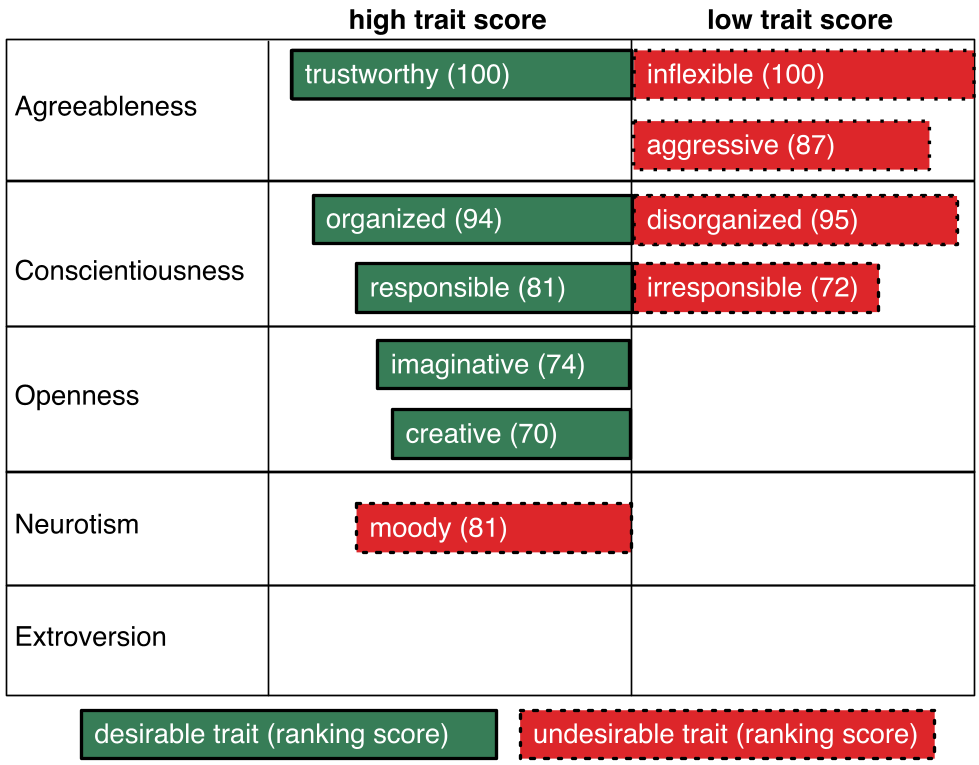 Figure 2: Trust and Responsibility are the "must-haves," while Moodiness and Aggression are the ultimate deal-breakers.
Critical Analysis & Conclusion
The research highlights a fundamental tension: we want our homes to be "smart" enough to help us, but "dumb" enough to remain predictable tools.
The Takeaway for AI Designers:
- Conscientious Proactivity: Don't just act; ask. Confirming a user's intent is a trust-building exercise, not an annoyance.
- The "Friendly Stranger" Problem: Designers must be careful with social boundary-crossing. A home that tries to be a friend often ends up feeling like a stranger invading your privacy.
- Personality as a Utility: Personality isn't just about "cuteness"—it's a way to signal system capabilities. A "calm" persona signals reliability; an "energetic" persona might signal a system prone to unexpected actions.
In conclusion, the future of the smart home isn't about creating a digital roommate. It’s about creating a "conscientious butler"—a system that is invisible when not needed, hyper-reliable when called upon, and always respectful of the owner's autonomy.
Limitations
As a lab study, the social dynamics of multi-person households were not explored. In a real home, an agent would have to navigate the personalities of multiple family members simultaneously—a much more complex "personality" challenge for future research.