
Perceptive Patient: Beyond Face Scanning in Affective Medical Simulation
Perceptive Patient: Important Factors for Practical Emotion Sensing in Conversational Human-Computer - Interactions and Simulations
The paper introduces "Perceptive Patient," a multimodal Virtual Standardized Patient (VSP) system designed for medical simulation. It utilizes a custom technical architecture integrating computer vision, NLU, and auditory processing to assess human emotion and behavior in real-time, adjusting the VSP's trust level and disclosure honesty based on a "Judgment Engine."
TL;DR
"Perceptive Patient" is a sophisticated Virtual Standardized Patient (VSP) that doesn't just "see" you—it judges you. By integrating computer vision, natural language understanding, and a hierarchical context engine, the system evaluates a trainee's bedside manner in real-time. If the student is dismissive or lacks empathy, the virtual patient becomes evasive, forcing the learner to adjust their interpersonal strategy to gain the patient's trust.
The Fallacy of "Easy" Emotion Sensing
Modern AI vendors often claim that identifying a "smile" via Facial Action Units (FAUs) is equivalent to detecting "happiness." The authors of this paper dismantle this notion. A smile can be a sign of joy, but in a clinical setting, it can just as easily represent nervousness, condescension, or social masking.
The core challenge in affective computing is Contextual Ambiguity. Without knowing what was just said or where we are in a conversation, raw sensory data is scientifically unreliable. The Perceptive Patient addresses this by making the AI the "driver" of the conversation, allowing it to know exactly what stimulus was just provided to the human user.
Methodology: The Hierarchical Signal Chain
The system's architecture (referred to as the "MultiSensing" framework) moves beyond raw data through three distinct levels:
- L1 Signals: Raw numerical data (e.g., "AU3 is at 0.12").
- L2 Signals: Interpretive context (e.g., "The user is smiling 30% of the time").
- L3 Signals: Fully interpreted psychological states (e.g., "The user showed a shocked reaction while listening").
Model Architecture
The interaction is treated like a turn-based strategy game. Each dyad (VSP statement + User response) updates a Judgment Engine.
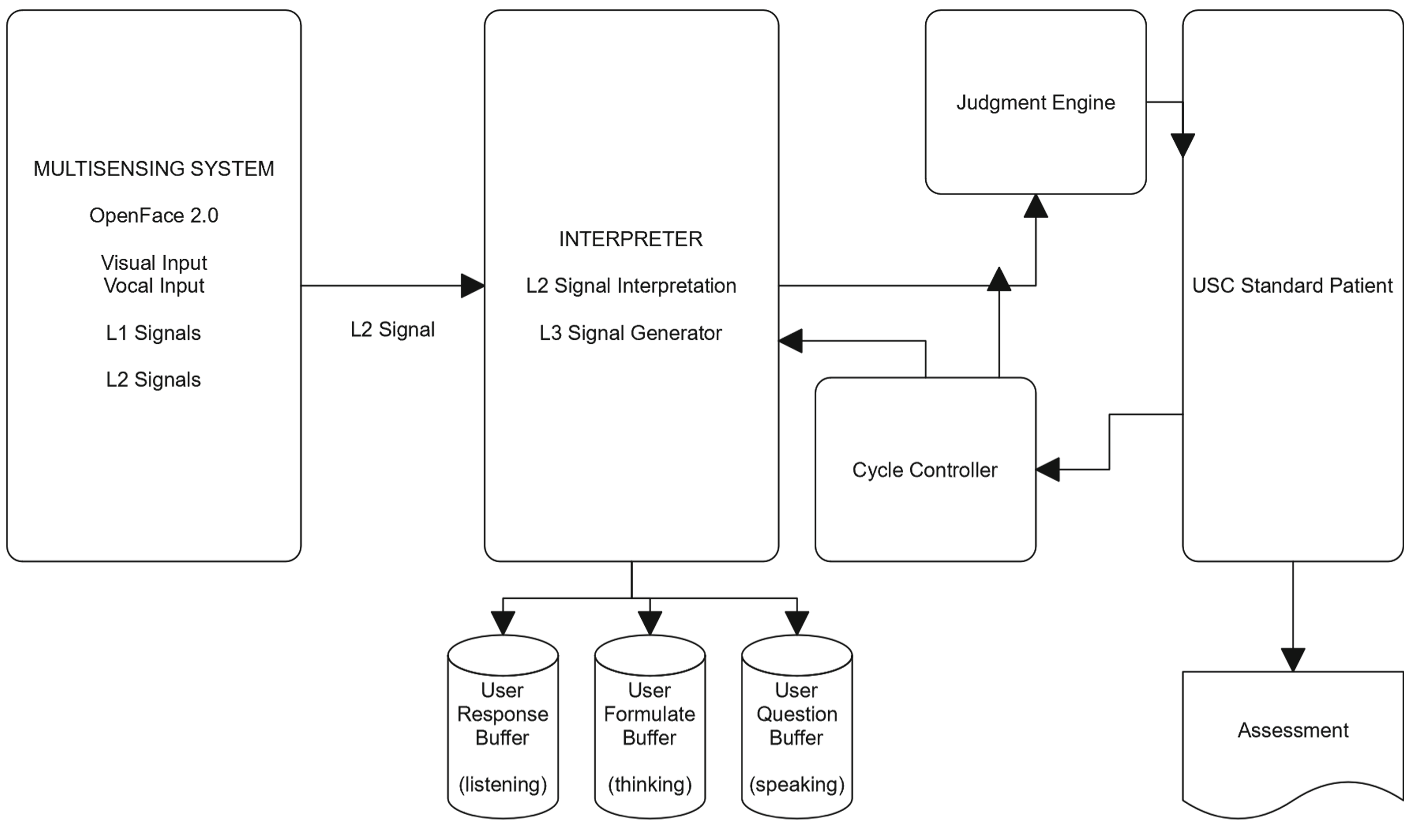 Figure 1: The technical architecture showing the flow from MultiSense sensors to the Judgment Engine and Standard Patient system.
Key Innovation: Provocative Stimuli & Trust Thresholds
Instead of waiting for the user to do something interesting, the system uses Provocative Stimuli. The VSP might share upsetting personal information to see if the user responds with an empathetic linguistic tone or maintains appropriate eye contact.
The Trust Variable
The system maintains a longitudinal "Trust" variable.
- Low Trust: If the user uses technical jargon, interrupts, or lacks empathy, the VSP provides "factitious" (fake) or evasive answers.
- High Trust: Only once a threshold of "Likability" and "Compassion" is met will the VSP reveal critical diagnostic info.
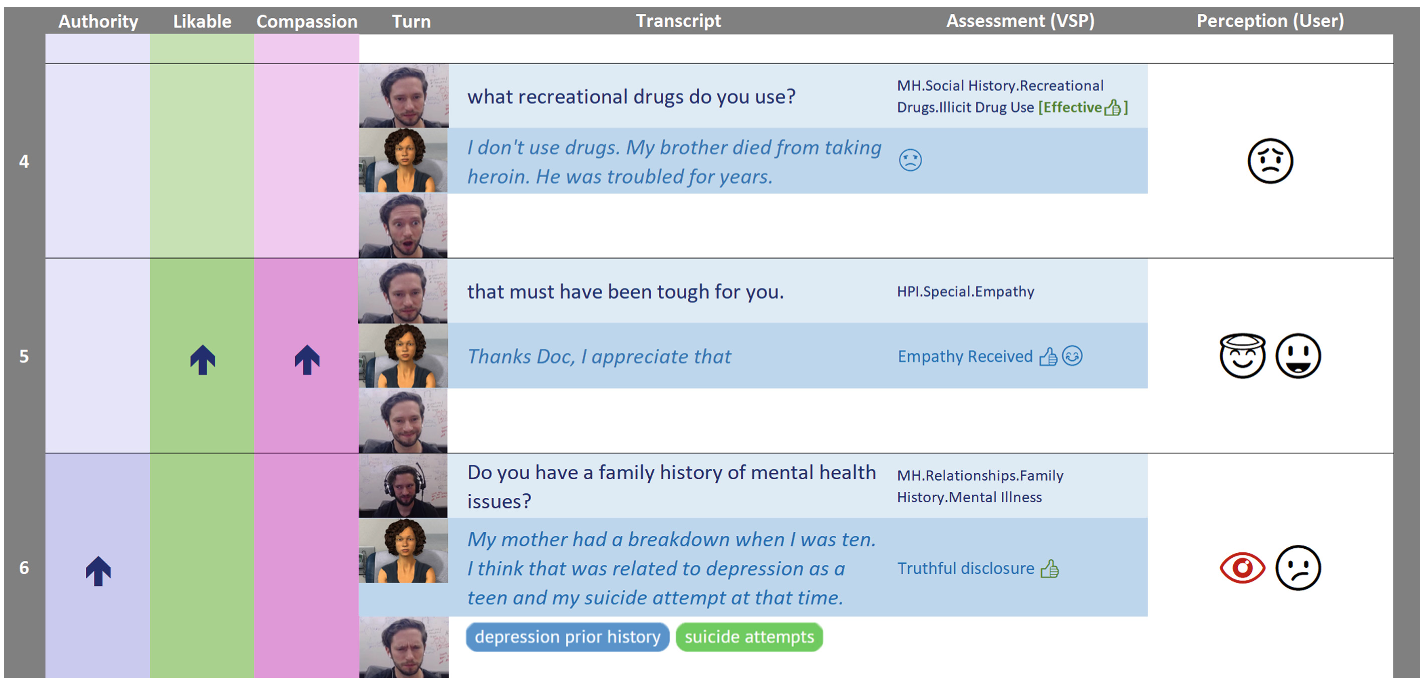 Figure 2: Example of a conversation transcript where the system logs user behaviors and adjusts internal variables.
Experimental Insights
The research highlights that Linguistic Inquiry & Word Count (LIWC) and entrainment (the subtle mirroring of posture and expressions) are more indicative of a successful clinical interaction than facial expressions alone.
Key takeaway from results:
- Interruption Detection: This was found to be a high-impact negative behavioral input for the judgment model.
- Eye Contact: Critical during "listening" phases but ignored during "formulating" phases, proving that context-aware sensing is superior to constant monitoring.
Critical Analysis & Conclusion
The Perceptive Patient moves affective computing from "passive observation" to "active interaction." By shifting the focus from simple FAU detection to a model of Human-Systems Integration, the authors provide a blueprint for more realistic medical simulations.
Limitations: The current prototype does not yet fully integrate vocal prosody analysis (tone of voice) due to technical constraints. Future iterations will likely leverage more robust cloud-based AI to handle the nuances of speech frequency and energy in real-time.
Takeaway: Realism in simulation isn't just about graphics; it's about the emotional consequence of the user's actions. When a virtual patient stops telling the truth because you were rude, the "soft skill" of empathy becomes a "hard requirement" for success.