
SROR: Leveraging Social DNA for Robust Routing in Dynamic Networks
Performance evaluation of social relation opportunistic routing in dynamic social networks
This paper presents an extended performance evaluation of the Social Relation Opportunistic Routing (SROR) algorithm for mobile social networks. SROR utilizes node social profiles and transition probabilities to maximize packet delivery in delay-tolerant, dynamic environments, significantly outperforming benchmarks like Prophet, SimBet, and Social Pressure Method.
TL;DR
In the world of mobile social networks, connections are fleeting and disconnections are the norm. This paper evaluates Social Relation Opportunistic Routing (SROR), a protocol that treats social affinity as a proxy for network reliability. By matching user profiles and predicting mobility through Markov chains, SROR achieves significantly higher delivery rates (up to 80%) than traditional opportunistic protocols like Prophet or SimBet.
Background & Motivation: The Chaos of Mobility
Standard routing protocols assume a relatively stable path between source and destination. However, in scenarios like school campuses or rural connectivity hubs, nodes (people) move unpredictably, causing "Delay Tolerant" conditions where a path may never exist end-to-end at a single moment.
The authors argue that while network topology is volatile, social relationships are stable. If two people share the same interest groups or work in the same office, their "inter-meeting probability" is inherently higher. The core insight of SROR is to bridge the gap between the Application Layer (social profiles) and the Network Layer (packet forwarding).
Methodology: The Three-Pillar Filtering Process
SROR doesn't just broadcast packets; it uses a sophisticated distributed filtering mechanism to select the next "best carrier" for a "store-carry-forward" strategy.
- Social Profile Matching (SPM): Matches metadata (interests, residency, education). If a potential carrier shares 80% of their "Social DNA" with the destination, they are prioritized.
- Social Connectivity Matching (SCM): Analyzes the logical social graph. It looks for "bridges"—nodes that belong to multiple social communities.
- Social Interaction Matching (SIM): Uses a Homogeneous Semi-Markov Process to model community transitions. It calculates the probability that a node will move from its current community to community .
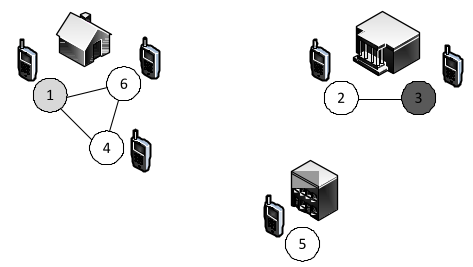 In the figure above, the system distinguishes between the logical Social Graph and the physical Network Graph, using the former to predict the latter.
Performance: Outperforming the Benchmarks
The authors conducted extensive ns-2 simulations on a 1000m x 1000m grid simulating a campus environment.
1. Robustness Against Network Fragmentation
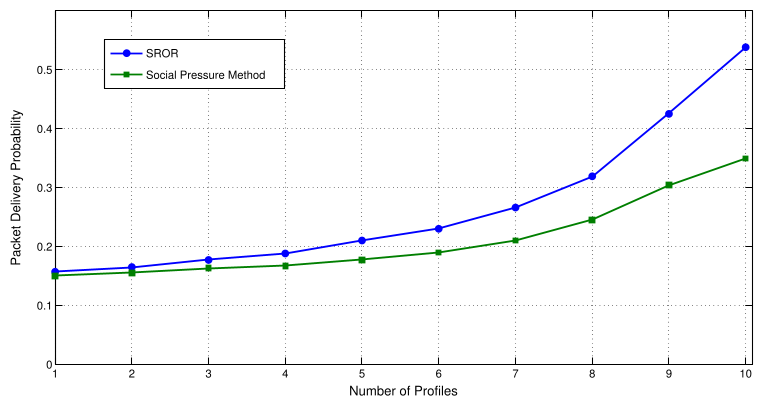
As the number of communities increases, the network becomes more fragmented. While all protocols see a decline, SROR maintains a dominant performance edge. The gap is particularly noticeable in dense communities where social information is rich.
2. Efficiency of the Filtering Pipeline
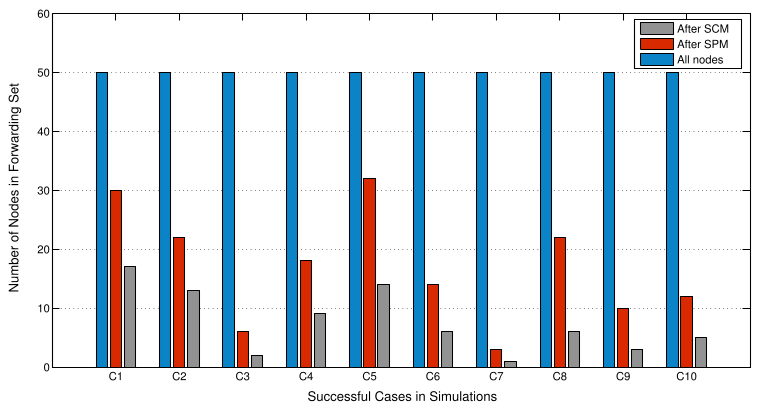
A key highlight of the paper is the "Filtering Efficiency." The SPM module is incredibly aggressive, pruning nearly 50% of inefficient candidate nodes before the packet is even sent. This drastically reduces network overhead (Average Cost).
Deep Insight: Why It Matters
The fundamental contribution of SROR is the shift from reactive routing (reacting to who is nearby) to predictive routing (predicting who will be near the destination based on shared attributes).
However, the paper acknowledges a critical limitation: Social Selfishness. In real-world scenarios, a node might refuse to carry a packet for a stranger to save battery. The authors propose that future work must integrate "Negative Social Characteristics"—modeling not just who we can trust, but who might behave selfishly.
Conclusion
SROR proves that in the absence of a stable physical path, "Social Context" is the most reliable currency for data delivery. By leveraging Markovian transitions and profile similarity, it transforms the unpredictability of human movement into a structured, efficient routing strategy for the next generation of mobile social networks.