
Deciphering the Rhythm of Social Mobility: Periodicity Detection in Sparse OMSNs
Periodicity Detection of Node Behaviour in Opportunistic Mobile Social Networks
This paper introduces the application of the Lomb-Scargle Periodogram to detect periodicity in node contact patterns within Opportunistic Mobile Social Networks (OMSNs). By treating sparse encounter data as unevenly sampled signals, the authors achieve high-accuracy behavior detection while drastically reducing memory requirements for mobile nodes.
TL;DR
Human movement is rarely random; we follow periodic social cycles. However, catching these rhythms in Opportunistic Mobile Social Networks (OMSNs) is hard because nodes are mostly disconnected. This paper leverages the Lomb-Scargle Periodogram—a tool originally meant for stargazing—to detect mobility patterns from sparse, "holey" data, matching FFT accuracy while saving massive amounts of device memory.
Background: The Sparsity Paradox
In OMSNs, messages are "carried" by humans. To route a message efficiently, we need to know if a node is likely to meet the destination again (e.g., "Do they meet every Monday?").
The problem? Traditional methods like Fast Fourier Transform (FFT) are "memory-hungry" and rigid. They require a value for every single time slot. In a real-world trace like MIT's Reality Mining, a node might only be "active" 3% of the time. To use FFT, you’d have to store thousands of "zeros" just to represent silence. For a smartphone or an IoT gadget, this is a waste of precious buffer space.
Methodology: From Astronomy to Networking
The authors identify that node contacts are essentially incomplete time-series data. Instead of forcing this data into a regular grid (and filling gaps with zero), they adopt the Lomb-Scargle Periodogram.
Why it works:
Unlike FFT, which decomposes a signal into a sum of sines and cosines on a fixed grid, Lomb-Scargle performs a least-squares fit of sinusoids to the data points actually present.
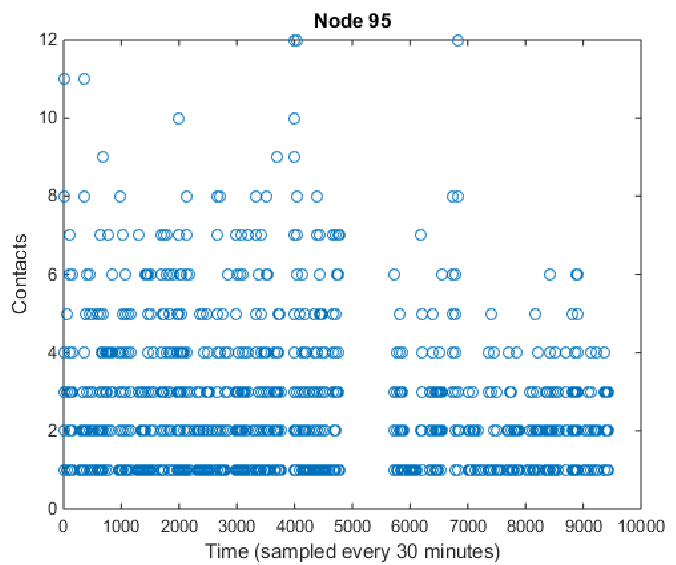 Above: Note how node contacts appear as sparse bursts. Storing and processing only these bursts is the key to efficiency.
The Mathematical Intuition: The algorithm adjusts the phase () for each frequency () such that the spectral power is invariant to time shifts. This allows it to handle data where the time intervals between contacts are completely irregular.
Experimental Results: Accuracy vs. Sparsity
The authors tested their approach on two iconic datasets:
- Reality Mining (Long-term): 97 participants over 10 months.
- Haggle (Short-term): 41 participants over a 3-day conference.
Performance Benchmarks:
The researchers compared the Lomb-Scargle output against the "Gold Standard" (FFT with complete data).
- The 7-Day Cycle: In the long-term Reality Mining trace, the method successfully identified the weekly rhythm of most active and moderately active nodes.
- The Hourly Cycle: In the short-term Haggle trace (a conference setting), it correctly identified the hourly session-switching behavior.
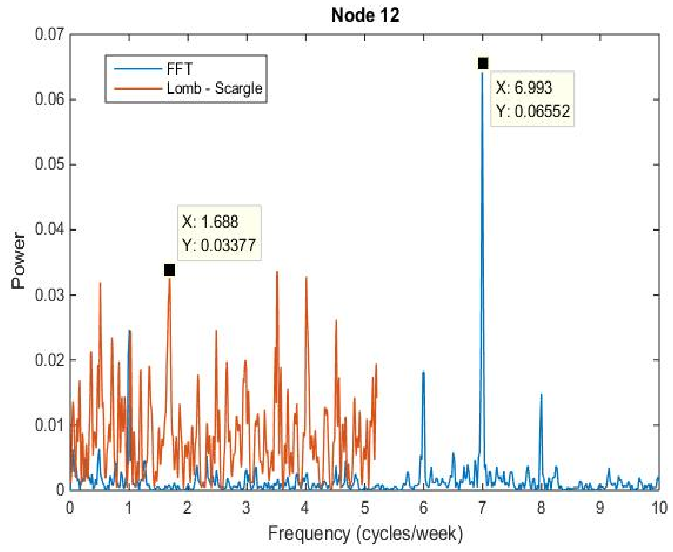 Fig: Node 95 Periodicity. Both FFT (complete data) and Lomb-Scargle (sparse data) converge on a 7-day peak.
The Limit of Sparsity
The "Failure Mode" occurred with the least active nodes. If a node has a sparsity level of 97%+ (meaning it almost never meets anyone), the periodogram loses its signal-to-noise ratio and fails to provide a dominant peak.
Critical Insight: Why This Matters
The real contribution here isn't just "detecting a cycle"—it's the resource-efficiency. By using Lomb-Scargle:
- Memory Impact: Nodes don't need to store "silence." They only store the timestamps of actual contact events.
- Predictive Routing: This periodicity can be fed into protocols like BubbleRap to predict exactly when a "socially central" carrier will become available.
Conclusion & Future Outlook
The paper proves that we don't need "Big Data" to understand social mobility; we just need the "Right Data." While the method struggles with highly inactive nodes, the authors suggest using Gossip Protocols to share periodicity insights across the network, allowing active nodes to "teach" the network about the patterns of less active ones.
As we move toward a world of fragmented, decentralized edge networks, techniques that embrace data sparsity rather than fighting it will be the ones that scale.