
PersoNet: Beyond Homophily—Building Friend Recommendations on Personality Science
PersoNet: Friend Recommendation System Based on Big-Five Personality Traits and Hybrid Filtering
The paper introduces PersoNet, a novel Friend Recommendation System (FRS) that leverages the Big Five personality traits (OCEAN model) and hybrid filtering. It integrates personality-based similarity with user harmony ratings to provide personalized social connections, outperforming traditional collaborative filtering (CF).
TL;DR
PersoNet is a hybrid friend recommendation system that moves beyond simple demographic matching (homophily) by utilizing the Big-Five Personality Traits. By combining personality computing with a hybrid filtering mechanism, it solves the "cold-start" problem and achieves higher recommendation accuracy (Precision: 0.81, Recall: 0.82) compared to traditional collaborative filtering methods.
Context: Why Common Interests Aren't Enough
In the world of social networking, most systems operate on the principle of homophily—the idea that people who share an age, a job, or a location should be friends. While this works for physical attributes, psychology tells a different story regarding personality. Two "highly neurotic" individuals might not actually get along, while an "Extrovert" might be the perfect foil for an "Introvert."
The current challenge in Friend Recommendation Systems (FRS) is twofold:
- The Compatibility Gap: Shared traits do not equate to social harmony.
- The Cold-Start Problem: New users have no interaction history, leaving Collaborative Filtering (CF) systems blind.
Methodology: The PersoNet Architecture
PersoNet bridges the gap between psychological theory and data science using a Hybrid Filtering approach.
1. The Multi-Factor Input
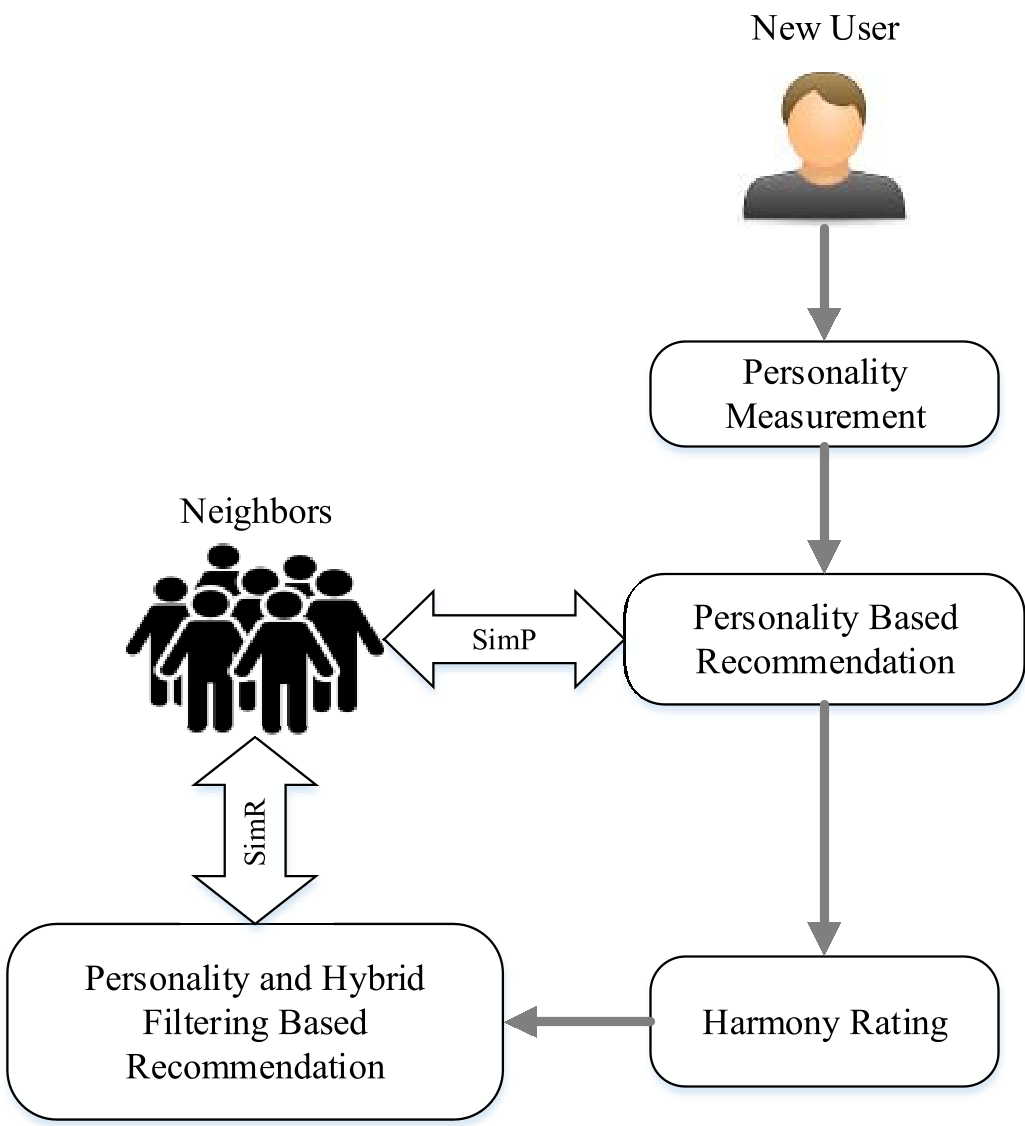
The system utilizes the NEO-PI-R (IPIP-60) questionnaire to map users into five dimensions: Openness, Conscientiousness, Extraversion, Agreeableness, and Neuroticism.
2. Hybrid Similarity Engine
The core of the system is the implementation of two distinct similarity measures:
- SimP (Personality Similarity): Calculated using the Pearson correlation coefficient of personality vectors.
- SimR (Harmony Rating Similarity): Analyzes how users rate their social "harmony" with others.
3. Solving the Cold Start
PersoNet uses a dynamic weight parameter (). For new users, is high, relying entirely on personality similarity. As the user interacts and provides "Harmony Ratings," decreases, allowing the specific preferences (Collaborative Filtering) to take the lead.
Experiments and Results
The researchers built a custom social network and conducted a 3-month experiment with 123 active participants. To ensure results were based on personality rather than superficial traits, users were asked to remain anonymous regarding their real names, locations, and religions.
Performance Metrics
The researchers compared PersoNet against two baselines:
- Birds-of-Feather (BOF): Simple personality matching.
- Standard Collaborative Filtering (CF): Pure rating-based matching.
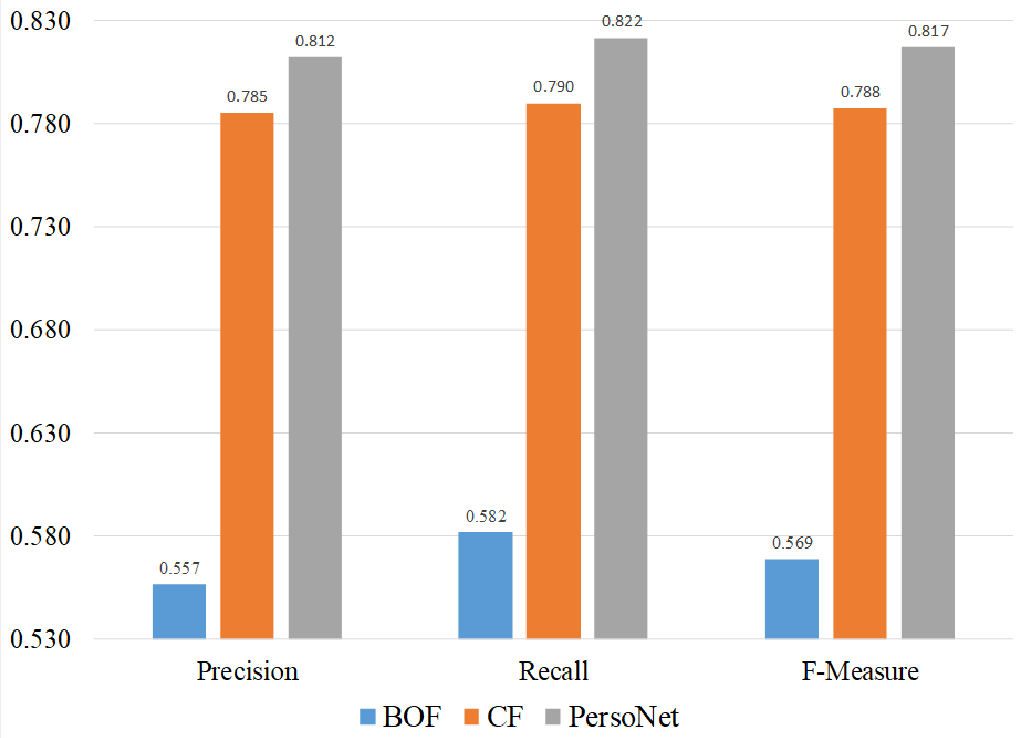
The results were clear: PersoNet's hybrid approach outperformed both. While BOF was too simplistic and CF struggled with new connections, PersoNet’s integration allowed for a 3.8% increase in precision over standard CF and a massive 47% increase over simple trait matching.
Critical Insight: Why Does It Work?
The success of PersoNet lies in its "Content Filtering" of the human character. By treating personality as the stable "content" of a user profile, the system can predict compatibility even before the first message is sent.
The study also validated its findings by analyzing Message Exchange frequency (SimM). Results showed that people recommended by PersoNet didn't just "match" on paper—they actually communicated more frequently in real-time chat environments.
Conclusion and Future Outlook
PersoNet demonstrates that social computing can be significantly enhanced by integrating deep psychological frameworks.
Future Directions:
- Automated Recognition: Moving from questionnaires to NLP-based personality detection from text.
- Graph Integration: Combining these trait-based models with modern Graph Neural Networks (GNN) to map the evolution of the social graph.
- Scale: Testing the model on populations larger than the current 123-subject cohort to verify global cultural applicability.
By putting the "human" back into social algorithms, PersoNet provides a roadmap for more meaningful digital connections.