
Beyond Random Walks: Leveraging Personal Interest for Efficient Mobile Social Routing
Exploring personal interest in intermittently connected wireless mobile social networks
This paper introduces the Interest-Driven Mobility Model (IDMM) and a corresponding Weighted Spray routing strategy for Intermittently Connected Wireless Mobile Social Networks. By leveraging user interests and "hotspot" attractions, the proposed Weighted Spray and Focus (WSF) scheme optimizes message dissemination in Delay Tolerant Networks (DTNs).
TL;DR
Researchers from the University of Victoria have challenged the status quo of "oblivious" message spraying in mobile networks. By replacing the standard binary splitting of message copies with a Weighted Spray strategy based on user interest profiles, they've demonstrated that networks can achieve higher delivery reliability with significantly fewer wasted transmissions.
The Flaw in the i.i.d. Assumption
Most classical opportunistic routing protocols—like Epidemic or standard Spray and Wait—rely on the assumption that human mobility is Independent and Identically Distributed (i.i.d.). In this vacuum, the best strategy is to spread message copies as fast and as widely as possible.
However, human beings are not gas molecules. Our movement is driven by Interests. We visit specific "Hotspots" (work, gyms, cafes) because they align with our profiles. This paper argues that if mobility is non-random, our routing should be too.
Methodology: IDMM and Weighted Spray
The authors propose two major components to bridge the gap between social theory and network engineering:
1. Interest-Driven Mobility Model (IDMM)
Unlike the Random Waypoint (RWP) model, IDMM uses a Dot-Product Model. Every user has an -dimensional interest profile, and every geographical hotspot has an attraction profile. A user chooses their next destination based on:
- Profile Similarity: High dot-product between user interest and hotspot attraction.
- Distance: Inverse Euclidean distance (closer hotspots are preferred).
2. Weighted Spray Strategy
In previous "Binary Spray" versions, if Node A (with 10 copies) met Node B, it would simply give Node B 5 copies. In Weighted Spray, the split is determined by Utility (): Where utility is the similarity between the node's profile and the destination's interest. This ensures "better" carriers hold more copies.
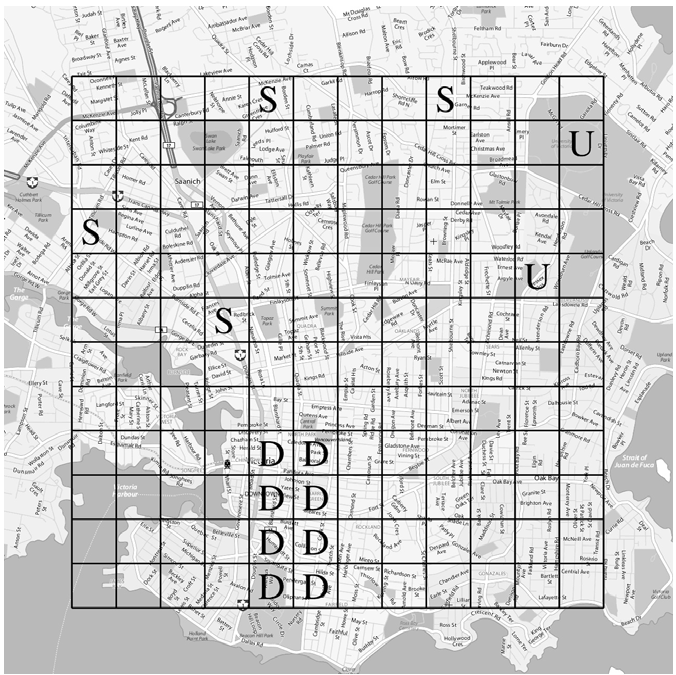 Fig 1: A grid-based simulation of Victoria, BC, using hotspots like Universities (U) and Shopping Centers (S).
Experimental Insights: Performance vs. Cost
The researchers utilized the ONE (Opportunistic Network Environment) simulator to compare their method against Epidemic and Binary Spraying.
The Trade-off: Delay vs. Efficiency
Weighted Spray introduces a "double-edged sword" effect. Because the spray tree becomes unbalanced (copies stay with the most "interested" nodes), the initial spray phase takes slightly longer, leading to a minor increase in average delay (see Fig 4).
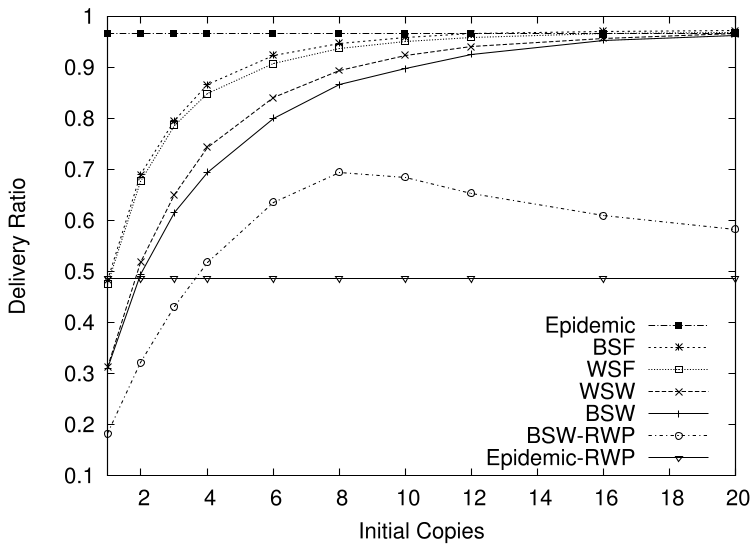 Fig 2: Weighted strategies (WSW, WSF) show a slightly higher delay than Binary counterparts due to the selective forwarding process.
The Critical Win: Overhead Reduction
The true value of this work lies in the Message Delivery Overhead (MDO). Weighted Spray and Focus (WSF) eliminates the "blind" transmissions that plague Binary Spray. By steering copies toward the correct social community early on, the network avoids thousands of useless handshakes.
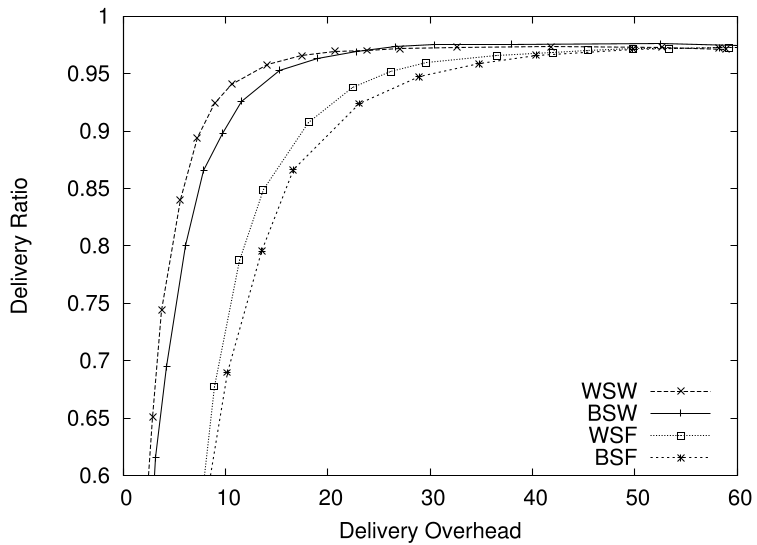 Fig 3: Delivery Ratio vs. Overhead. At the same cost level, WSF provides a superior delivery success rate.
Critical Analysis & Conclusion
This paper successfully moves the needle toward Context-Aware Routing. By treating the "Spray" phase as a social filtering process rather than just a distribution phase, they achieve a more sustainable network.
Limitations: The model assumes users are willing to share their "Interest Profiles," which raises significant Privacy concerns in a real-world deployment. Future work would need to address how to calculate utility without exposing raw personal data.
Takeaway: In Mobile Social Networks, who carries the message is just as important as how many copies exist. Efficiency is found at the intersection of geographical proximity and social affinity.