
The Hidden Mind of the Machine: Unveiling Personality Bias in Music AI
Personality Bias of Music Recommendation Algorithms
This paper investigates the "Personality Bias" in music recommendation systems by analyzing how state-of-the-art algorithms (SLIM, EASE, and Mult-VAE) perform across various user groups defined by the Big Five (OCEAN) personality traits. Utilizing a novel dataset of Twitter music consumption, it reveals significant performance disparities, particularly for Openness and Neuroticism.
TL;DR
Do AI-driven music platforms treat you differently based on whether you are an extrovert or a neurotic perfectionist? According to a study from RecSys '20, the answer is a resounding yes. By testing state-of-the-art algorithms like Mult-VAE and EASE, researchers found that users scoring high in Openness actually receive significantly worse recommendations, while those high in Neuroticism enjoy much higher accuracy.
Decoding the Problem: Why Personality Matters
Most "fairness" research in AI focuses on demographics: age, gender, or location. However, our music taste is deeply rooted in our personality—a stable psychological construct that dictates how we discover and consume art. If an algorithm ignores these traits, it might inadvertently create a "psychological glass ceiling," where certain groups of people are perpetually underserved by the technology.
The authors argue that because personality correlates with music usage (e.g., extroverts might use music for social background, while those high in openness seek complex, niche genres), the data we feed into these systems is inherently biased by our psyche.
Methodology: From Tweets to Traits
The researchers built a unique pipeline to bridge the gap between social media behavior and psychological profiles:
- Interaction Data: Scraped #nowplaying tweets to identify 18,310 users and nearly 400k listening events.
- Trait Extraction: Used the OCEAN Model (Openness, Conscientiousness, Extraversion, Agreeableness, Neuroticism) via the IBM Personality Insight API.
- The Benchmark: Tested three heavy-hitters in recommendation science:
- SLIM & EASE: Linear models that excel at sparse data.
- Mult-VAE: A deep learning approach using variational autoencoders for non-linear patterns.
 The study utilized the OCEAN model to split users into high/low groups for comparative analysis.
The "Openness" Paradox: Key Results
The most striking findings involved Openness and Neuroticism.
- The Neuroticism Bonus: Users scoring "High" on Neuroticism saw significantly better Recall and NDCG scores. Why? High-neuroticism users tended to have fewer unique tracks and more concentrated listening habits, making their behavior easier for the algorithm to predict.
- The Openness Penalty: Conversely, "High" Openness users (the creative, curious types) were penalized with lower accuracy. Their eclectic tastes and tendency to explore the "long tail" of music make them "hard-to-recommend-for" users using standard collaborative filtering.
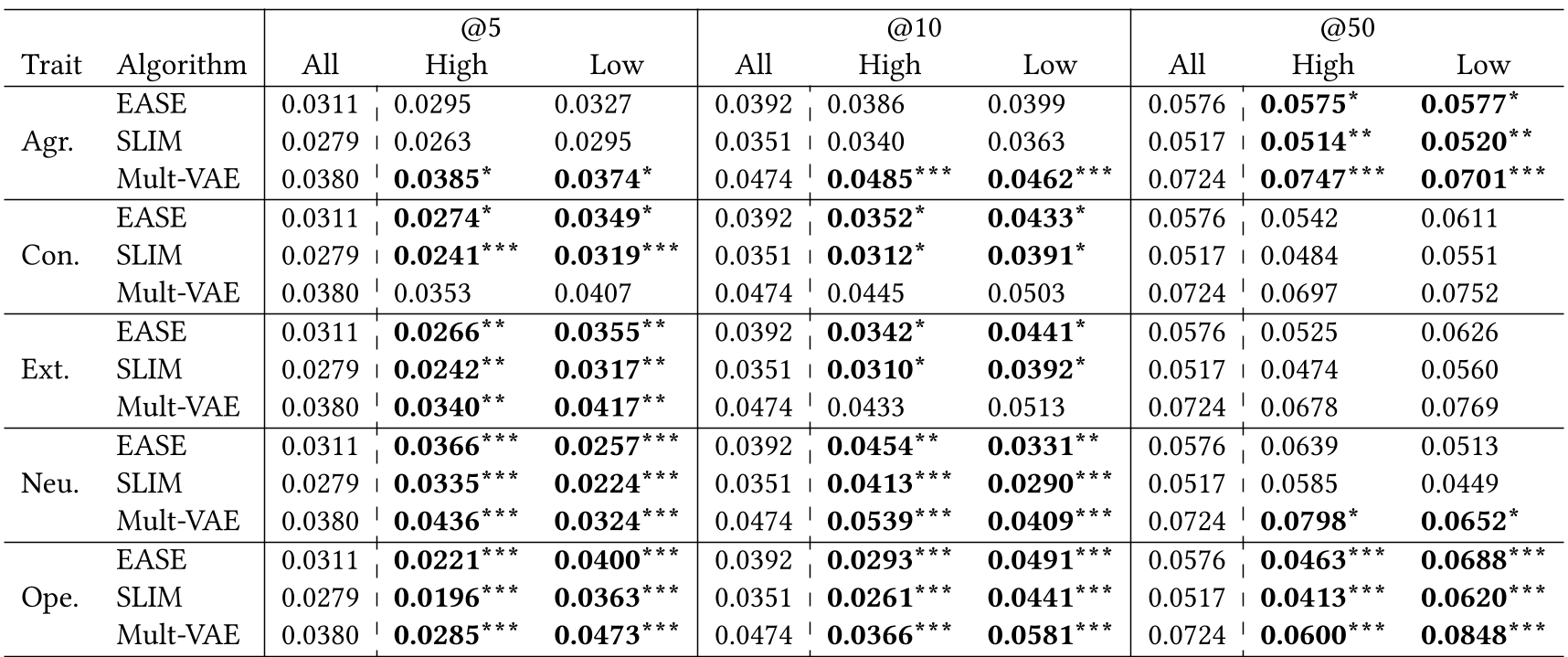 Table showing significant performance gaps (marked with asterisks) between high and low trait groups across different metrics.
Critical Insight: Data Bias vs. Algorithmic Bias
While the algorithms (EASE, SLIM, Mult-VAE) generally followed the same bias trends, the absolute performance gap varied. This suggests two things:
- Data Bias: Certain personalities naturally produce "cleaner" data (more repetitions, fewer niche items), which any algorithm finds easier to process.
- Algorithmic Bias: Even with the same data, non-linear models like Mult-VAE treated groups like "Agreeable" users more fairly than linear models did, indicating that architecture choice can mitigate some psychological bias.
Takeaway for the Industry
The industry must stop viewing users as mere ID numbers or demographic boxes. If a platform like Spotify or Apple Music wants to truly serve the "Open" explorer, it cannot rely solely on popularity-weighted collaborative filtering.
Future Outlook: We need "Personality-Aware" models that recognize when a user is in an "exploratory" mode (High Openness) and adjust the recommendation diversity accordingly, rather than punishing them with low-accuracy results just because they don't fit the "average" listening profile.
Reference: Melchiorre, A. B., Zangerle, E., & Schedl, M. (2020). Personality Bias of Music Recommendation Algorithms. RecSys '20.