
NICO the Social Gamer: Why "Socially Engaged" Robots Win Our Hearts Even When They Lose the Game
Designing a Personality-Driven Robot for a Human-Robot Interaction Scenario
This paper introduces an autonomous AI system for the NICO humanoid robot, investigating how "Socially Engaged" vs. "Competitive" personalities influence user acceptance in a dice game scenario. The study finds that a socially engaged persona significantly enhances robot likability, perceived animacy, and emotional rapport.
TL;DR
Researchers have developed a humanoid robot named NICO that can switch between two personalities: a friendly, joke-telling social companion and a serious, win-oriented competitor. In a user study involving a competitive dice game, participants overwhelmingly preferred the social robot—even when it was less efficient at the game—showing significantly higher levels of happiness and engagement through real-time facial emotion analysis.
Problem & Motivation: The Functional vs. Social Paradox
When we design robots, we often focus on Rational Intelligence: can the robot solve the problem? Can it win the game? However, in Social Robotics, a robot that is "too perfect" or "too focused" often fails the human-centric test.
The authors identified a critical gap: existing HRI (Human-Robot Interaction) frameworks often treat "personality" as a static trait (appearance) rather than a dynamic behavioral output. They set out to see if Social Intelligence—the ability to make small talk, tell jokes, and express empathy—could outweigh Task Intelligence in gaining human acceptance.
Methodology: Building a Multimodal Personality
The study utilized the NICO (Neuro-Inspired COmpanion) robot, styled to resemble a 10-year-old boy. The technical heart of this project is a modular architecture built on ROS (Robot Operating System) that synchronizes several key components:
- The Scheduler: A finite-state machine that manages the flow of the dice game.
- The Dialog Module: Uses Google Speech Recognition and Amazon Polly. Crucially, the "Social" personality includes a Natural Language Understanding (NLU) unit tailored to recognize names and favorite foods to simulate personal interest.
- The Emotion Module: A real-time CNN (Convolutional Neural Network) that monitors the user's face to measure their reaction.
Architecture Overview
 The architecture separates high-level logic (Scheduler) from specific interaction modalities, allowing for flexible personality switching.
The Two Personas
| Feature | Competitive NICO | Socially Engaged NICO |
|---|---|---|
| Goal | Minimize points, maximize wins | User interaction & social norms |
| Verbal | Game-related only | Jokes, small talk, empathy |
| Physical | Purely functional moves | Fist-bumps, expressive gestures |
| Emotion | Neutral/Serious | Happiness, humor, sadness (if losing) |
Experiments & Results: The "Happy" Metric
The team conducted a study with 22 participants playing a "Jeopardy" style dice game. They used standard tools like the Godspeed Questionnaire, but the most "honest" data came from the robot's own vision system analyzing the users' facial expressions.
Key Findings:
- Likability and Animacy: The Social NICO was rated significantly higher in being "lively," "interactive," and "responsive."
- Emotional Rapport: Participants displayed significantly more Happiness and less Neutrality when playing with the Social NICO. Even when the Social NICO was "sad" about losing (requesting ice cream to feel better), users felt more connected.
- The "Competitive" Insight: Interestingly, some highly competitive participants found the social robot "distracting," suggesting that robots might eventually need to adapt their personality to match the human player.
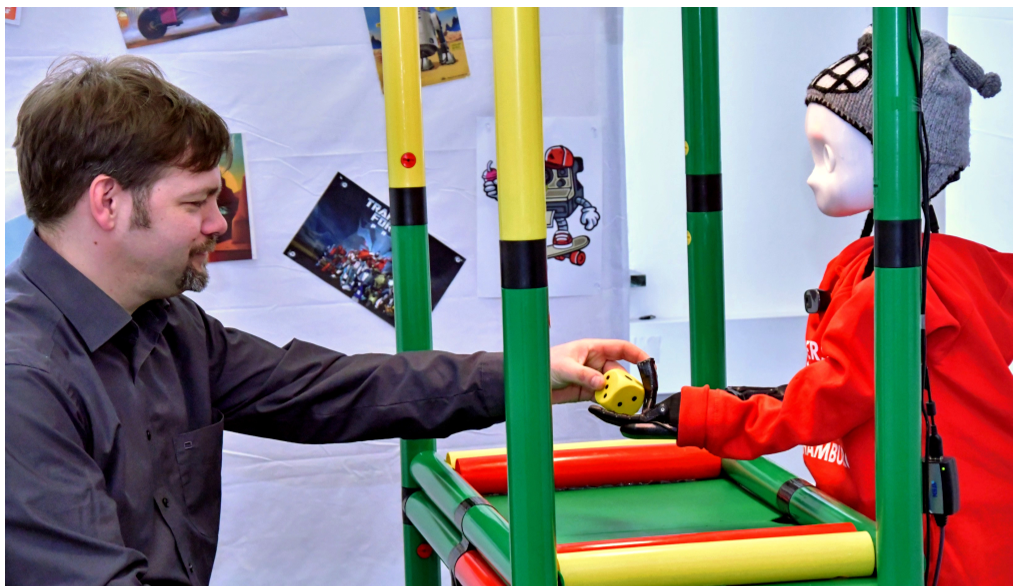 NICO interacting with a participant. The use of a child-like appearance helps mitigate the "Uncanny Valley" effect.
Statistical Visuals
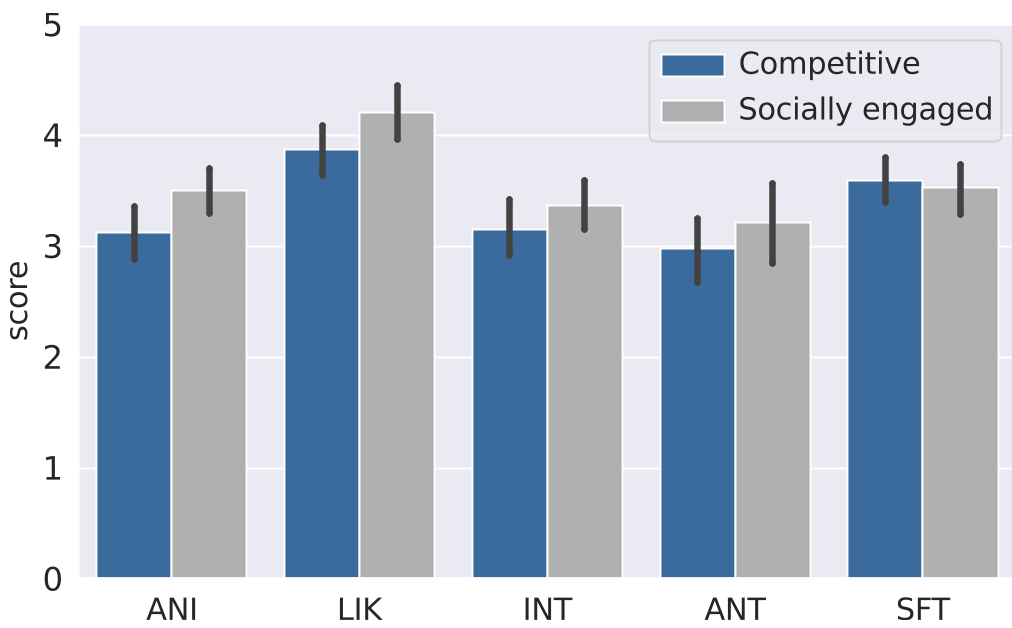 Results showing the edge Social NICO holds in Animacy and Likability. Higher scores indicate a more positive perception of the robot’s "soul" or presence.
Critical Analysis & Conclusion
This research underscores a fundamental truth in HRI: vulnerability and humor are features, not bugs. By allowing NICO to express sadness over a loss or tell a "corny" joke about heavy metal music, the researchers humanized the machine in a way that pure efficiency never could.
Takeaway: Future social robots should not just be "smart"; they must be "relatable." However, the study also hints at the need for Adaptive Personalities—where the robot senses if a user is frustrated or hyper-competitive and adjusts its social "volume" accordingly.
Limitations: The study relied on a relatively small, tech-savvy demographic (ages 25-34). Future work will need to test these personalities across children and the elderly to see if the "10-year-old boy" persona remains universally appealing.