
Decoding the Hidden Persona: How Personality Shapes Our Digital Expressions
The Influence of Personality on Users’ Emotional Reactions
This study investigates the correlation between the HEXACO personality dimensions and facial emotional expressions during Human-Computer Interaction (HCI). By analyzing 88 students playing "Team Fortress 2," the authors demonstrate that personality traits—particularly Emotionality—significantly influence automated facial analysis results, providing a foundation for personality-aware neuroadaptive interfaces.
TL;DR
Can a computer truly understand how you feel if it doesn't know who you are? This research highlights a critical missing link in affective computing: Personality. By analyzing students playing a high-stakes video game, the study reveals that traits like Emotionality and Conscientiousness significantly dictate how our faces react to digital stimuli. The takeaway? Future AI interfaces must be "personality-aware" to be truly effective.
The Motivation: Moving Beyond "Average" Users
In the quest to build Neuroadaptive Interfaces—systems that change in real-time based on your mental state—researchers have hit a wall. Most current models assume that a specific facial muscle movement (Action Unit) means the same thing for everyone.
However, we know intuitively that a stoic person and an expressive person react differently to the same frustration. The authors argue that without factoring in idiosyncrasies, neuroadaptive models remain "noisy" and imprecise. They set out to prove that personality isn't just a mental state; it's a filter that modifies our external emotional output.
Methodology: Combat, Cameras, and Character Traits
The researchers set up a controlled but socially dynamic environment using the game Team Fortress 2.
- Participants: 88 university students.
- Psychometric Profiling: Players were assessed using the HEXACO model, which measures dimensions like Honesty-Humility, Emotionality, Extraversion, Agreeableness, Conscientiousness, and Openness.
- Facial Analysis: Using FaceReader 6, the team extracted intensity data for six basic emotions while participants played or spectated games of varying difficulty.
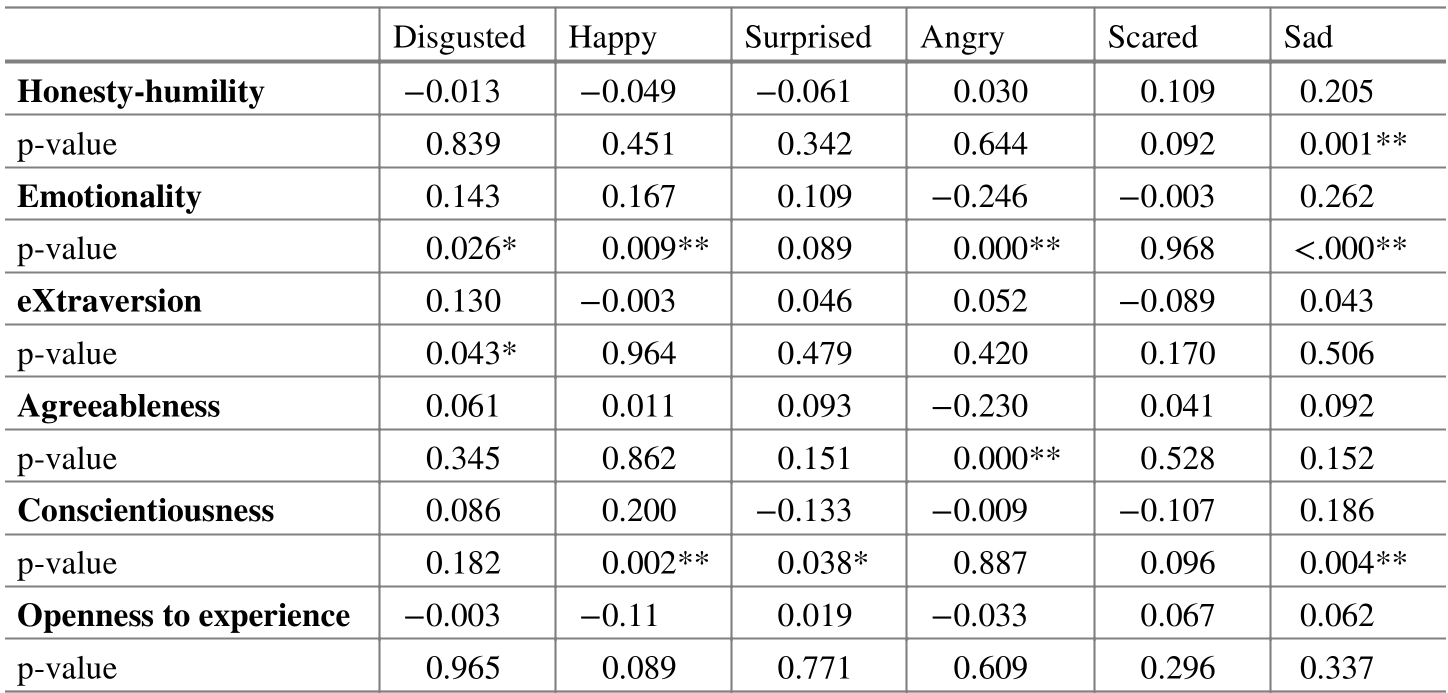 Table 1: The correlation matrix between HEXACO dimensions and detected facial emotions.
Key Insights: Why Your Personality Changes the "Data"
The results, as seen in the table above, offer several profound insights for HCI (Human-Computer Interaction) professionals:
1. The "Emotionality" Filter
The Emotionality dimension was the "MVP" of the study. It correlated with nearly every major emotion. Users high in this trait are "expressively transparent"—their faces provide a much richer (and easier to track) data stream for AI.
2. The Stoicism of the Disciplined
A fascinating find was the negative correlation between Conscientiousness and Surprise. High-scoring individuals (organized, disciplined) were significantly less likely to show surprise. This suggests a "need for control" that physically inhibits spontaneous facial reactions, potentially leading a standard AI to misinterpret their level of engagement.
3. The Social Mask of Agreeableness
In the social "online" setting of the experiment, users high in Agreeableness and Emotionality showed less anger. This implies that personality traits also dictate how much we "mask" our negative emotions to maintain social harmony, a factor that facial recognition software often ignores.
Critical Analysis & Future Outlook
The study successfully proves that personality is a significant "confounding variable" in emotional data. If an interface detects "Sadness," is the user actually failing the task, or are they simply high in the Honesty-Humility trait (which showed a p=0.001 correlation with Sadness expressions)?
Limitations
- The Social Context: The study was conducted in a room with others. Facial expressions in private might look radically different, as the "social mask" is removed.
- Static vs. Dynamic: While the study used averages, the temporal aspect of how a personality type recovers from an emotion remains an open question.
Conclusion: The Future is Personality-Aware
This research marks a shift from Generic AI to Personalized AI. For developers building neuroadaptive systems—whether for gaming, education, or mental health—the message is clear: Before you try to read the user's mind, you first need to understand their character.
Incorporating a simple personality pre-assessment could improve the signal-to-noise ratio of emotional tracking models by orders of magnitude, finally delivering the "right content at the right time."