
Decoding the Digital Self: Personality Expression and Recognition on Chinese Weibo
Personality expression and recognition in Chinese language usage
This study investigates the relationship between Chinese language usage on Sina Weibo and the "Big Five" personality traits (OCEAN). By utilizing the TextMind system and machine learning algorithms, the authors developed a personality recognition model that outperforms traditional essay-based benchmarks.
TL;DR
Can your Weibo posts reveal more about you than a personality test? A study published in User Modeling and User-Adapted Interaction proves that Chinese linguistic patterns—from specific function words to punctuation habits—are robust predictors of the "Big Five" personality traits. By analyzing thousands of posts via the TextMind system, researchers built a model that achieves up to 70% accuracy in identifying personality, offering a new frontier for automated recruitment and consumer insights.
The Problem: The English-Centric Bias in Computational Psychology
For decades, the intersection of linguistics and psychology has been dominated by English-language corpora. While we know that English speakers high in Neuroticism tend to use more first-person singular pronouns ("I", "Me"), we have lacked a systematic understanding of the world's most spoken native language: Chinese.
Chinese presents unique challenges for AI:
- Morphological Simplicity: No tenses or genders marked by word endings.
- Syntactic Flexibility: One word can function as multiple parts of speech.
- Contextual Nuance: Essential "function" words are often omitted unless ambiguity arises.
The authors argue that existing psychological dictionaries like LIWC 2007 were too formal for the raw, evolving slang of social media, necessitating a specialized tool for the "Weibo era."
Methodology: Mapping the "OCEAN" in Mandarin
The researchers recruited 127 participants, collecting both their self-reported Big Five scores and 32 months of historical Weibo data (over 45,000 posts).
The TextMind Advantage
Unlike standard translation-based tools, TextMind is a psycho-linguistic system optimized for simplified Chinese. It doesn't just look at word counts; it analyzes:
- Linguistic Dimensions: Pronouns, verbs, and adverbs.
- Psychological Processes: Affective (emotions), Social, and Cognitive.
- Chinese-Specific Markers: Four-character idioms, multifunction words (e.g., 的, 有, 是), and even the frequency of URL/hashtag usage.
 Table 1: The Cronbach’s α values confirm the reliability of the IPIP-based personality measures used as the ground truth for the model.
Key Findings: More Than Just Words
The results revealed fascinating "linguistic signatures" for different traits:
- Extraversion: Positively correlated with "friend" and "human" categories. Interestingly, on Weibo, extraverts express more negative emotion and anger, suggesting they feel more comfortable venting in public spaces than their English-speaking counterparts.
- Agreeableness: Linked to a high frequency of multifunction words and first-person singular pronouns, reflecting a focus on interpersonal harmony and the "self" within social contexts.
- Neuroticism: Higher usage of four-character words, Latin words, and numbers. These users also tend to use more commas and fewer question marks, signaling a specific style of intense, descriptive expression.
- The "Seniority" Paradox: One of the study's most striking findings was that users with higher "Weibo Seniority" (accumulated experience points) tended to use more swear words and express more anger. The anonymity of the platform acts as a release valve for "emotional dissonance" experienced in real-world professional lives.
Results: AI vs. Human Perception
The researchers used Stepwise Linear Regression and SVM (Support Vector Machines) to classify users.
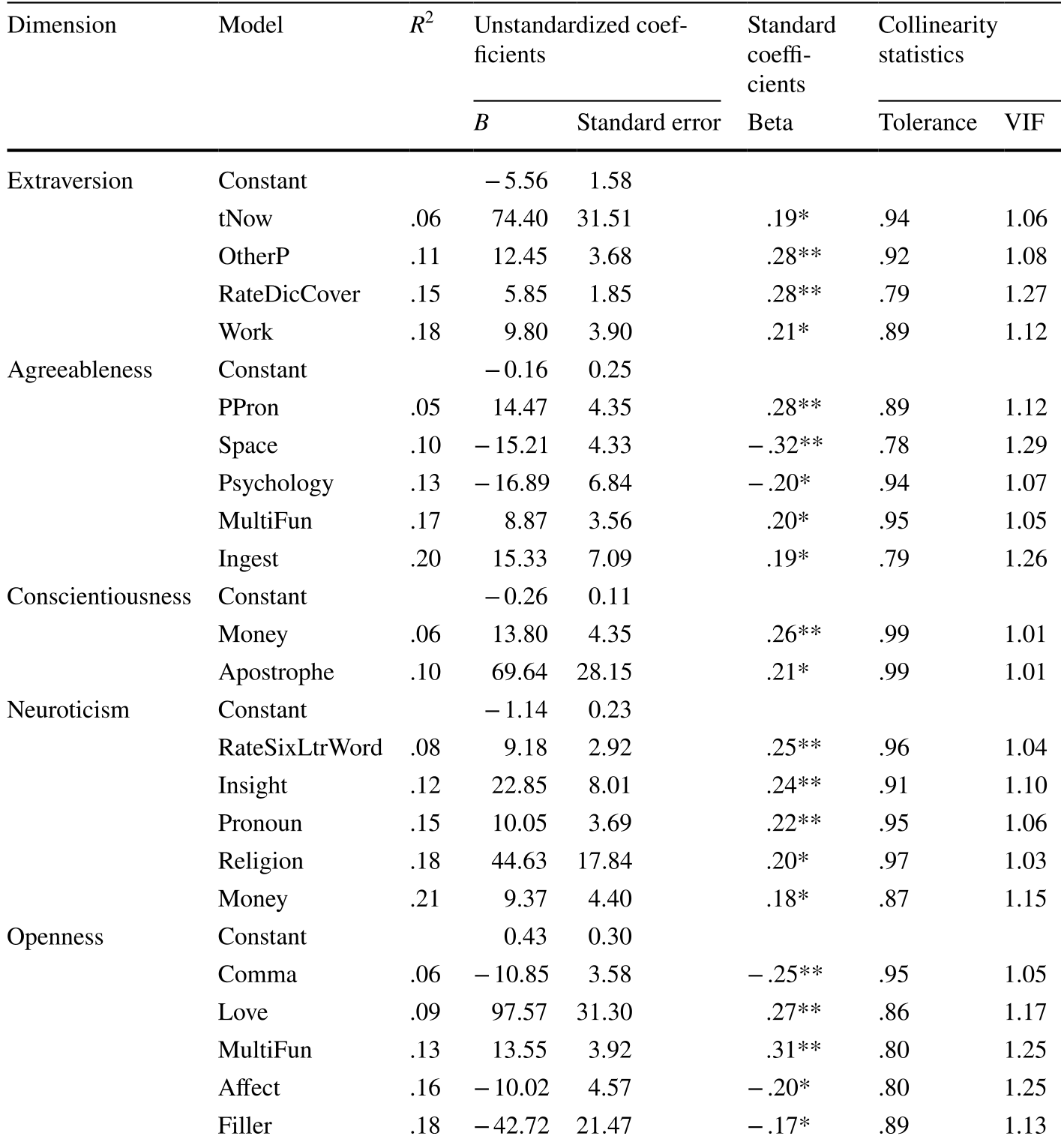 Table 3: The regression models show significant predictive power across all five dimensions, with R-squared values indicating that word choice is a reliable indicator of internal traits.
Key Benchmark: The model's accuracy for Extraversion (0.70) and Openness (0.69) outperformed previous studies based on Facebook and formal essays, proving that the informal, unfiltered nature of Weibo is a superior data source for behavioral prediction.
Critical Insight: The HR Revolution
The practical takeaway for organizations is profound. Traditional personality tests are prone to Social Desirability Bias—applicants answer how they think they should, not how they actually are.
By contrast, automated personality recognition via social media:
- Bypasses the "Persona": Captures the "true self" expressed in uninhibited digital environments.
- Scalability: Allows for the massive screening of candidates without the man-hours required for standardized testing.
- Cultural Alignment: Provides a localized tool for the Chinese market that respects linguistic nuances like the usage of "wo juede" (I think) in medial positions.
Limitations & Future Outlook
While the study is a breakthrough, it relies on a relatively young sample (average age 24). Additionally, as LLMs (Large Language Models) continue to evolve, the transition from "word-frequency" (closed-vocabulary) to "contextual-embedding" (open-vocabulary) models is the next logical step.
In conclusion, your digital footprint is not just a trail of data—it is a detailed map of your psyche. For companies and researchers alike, the ability to read between the lines of a Weibo post is no longer just psychology; it’s data science.