
Beyond the Map: How Personality Shapes Our Digital Footprints in the Real World
Personality and location-based social networks
This study investigates the relationship between the "Big Five" personality traits and human mobility behavior using Foursquare location-based social network (LBSN) data. By analyzing check-in patterns of 174 users, the authors identify significant correlations between personality traits like Conscientiousness, Openness, and Neuroticism and the types of venues individuals choose to visit.
TL;DR
Does your personality determine where you go on a Saturday night? This study leverages Foursquare data to prove that our "Big Five" personality traits—Openness, Conscientiousness, Extraversion, Agreeableness, and Neuroticism—influence not just how much we use location-based social networks (LBSNs), but the types and diversity of places we choose to visit.
Background Positioning
In the landscape of social media research, most studies focus on "digital-only" interactions (likes, tweets, comments). This paper bridges the gap between psychological profiling and physical mobility, positioning itself as a pioneering "in-the-wild" study that treats physical venues as extensions of an individual's persona.
Problem & Motivation: The Missing Link in Mobility
We know a lot about where people go in aggregate (the physics of mobility), but we know very little about why specific individuals choose certain venues.
- The Gap: Previous research focused on structural patterns (distance, frequency).
- The Insight: The authors argue that because LBSNs require an explicit "choice" to check in, these digital signals are actually reflections of deep-seated personality traits.
Methodology: Mapping Traits to Venues
The researchers built a participatory tool where Foursquare users shared their history and took a personality test. They didn't just look at check-in counts; they analyzed:
- Shannon Diversity: How diverse is your palette of venue categories?
- Venue sociability: Do you prefer "sociable" spots (bars/restaurants) vs. solitary ones?
- Venue Popularity: Do you follow the crowd or seek the obscure?

Key Insights: The Surprise of Conscientiousness
The most striking finding involves Conscientiousness. In traditional social networks like Facebook or Twitter, highly conscientious people often use the services less because they see them as a distraction.
In LBSNs, the opposite is true.
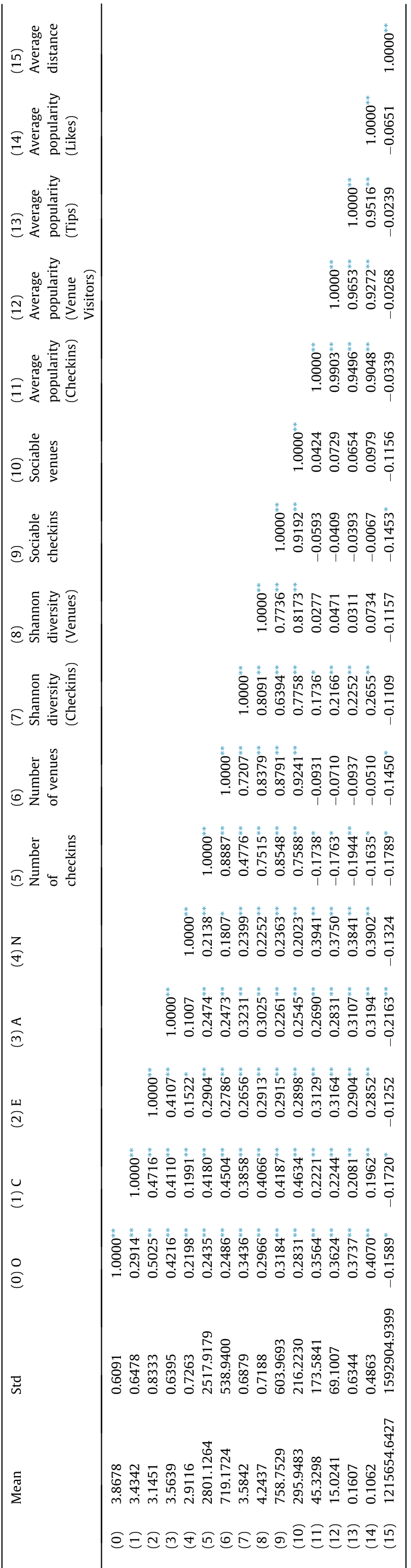
- Finding: Conscientiousness is positively correlated with check-in volume and venue diversity.
- The "Why": The authors suggest that for a disciplined person, a check-in is a low-overhead "log" of their organized life. It’s not a distraction; it’s a form of record-keeping.
Openness and Neuroticism
- Openness: High scorers travel further (average distance) and visit venues with more "likes," likely seeking novel and high-quality experiences.
- Neuroticism: High scorers visit fewer unique venues and fewer sociable venues. This suggests LBSNs might trigger social anxiety or a desire to limit public exposure to a small "safe" circle of locations.
Critical Analysis & Conclusion
This paper reveals that LBSNs are more than just "social" tools—they are spatial-identity performances.
Takeaways:
- For Tech Design: LBSN apps should tailor recommendations based on personality. A "Neurotic" user might prefer familiar, quiet spots, while an "Open" user wants the most distant, trending art gallery.
- Limitations: The sample (174 users) is tech-savvy and self-selected, which may not represent the general population perfectly.
- Future Work: The "missing" correlation for Extraversion suggests that extroverts might use LBSNs for "social compensation" in ways that simple correlation analysis can't capture, requiring more nuanced behavioral modeling.
Ultimately, the places we "check in" at are more than just coordinates; they are a map of who we are.