
The Psychology of the Feed: How Your Personality Shapes Your SNS Habits
Effects of Personality Traits on Usage of Social Networking Service
This study investigates the correlation between the "Big Five" personality traits and Social Networking Service (SNS) usage patterns among Japanese university students. Using a survey of 215 participants, it maps psychological profiles to specific service preferences and attitudes toward privacy divulgence.
TL;DR
Is your Facebook or Twitter usage a digital mirror of your soul? This research explores the deep-seated links between the Big Five Personality Traits and how we interact with Social Networking Services (SNS). It finds that our psychological makeup doesn't just influence if we use social media, but how we use it—from the way we search for info to why we ignore privacy warnings in favor of "digital fun."
Core Position: This work moves beyond technical metrics of SNS usage and establishes a behavioral baseline for user segmentation based on psychological traits, bridging the gap between social psychology and ICT management.
Problem & Motivation
Despite the explosion of SNS platforms, researchers often treat "users" as a monolithic group. However, as these platforms become "reflections of the real world," vulnerabilities like privacy leakage become critical.
The author posits that if SNS usage is a reflection of daily life, it must mirror interpersonal relationships in the physical world. The fundamental question: Does our personality act as an "Internal Filter" for technology acceptance? Existing works showed that personality affects the acceptance of invasive technologies (like RFID), and this study extends that logic to everyday "Services."
Methodology: Mapping the Mind
The study utilized a two-part survey involving 215 students, applying the Big Five Model:
- Extroversion (E): Outgoing vs. Introverted
- Agreeableness (A): Warm vs. Cold
- Conscientiousness (C): Hardworking vs. Lazy
- Neuroticism (N): At Ease vs. Nervous
- Openness (O): Intellect vs. Unintelligent
Model Framework
The researchers categorized services into four distinct clusters using Principal Component Analysis (PCA):
- Popular Services: Search, e-Mail, News.
- Interactive Services: Blogs, Music/Video, Maps.
- Transaction Services: Online Shopping, Auctions.
- Entertainment: Games.
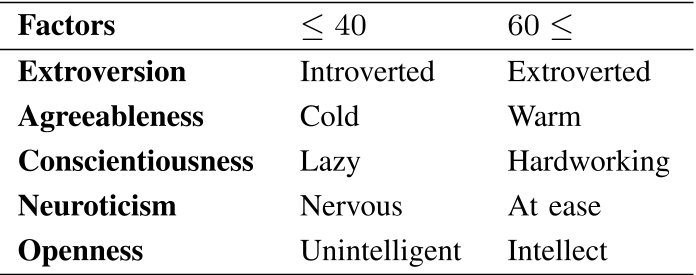 Figure 1: Thresholds for Big Five Categorization and Service Mapping.
Key Results & Experimental Insights
1. The Search Gap
Introverts were found to use "Search" functions significantly less than Extroverts. This suggests that Extroverts act as the "Hubs" of cyber-networks, proactively expanding their reach, while Introverts may wait for information to come to them.
2. Privacy vs. Pleasure
One of the most striking findings is the "Privacy Paradox."
- 87.9% of users are aware their privacy is being divulged.
- 71.2% continue use anyway.
Why? The study reveals that personality provides the justification. Extroverts prioritize "Enjoyment" (p=0.025) and "Trust in Service Providers" (p=0.039) over risk. Meanwhile, Agreeable (Warm) individuals adopt a "don't care" attitude, effectively using their empathetic nature to trust the system.
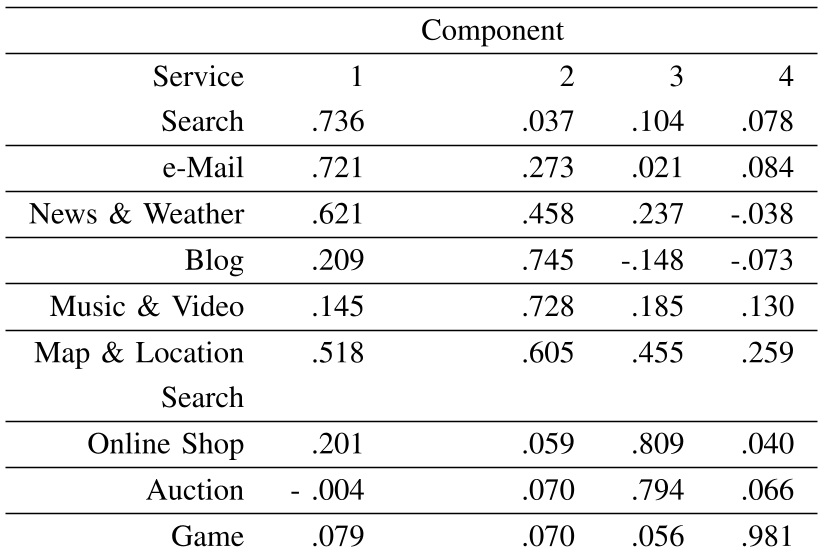 Figure 2: Statistical breakdown of SNS service usage clusters.
Critical Analysis & Conclusion
Takeaway for Business & Research
- For Product Managers: If you want to engage "Introverted" users, don't force them to search. Use proactive "Push" mechanisms like e-Mail or News feeds. If targeting "Lazy" (low conscientiousness) users for music services, implement heavy Recommendation Engines to reduce the friction of active searching.
- For Society: SNS are vital during disasters (as seen in the Japan earthquakes). Understanding how to include all personality types is not just a marketing goal, but a social necessity.
Limitations
The study relies on a student sample (aged 20-21), which may not represent the digital habits of older generations. Furthermore, it uses self-reported survey data rather than actual SNS server logs.
Future Outlook
The next frontier is validating these psychological correlations using Big Data. By analyzing actual clickstream logs and sentiment analysis of posts, we can move from "what users say they do" to "what users actually do."