
Beyond Generic Crowdsourcing: Personalizing the Transcription of Ancient Manuscripts
Opportunities for Personalization for Crowdsourcing in Handwritten Text Recognition
This paper explores "Tikkoun Sofrim," a framework that integrates Automatic Handwritten Text Recognition (AHTR) with personalized crowdsourcing. By leveraging the Midrash Tanhuma Hebrew manuscripts as a case study, it proposes a multi-stage personalization strategy to improve transcription accuracy from 91-97% to nearly 100%.
TL;DR
Transcribing historical documents is a battle against time and complexity. While Automatic Handwritten Text Recognition (AHTR) is getting better, it still falls short of the precision needed for scholarly research. The "Tikkoun Sofrim" project introduces a personalized crowdsourcing framework that bridges this gap, moving from a generic task model to one that adapts to the user’s skills and motivations, ultimately pushing transcription accuracy toward 100%.
Background & Motivation: The Bottleneck of Ancient Texts
The digitization of ancient and medieval corpora is hindered by a circular problem: Machine Learning models need massive amounts of annotated data to learn varied historical scripts, yet those very scripts are so diverse that creating training data requires thousands of hours of expert intervention.
The authors identify a critical inefficiency in current Computer Assisted Transcription of Text Images (CATTI): they treat all "crowd" members as a homogenous block. This ignores the vast differences in user literacy, device constraints, and psychological drivers (e.g., why one person transcribes for religious identity while another does it for the challenge).
Methodology: The Personalization Flow
The core contribution of this paper is a structured taxonomy of personalization opportunities categorized into four distinct stages of the user journey.
1. Pre-task: Tailoring the Hook
Instead of a blind "Call for Volunteers," the system suggests personalizing the recruitment channel (Facebook vs. Professional Forums) and the motivational "nudge." For instance, a user motivated by altruism is reached through community-centric messaging, while one driven by curiosity is shown teaser images of mysterious unread fragments.
2. Task Choice & Execution: Adaptive Complexity
Not all manuscript lines are created equal. Some exhibit clear calligraphy, while others are marred by ink bleeds or abbreviations.
- Skill-Matching: Experienced users are assigned "tie-breaking" tasks or difficult initials.
- Adaptive UI: The interface adjusts based on whether the user is a native speaker or whether they are using a mobile device versus a desktop. A novice might see more "helper" tools (spell-checkers, concordances), which are phased out as their accuracy increases.
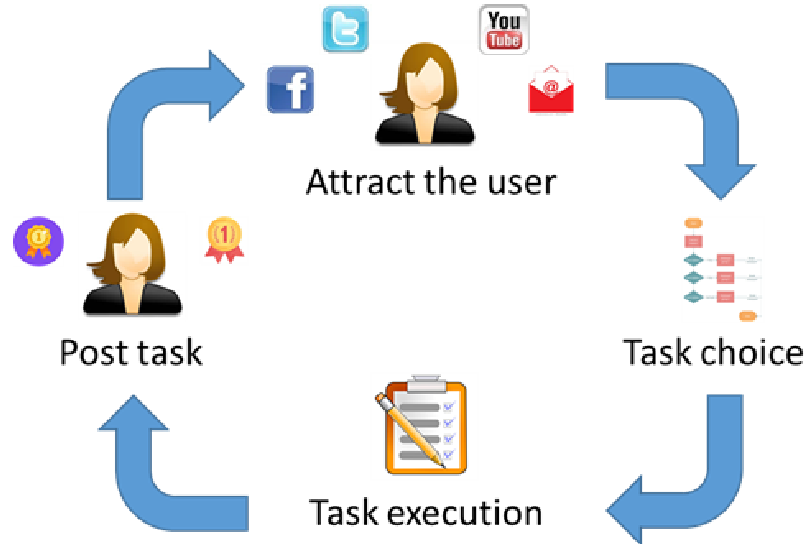 Figure 1: The proposed workflow for integrating user modeling into the crowdsourcing pipeline.
3. Post-task: Closing the Loop
The "reward" for finishing a task must match the user's personality:
- Competitive Users: Receive leaderboard rankings and high-score badges.
- Altruistic Users: Receive statistics on how much they have contributed to the "global knowledge" of the project.
Experimental Insight: Human-in-the-loop vs. Pure HTR
The study utilizes the Hebrew Midrash Tanhuma manuscripts. The baseline AHTR engine (using tools like Kraken or eScriptorium) typically achieves between 91% and 97% accuracy. By introducing an integrated correction layer, the project successfully pushed this figure to near 100%.
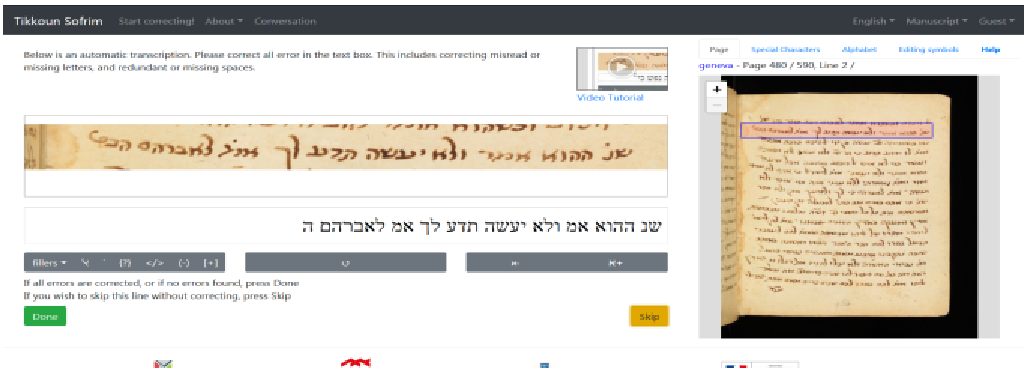 Figure 2: The Tikkoun Sofrim interface, designed to facilitate rapid human correction of machine-generated text.
Critical Analysis & Conclusion
This work highlights a shift in Digital Humanities from "big data" to "smart data." The limitation, however, remains the cold-start problem: how do you accurately model a user's skill without first making them perform a series of standard (and potentially boring) tasks?
The future of AHTR lies in dynamic UI adaptation. By correlating task choice to user skill, we can increase throughput without sacrificing quality. This paper serves as a blueprint for researchers looking to build more resilient and engaging citizen science platforms.
Takeaway: In the realm of historical text, the most powerful AI is one that knows how to best ask a human for help.