
Beyond "Cat" vs "Dog": Leveraging Social Circles for Deeply Personalized Photo Annotation
Personalized Annotation for Mobile Photos Based on User’s Social Circle
This paper introduces a personalized mobile photo annotation framework that leverages a user's social circle to generate context-aware tags. The core method utilizes a multi-modality hierarchical clustering algorithm with an "Album-based" unit to detect social events and propagate reliable labels via a weighted K-Nearest Neighbor (KNN) model.
TL;DR
Mobile photography is inherently personal, yet most AI taggers struggle to move beyond generic object detection. This paper introduces a framework that mines your Social Circle to provide context-rich labels (like "Brother's Graduation"). By treating photos as "Albums" and detecting "Events" through multi-modal hierarchical clustering, the system achieves a massive performance boost over standard content-based models.
Background: The Semantic Gap in Personal Memories
When you look at your phone's gallery, you aren't looking for "a man in a suit"; you're looking for "Jack at his wedding." Standard SOTA models are designed for general-purpose classification. The context required for personalization exists in our social networks (Renren, Facebook, Flickr), but social data is notoriously messy—tags are often misspelled, missing, or irrelevant.
The Problem: Why Social Features are Brittle
The authors identify two primary bottlenecks:
- The Reliability Gap: Individual social tags are noisy. A user might tag a photo "Cool" or "Sunday," which provides zero utility for a search system.
- Scalability vs. Personalization: Standard discriminative models require pre-defined classes. In a social circle, the number of unique "events" (labels) is potentially infinite and grows daily.
Methodology: The "Album" as a Core Unit
The breakthrough insight of this paper is shifting the focus from Individual Photos to Albums.
1. The Album Hypothesis
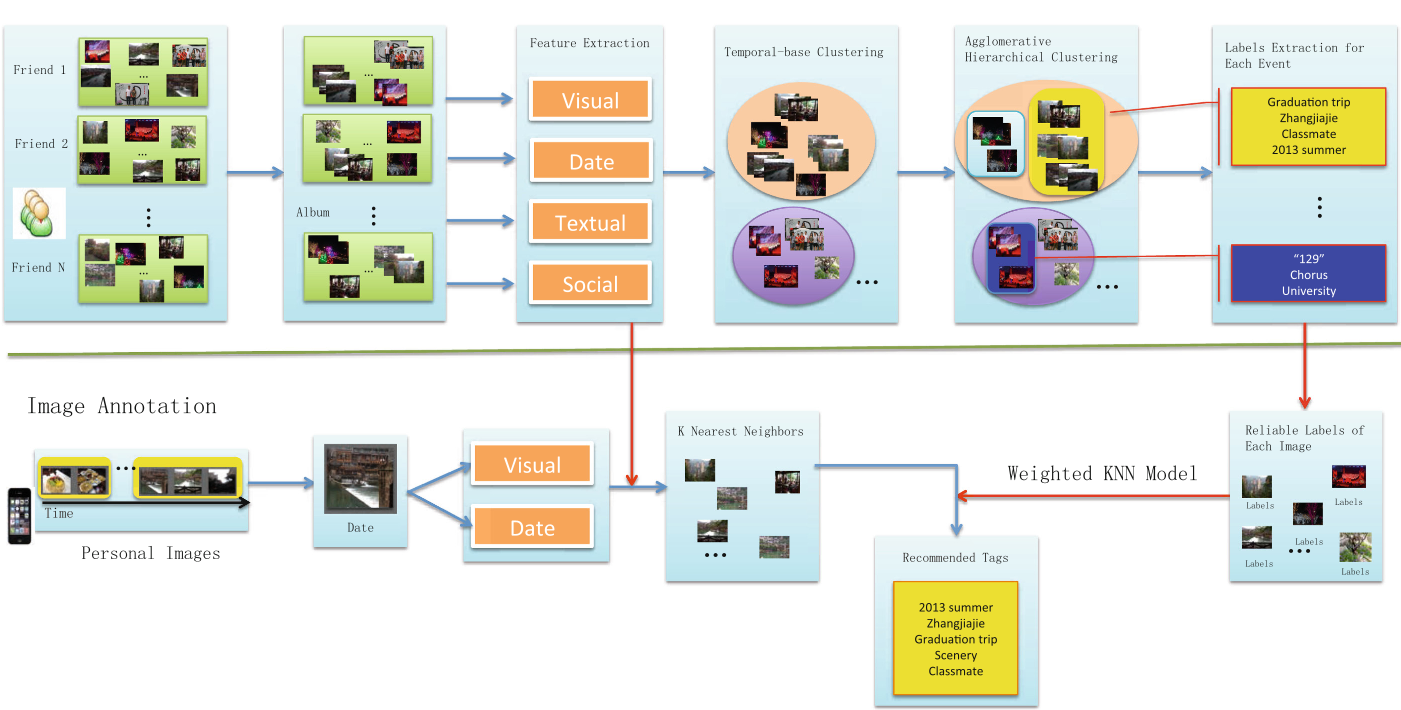
Photos uploaded by the same user within a short timeframe (e.g., one hour) almost always belong to the same event. By clustering "Albums" instead of millions of individual photos, the system reduces noise and computational complexity simultaneously.
2. Multi-Modality Hierarchical Clustering
The framework uses a clever two-step clustering process for social event detection:
- Step A (Temporal): A density-based algorithm (based on Gaussian kernels) separates photos into broad time windows.
- Step B (Multi-Modal): Within those windows, an agglomerative hierarchical clustering merges albums based on a weighted consensus of:
- Visual (CNN): 4096-D vectors from deep nets.
- Textual: Jaccard similarity of tags/titles.
- Social: "Likes," comments, and friend relationships.
Experiments: Real-World Performance
The authors tested their system on a massive crawl of Renren (China's Facebook equivalent) involving over 33,000 photos and 361 social circles.
Key Results:
- Album Accuracy: Using "Albums" as a unit reached nearly 100% Purity, proving that time-based grouping is a reliable proxy for event membership.
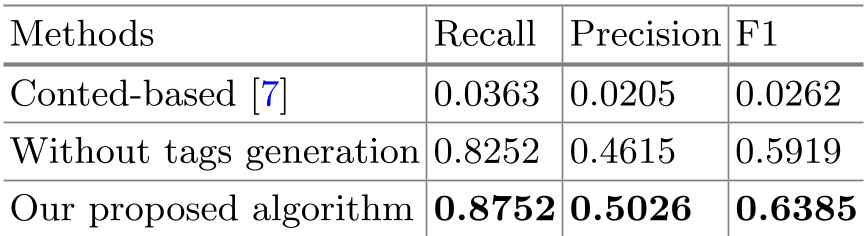
- Annotation Quality: Compared to the renowned TagProp model and standard CNN classifiers, this framework increased the F1-score from 0.026 (content-only) to 0.638 (social-aware).
Critical Analysis & Takeaways
This work highlights that Context is King in personal AI. While modern LLMs and Vision Transformers have improved visual understanding, they still lack the "Social Intelligence" to know who your friends are or which trip you took last summer.
Strengths:
- The "Album" unit is an elegant solution to the scalability problem of hierarchical clustering.
- The integration of social behavioral data (likes/shares) provides a layer of metadata that pure computer vision cannot replicate.
Limitations:
- The system relies on the existence of a shared social network. In an era of increasing "Dark Social" (private messaging), gathering this data is more difficult than in the public-tagging era of 2013-2016.
Future Outlook: Integrating these event-detection logic into modern Vector Databases could allow for real-time, privacy-preserving personalized search on mobile devices without needing to upload every photo to a central classification server.