
Beyond the List: Optimizing Crowdsourcing through Personalized and Diverse Task Composition
Personalized and Diverse Task Composition in Crowdsourcing
The paper introduces a worker-centric task assignment framework that utilizes "Composite Tasks" (CTs)—personalized and diversified summaries of micro-tasks. By formulating the problem as a fuzzy clustering optimization, the authors aim to maximize task representativeness, relevance, and variety to improve crowdsourcing performance.
TL;DR
Crowdsourcing isn't just about maximizing the number of tasks completed; it's about the humans doing the work. This paper introduces Composite Tasks (CTs)—personalized bundles of micro-tasks that replace traditional "flat" lists. By balancing topic similarity (to reduce context switching) and requester diversity (to build worker reputation), the authors demonstrate that structured task assignment significantly improves worker retention and output quality.
The "Turker" Dilemma: Hidden Costs of Self-Assignment
On platforms like Amazon Mechanical Turk (AMT), workers spend a non-negligible amount of time "hunting" for tasks. They look for tasks that match their skills, offer fair pay, or come from reputable requesters.
Current systems use simple ranking (by date or reward), which leads to two major issues:
- High Cognitive Load: Workers must evaluate every item in a long list independently.
- Context-Switching Penalty: Hopping between completely different task types (e.g., from image tagging to sentiment analysis) slows down productivity.
The authors' central insight is that tasks should be presented as summaries (bundles) that are valid (meeting qualifications), representative (covering available work), and personalized (matching worker interests).
Methodology: Task Composition as Fuzzy Clustering
How do you build a bundle that is both coherent and diverse? The authors frame this as a 3-way optimization problem:
- Representativeness: Covering the breadth of available tasks.
- Personalization: Matching the worker's specific topic profile (e.g., a preference for "Surveys" over "Audio Transcription").
- Diversity vs. Uniformity: Finding the "sweet spot" where tasks are similar enough to be efficient but diverse enough to keep the worker motivated.
They solve this by mapping the problem to Fuzzy C-Means (FCM) Clustering. Unlike hard clustering, fuzzy clustering allows tasks to have degrees of membership across different clusters, making it easier to find representative centroids.
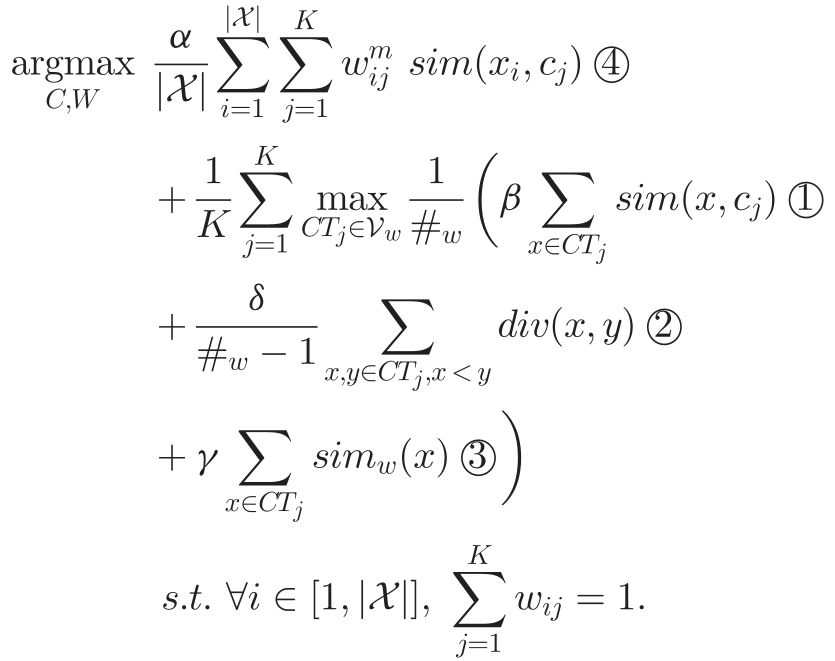
The algorithm follows a two-stage iterative process:
- Positioning Centroids: Dynamically updating cluster centers to ensure the generated CTs represent the overall available task pool.
- Greedy Task Selection: Once centroids are fixed, the system selects tasks that maximize similarity to the centroid (Uniformity) while optionally maximizing diversity (e.g., different requesters).
Experimental Insights: Quality Over Raw Speed
The authors conducted both user studies and live online deployments. One of the most striking findings was the trade-off between throughput and quality.
1. Retention and Perception
Workers overwhelmingly preferred CTs over ranked lists. In comparative trials, Personalized CTs (PCT) were preferred to Reward-Ranked Lists (RRL) 87% of the time.
2. The Power of Requester Diversity
In the online deployment, the TR configuration (Topic Similarity + Requester Diversity) emerged as the "Goldilocks" solution.
- Why Topic Similarity? It prevents context switching, allowing workers to stay "in the zone."
- Why Requester Diversity? Workers want to expose their "good work" to multiple requesters to build a broader reputation and diversify income sources.
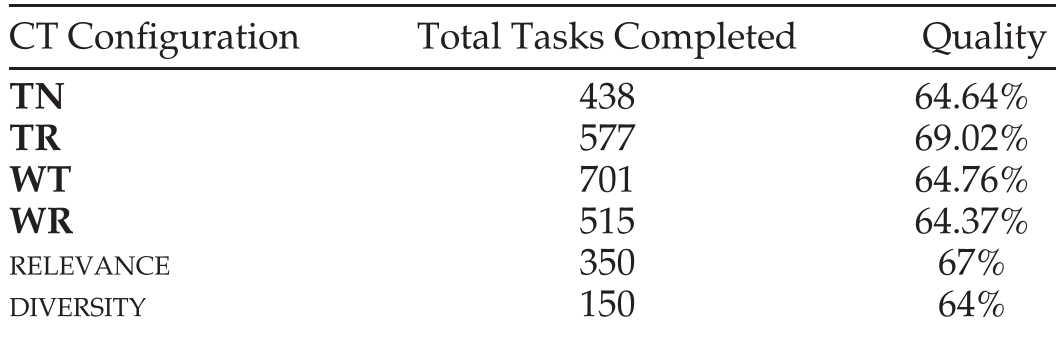
As shown in the results, while simple relevance-based lists (RELEVANCE) had high throughput, the TR (Topic-Requester) CTs yielded the highest quality (69.02%) and excellent worker engagement.
Critical Perspective & Summary
This research highlights a crucial shift from platform-centric to worker-centric AI.
Key Takeaways:
- Context Matters: Similarity in topics is the primary driver of efficiency (throughput).
- Motivation Matters: Perceived diversity (especially in requesters) is the primary driver of quality and retention.
- Scalability: The computational overhead of running FCM is negligible compared to the productivity gains of the workforce.
Limitations: The study primarily focuses on micro-tasks. For complex, long-form tasks, the grouping requirements might change significantly, requiring even more sophisticated semantic understanding of "task similarity."
Future platforms should move away from the "infinite scroll" of tasks and toward "intelligent bundles" that act more like personalized work itineraries.