
PIF: Balancing Personalization and Privacy in Mobile Social Spam Filtering
15849_PIF A Personalized Fine-Grained Spam Filtering Scheme With Privacy Preservation in Mobile Social Networks.
The paper proposes PIF, a Personalized Fine-grained spam filtering scheme for Mobile Social Networks (MSNs). It combines social-assisted distribution with privacy-preserving cryptographic filters to enable decentralized, efficient message blocking without compromising user privacy.
TL;DR
As Mobile Social Networks (MSNs) grow, so does the threat of spam. Traditional filters fail in these decentralized, opportunistic environments. The PIF (Personalized Fine-grained Filtering) scheme introduces a social-aware distribution mechanism and robust cryptographic filters that allow for "fine-grained" blocking (based on degree of interest) while keeping user keywords strictly private.
Context & Motivation: The MSN Dilemma
Mobile Social Networks thrive on Device-to-Device (D2D) communication. However, every "hop" a message takes consumes precious battery life. In 2013 alone, social media spam increased by 355%. Existing solutions face a "Triple Threat":
- Lack of Centralization: No trusted server to verify packets.
- Coarce Logic: Simple keyword matching isn't enough for personalized needs.
- Privacy Leakage: Your spam filters (keywords like "diabetes" or "political rumors") reveal your most sensitive personal interests to strangers holding your filters.
Methodology: The Core Architecture
The authors solve this by introducing three distinct layers:
1. Social-Assisted Distribution
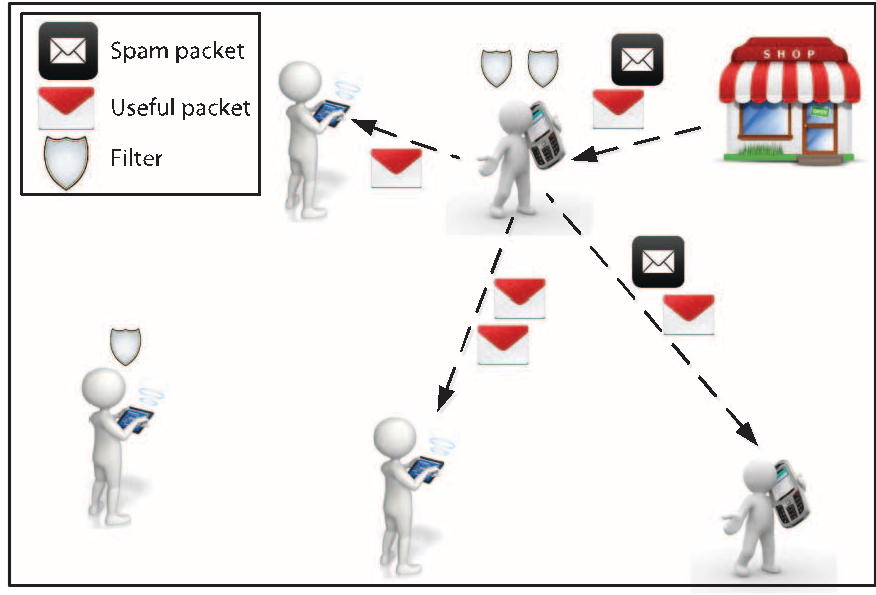
Instead of broadcasting filters to everyone, PIF uses an analytical model based on Poisson distributions and Social Communities. Filters are only sent to "social friends"—users who share a high number of common communities (Threshold ) and are thus more likely to meet the packet recipient.
2. Dual-Layer Cryptographic Filtering
- Coarse-Grained: Uses Bilinear Pairings and Trapdoor Hash functions. It allows a filter holder to check if a packet's keyword matches the filter without ever seeing the keyword in plaintext.
- Fine-Grained: Implements a variant of Hidden Vector Encryption (HVE). This allows creators to set interest "vectors" (e.g., "I only want health news if it's rated above level 3 for urgency").
3. Merkle Hash Tree Management
To prevent Outside Forgery Attacks (OFA), all filters are stored as leaf nodes in a Merkle Hash Tree. This allows for:
- Instant Verification: Checking the root node detects if a filter holder has tampered with the criteria.
- Efficient Updates: Only the changes in the tree need to be synced, moving from toward complexity.
Experimental Validation
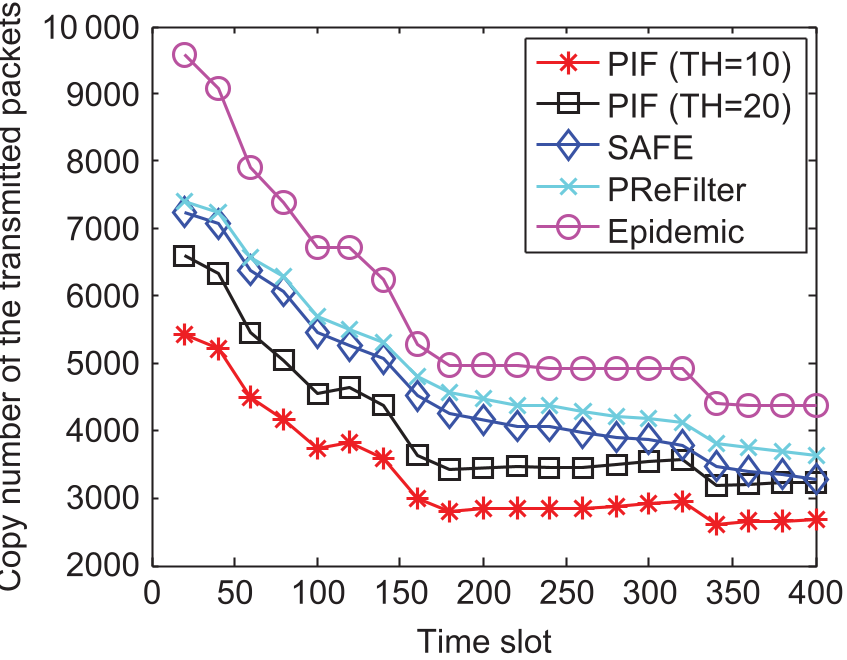
Using the Infocom06 Trace (78 users over 4 days), the PIF scheme was compared against legacy protocols like Epidemic and SAFE.
- Filtering Accuracy: PIF blocked significantly more spam than SAFE due to its fine-grained interest matching.
- Communication Overhead: By optimizing the value, the system balanced the number of distributed filters against the reduction in message "copies" (overhead).
- Latency: Despite the cryptographic overhead, delivery delay remained low because spam was eliminated early in the routing process.
Critical Insight & Conclusion
The genius of PIF lies in its use of Social Inductive Bias. By recognizing that social proximity is the best predictor of message relevance in MSNs, the authors turn a disadvantage (decentralization) into an advantage (personalized, localized control).
Takeaway: Future decentralized systems must treat "privacy" as a functional requirement of the filtering process, not an afterthought. While the computational cost of pairings/HVE is higher than plaintext matching, the massive savings in radio-frequency transmission (energy) make it a net positive for mobile ecosystems.
Limitations: The system assumes a semi-trusted Authority (TA) for initialization. Future iterations should explore fully "bootstrap-less" setups using decentralized identity (DID).