
SNPG: Transitioning from Extrinsic Rewards to Intrinsic Engagement through Personalized Gamification
A personalized gamification method for increasing user engagement in social networks
The paper introduces SNPG (Social Networks Personalized Gamification), a method that personalizes reward-based game elements (points, leaderboards, levels) using an explicit fuzzy-like concept. Tested on the Gegli.com social network, it achieved a 141.9% increase in page views and a 63.34% increase in time spent compared to standard gamification.
TL;DR
While gamification is a multi-billion dollar industry, most implementations suffer from the "one-size-fits-all" trap, leading to short-term spikes followed by rapid user churn. The SNPG (Social Networks Personalized Gamification) method solves this by allowing users to weight their own rewards. By using a "fuzzy-like" interface, users dictate which rewards they value most (Points vs. Leaderboards vs. Levels). The result? A massive 141.9% boost in page views and a sustainable increase in long-term engagement.
The "Lurker" Problem and the Limits of Extrinsic Motivation
Social networks live and die by user activity. However, most platforms struggle with "lurkers"—users who consume content but never interact. Traditional gamification tries to "push" these users into activity using Points, Badges, and Leaderboards (PBL).
The academic consensus is that these are extrinsic motivators. They work like caffeine: a quick jolt of energy that eventually wears off. The authors argue that the reason for this "wear-off" is a lack of personalization. If you don't care about your rank on a leaderboard, receiving leaderboard points feels like spam, not a reward.
Methodology: The SNPG Approach
The core innovation of this paper is the SNPG Method, which integrates a "Fuzzy Like" mechanism into the rewarding logic.
1. The Fuzzy-Like Bar
Instead of a binary "Like," users utilize a sliding bar to express the intensity of their interest in specific game elements. This maps linguistic variables (e.g., "Not Sure," "Interested," "In Love") to a numerical value between 0 and 100.
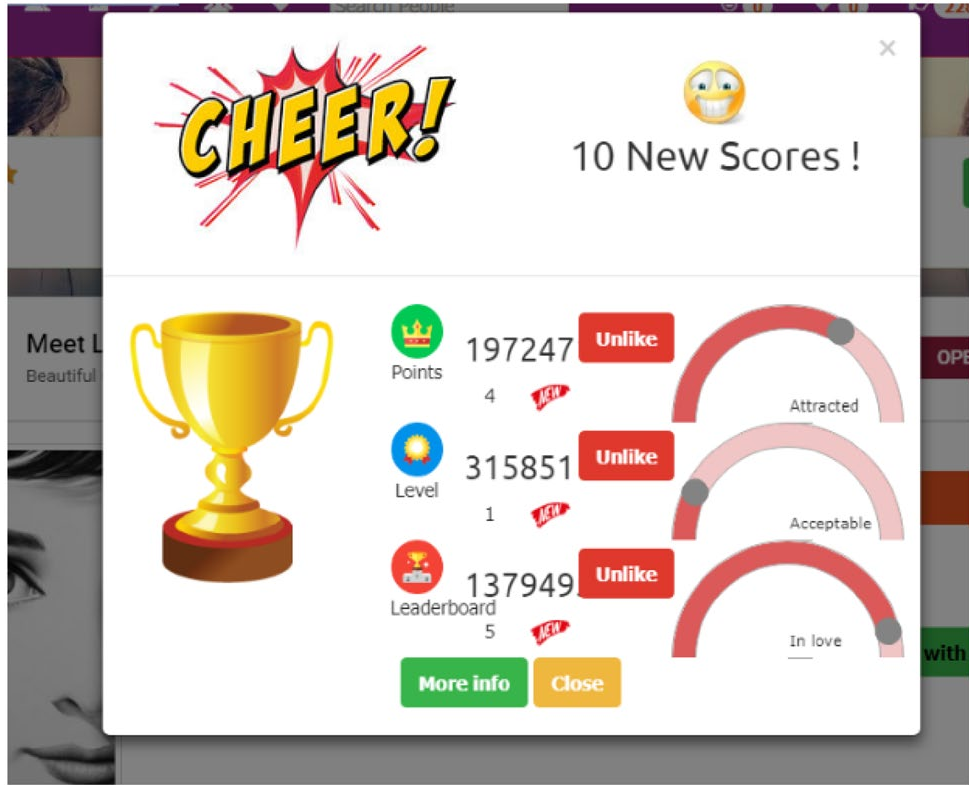
2. Proportional Reward Distribution
When a user performs an action (like sending a message), the system doesn't just grant +10 points to every category. It calculates a new score () based on the user's fuzzy weights:
This means if a user "Loves" Leaderboards but is "Indifferent" to Levels, the majority of their "Action Score" (AS) will be funneled into their Leaderboard standing. This gives the user Autonomy—a key pillar of Self-Determination Theory (SDT)—turning a generic system into a personalized experience.
Experimental Results: Sustained Growth
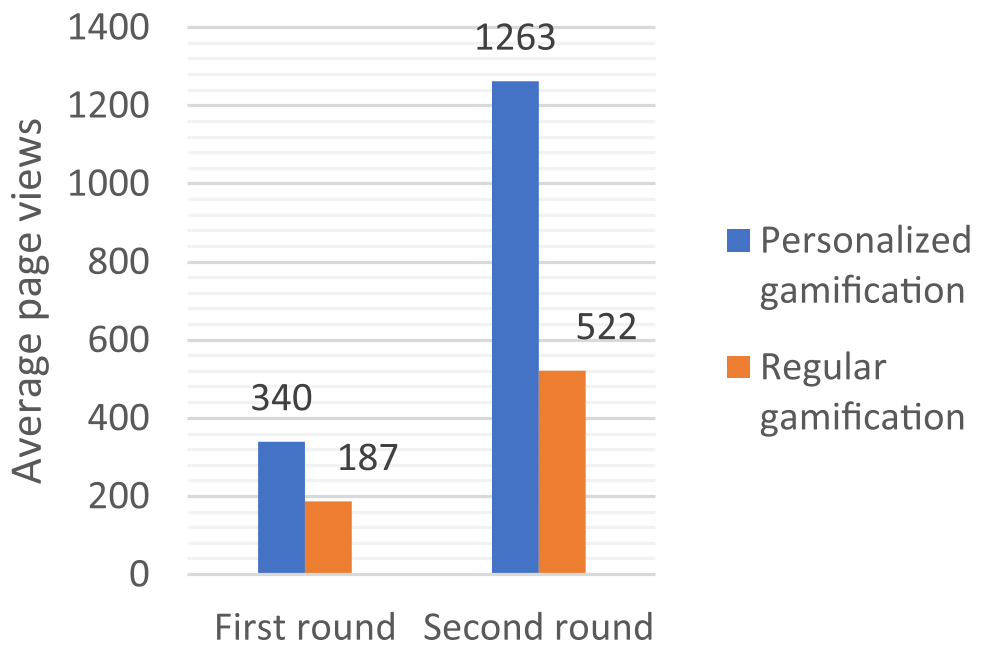
The authors conducted a two-round experiment on Gegli.com, a social network with 500,000 members. They compared a "Regular Gamification" group (uniform rewards) with a "Personalized" group.
Long-Term Impact
The data shows that while regular gamification provides a baseline, personalization accelerates engagement over time:
- Page Views: Increased by 81% in the short term, but jumped to 141.9% in the long term.
- Time on Site: Increased by 23.3% in the short term and 63.34% in the long term.
Gender and Element Preferences
The study found that:
- Leaderboards remain the most popular element for both genders.
- Men showed a 5% higher preference for using personalization features than women.
- Women who engaged with the system were 3% more interested in Leaderboards than their male counterparts, contrary to some prior stereotypes about female competitive behavior in digital spaces.
Critical Insight: Why It Works
The success of SNPG isn't just about the math; it's about Human-Computer Interaction (HCI). By moving the "Fuzzy Like" bar, users are performing a "Play" action (exploration) and a "Choice" action (autonomy). This effectively blends Meaningful Gamification with Reward-based Gamification.
Conclusion and Limitations
The SNPG method proves that personalization isn't just a "nice to have"—it's a requirement for long-term digital retention. However, the study relies on users manually setting their preferences via a slider.
Future Outlook: The next logical step for this research is to automate the "Fuzzy Weight" detection using behavioral analytics (e.g., if a user checks the Leaderboard page 10x a day, the system should automatically increase the weight of Leaderboard rewards).
Takeaway for Designers: Stop building static reward systems. If your users can't choose how they are rewarded, they will eventually stop playing.