
Beyond Aggregation: Mastering Group Dynamics in LBSNs and EBSNs
11856_Personalized Group Recommender Systems for Location- and Event-Based Social Networks.
The paper introduces PCGR and PCGR-D, novel hierarchical Bayesian models for personalized group recommendations in Location-Based Social Networks (LBSNs) and Event-Based Social Networks (EBSNs). By integrating Latent Dirichlet Allocation (LDA) with Collaborative Filtering (CF), the models achieve a 20% improvement in Recall@10 over state-of-the-art aggregation-based methods.
TL;DR
Recommending a restaurant to a group of friends isn't as simple as averaging their favorite foods. This paper introduces PCGR (Personalized Collaborative Group Recommender), a Bayesian framework that moves beyond simple aggregation. By modeling groups and locations through latent "communities" and "activity topics," the authors achieve a 20% boost in recommendation recall and solve the notorious cold-start problem.
The Problem: The Failure of "Average" Preferences
In social choice theory, the easiest way to recommend something to a group is to aggregate individual tastes—using strategies like "least misery" (don't pick anything anyone hates) or "averaging."
However, the authors identify three critical flaws in this approach:
- Emergent Behavior: Groups often visit places that individual members never visit alone.
- Social Influence: One "dominant" member often drives the group's choice.
- Data Sparsity: If a user is new (cold-start), aggregation has no data to work with.
Methodology: The Generative Insight
The core of the paper lies in its hierarchical Bayesian structure. Instead of treating a group as a static list, it treats group formation as a Generative Process.
1. Group & Community Modeling
The model assumes users belong to latent communities (similar to LDA topics). A group is generated as a mixture of users from these communities. This captures the "why" behind the group's existence.
2. Location & activity Modeling
Locations are modeled via Activity Topics. A shopping mall might offer "Electronics," "Food," and "Apparel." The model learns these from unstructured text descriptions (crawled from Foursquare API).
3. The Latent Offset Mechanism
The secret sauce is the inclusion of offsets (). These variables explain why a group might prefer a specific location even if it doesn't perfectly match their broad community interests, effectively capturing the "fine-tuning" of group dynamics.
 Figure 1: The Plate Notation for PCGR and PCGR-D (with the dominant user switch ).
Experimental Results: SOTA Performance
The researchers tested their models on two massive datasets: Gowalla (LBSN) and Meetup (EBSN).
- In-Matrix (Known entities): PCGR achieved an accuracy of 0.89 vs. MF's 0.74.
- Out-Matrix (Cold-Start): For brand new locations where MF fails entirely, PCGR outperformed CTR by ~12%, using its topic-modeling capabilities to "guess" the location's appeal based on its description.
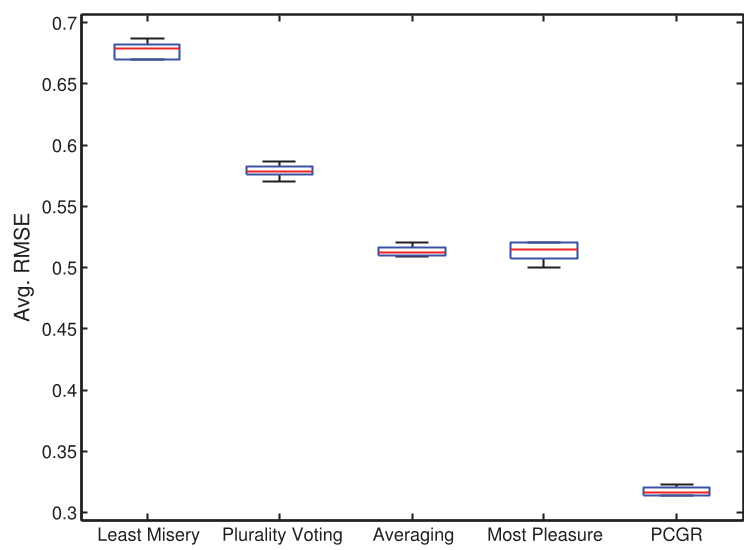 Figure 2: Performance comparison showing PCGR dominating standard aggregation strategies.
Deep Insight: The "Dominant User" Effect
One of the most interesting additions is PCGR-D. It identifies a "Dominant User" ()—someone who essentially decides where the group goes. When such a user exists, the model switches its focus toward that individual’s latent preference vector (). The results show that for groups with high leader influence, this explicit modeling is significantly more accurate than treating all members equally.
Critical Analysis & Future Outlook
While the model is robust, it relies on static descriptions. The authors admit that external factors like weather, holidays, or trending events are not yet captured.
Takeaway for Practitioners: If you are building a social recommendation engine (e.g., for travel or dining), stop just averaging user profiles. You must model the context of the group and the semantics of the venue to bridge the gap between what people like alone versus what they enjoy together.
Conclusion
PCGR represents a shift toward "interpretable" AI in recommendations. By looking at the latent spaces, we can finally understand why a group of Harry Potter fans (Community A) chose a specific hiking trail (Activity Topic B)—it wasn't just a random check-in; it was a modeled social dynamic.