
SSLR: Mastering the Spatial and Sequential Nuances of LBSN Recommendations
Personalized location recommendation for location-based social networks
The paper proposes SSLR, a hybrid Point-of-Interest (POI) recommendation framework for Location-Based Social Networks (LBSNs). It uniquely combines spatial distribution modeling using Hierarchical Semantic Clustering and 2D Kernel Density Estimation with a Reinforcement Random Walk model that captures sequence dependencies and social influence.
TL;DR
The paper introduces SSLR, a hybrid recommendation framework that solves the data sparsity and mobility modeling challenges in Location-Based Social Networks (LBSNs). By combining 2D Kernel Density Estimation (KDE) with a Reinforcement Random Walk on a heterogeneous graph, the model captures both "where" users go (spatial clustering) and "in what order" they go (sequence transitions), significantly outperforming traditional Matrix Factorization and social-only models.
Problem & Motivation: Beyond Simple Coordinates
Location recommendation is inherently harder than movie or product recommendation. Why?
- Data Sparsity: Most users only visit a tiny fraction of available POIs.
- Geographical Constraints: Humans don't teleport; their movements are clustered and sequentially dependent.
- Social Nuance: While friends influence long-distance travel, short-range movement is often dominated by personal routine and spatial proximity.
Existing SOTA methods often simplify geographical influence into a "distance decay" formula. The authors argue that this ignores orientation (the direction of movement) and sequence (the probability of moving from point A to point B).
Methodology: The SSLR Framework
The core innovation of SSLR lies in its dual-track processing of geographical influence.
1. Spatial Modeling via 2D-KDE
Instead of assuming a standard Power Law distribution, SSLR uses Hierarchical Spatial Clustering to identify a user's activity centers. It then applies a 2D Normal Kernel to these clusters:
This allows the model to give equal weight to different "activity hubs" (e.g., home vs. work) regardless of how many check-ins are in each, preventing dense areas from overwhelming sparse but important ones.
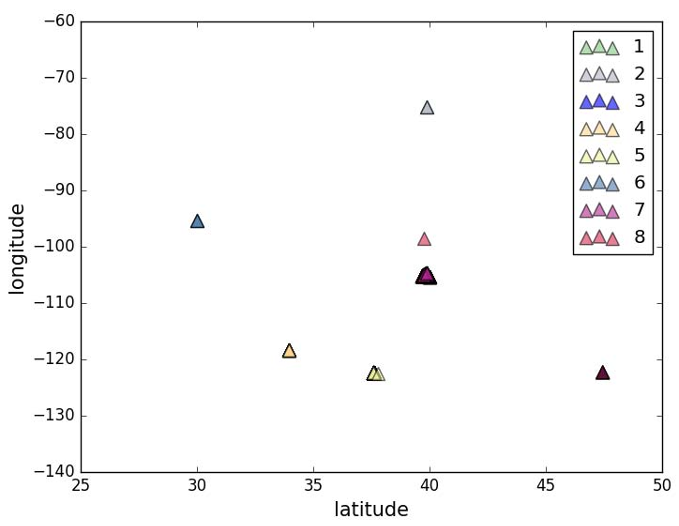 Fig 1. Illustration of the geographical clustering phenomenon where a user’s activity centers form distinct hubs.
2. Reinforcement Random Walk
To capture sequences, the authors construct three interaction matrices:
- User-User (U): Social ties weighted by shared POIs.
- User-Location (W): Check-in frequencies.
- Location-Location (V): Implicit transition dependencies, where weights are decayed by the time interval .
The final recommendation is derived from a steady-state probability distribution achieved through iterative updates, effectively "flowing" user preference across the social and physical graph.
Experiments & Results
The model was tested against several heavyweights, including USG (Collaborative Filtering + Power Law) and iGSLR (1D-KDE).
Key Findings:
- Precision and Recall: SSLR consistently sits at the top of the curve. On the Brightkite dataset, its ability to maintain high precision as increases indicates a superior ranking quality.
- Handling Sparsity: On the Gowalla dataset—which is significantly sparser—SSLR's improvement over the second-best method (USG) became even more pronounced, proving that explicit transition modeling compensates for missing check-in data.
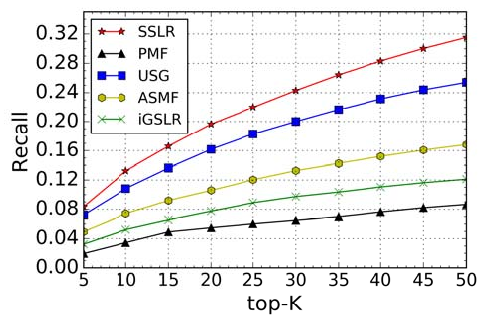 Fig 2. Performance comparison on the Brightkite dataset showing SSLR (the top-most line) outperforming baselines.
Critical Insight & Conclusion
The true value of SSLR is its recognition that geography is not just a distance, but a structure. By using hierarchical clustering before KDE, they treat "space" as a personalized set of regions. By using a Random Walk, they treat "sequences" as a graph connectivity problem.
Limitations: While the model is more accurate, the computational cost of the Random Walk is higher () than simple Matrix Factorization. However, the authors mitigate this with pre-calculations, bringing the per-user recommendation time down to a manageable ~7 seconds.
Final Takeaway: For modern LBSNs, the future lies in hybrid models that can blend the "static" spatial distribution of our lives with the "dynamic" flow of our daily transitions.