
Balancing the Buzz: Leveraging Twitter for Personalized News Recommendation
Personalized News Recommendation Using Twitter
The paper presents a hybrid news recommendation system that leverages Twitter's public timeline to determine article popularity. It combines real-time social "buzz" with manually defined user interest profiles to rank news articles, achieving superior relevance over single-signal methods.
TL;DR
In an era of information overload, should your news feed show what you usually like, or what the world is talking about right now? This paper introduces a hybrid recommender system that uses Twitter's public timeline to gauge global popularity and blends it with personalized user profiles. The results prove that a "sweet spot" ((\alpha=0.4)) exists where social buzz and personal interest meet to create the most relevant news feed.
Problem & Motivation: The Echo Chamber vs. The Information Flood
The authors identify a critical tension in news consumption:
- Pure Customization: If a system only shows what you liked yesterday, you might miss a global breaking news event (e.g., a major tech breakthrough or a political shift) simply because it wasn't in your profile.
- Pure Popularity: Following the "herd" on social media often leads to a flood of irrelevant content or "noise" that doesn't align with your specific professional or personal needs.
The research intuition here is that relevance is a function of both intent and context. Twitter serves as the ultimate real-time sensor for "context," while the user profile provides the "intent."
Methodology: Mining the Global Timeline
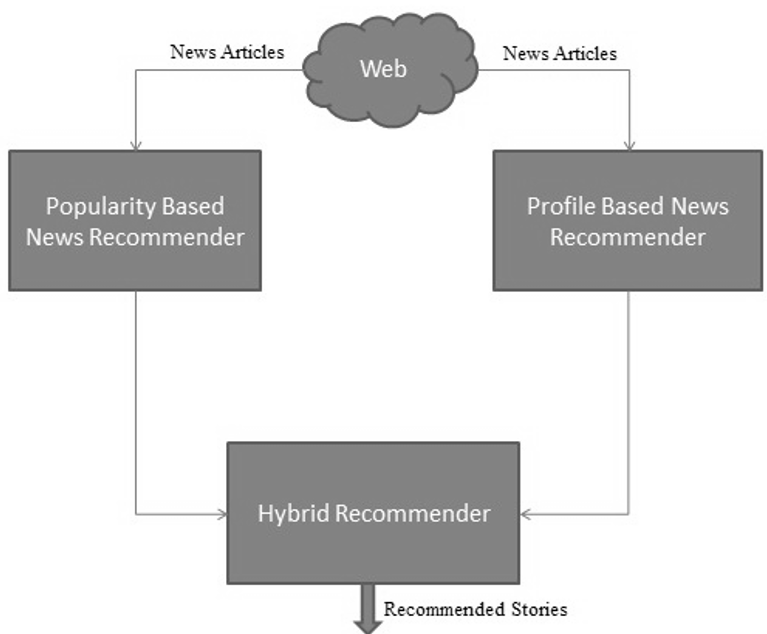
The system is built on a tripartite architecture designed to bridge the gap between micro-blogging and formal journalism.
1. Popularity Module
The system pulls a massive volume of tweets via Twitter’s Streaming API. Using Apache SOLR, it performs a cosine similarity match between the text of these tweets and a collection of news articles (CNN, BBC). The more tweets that "echo" an article's content, the higher its Popularity_Wt.
2. Profile Module
Articles aren't just tagged with a single category; they are passed through a k-Nearest Neighbor (k-NN) classifier to determine a distribution across 7 topics (Sports, Crime, Business, etc.). Users manually weight these categories to create a feature vector.
3. The Hybrid Fusion
The core innovation is the fusion formula:
Experiments: Finding the "Alpha"
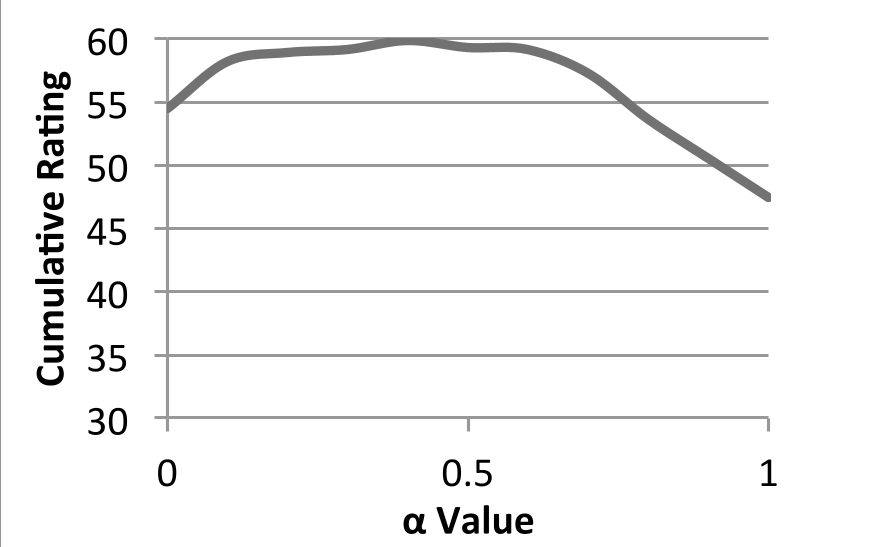
The researchers conducted a study with 27 volunteers and over 200,000 tweets. They didn't just ask if an article was "good"; they used Cumulative Rating to see if the top results were actually better.
Key findings included:
- The Popularity Trap: Using only Twitter popularity ((\alpha=1.0)) resulted in the lowest user satisfaction (47.4 cumulative rating).
- The Personal Peak: Personalization alone is strong (54.5), but it can be improved.
- The Hybrid Winner: At (\alpha=0.4), the system achieved a score of 59.8, a nearly 10% improvement over pure personalization. This suggests that users perceive articles as more relevant when they are both personally interesting and socially trending.
Critical Analysis & Future Outlook
The strength of this work lies in its early recognition of Social Signal as a proxy for temporal relevance. However, from a modern perspective, two limitations stand out:
- Manual Profiling: Users had to manually weight their interests. Modern SOTA systems use LLMs or GRUs to infer interests implicitly from clickstreams.
- Noise Handling: While the authors mention "unwanted noise," Twitter (now X) has a much higher ratio of bots and promotional content today than when this research was conducted, necessitating more robust filtering.
Conclusion
This paper serves as a foundational blueprint for hybrid systems. It reminds us that "Personalization" isn't a vacuum; it’s a dynamic interplay between our internal preferences and the external world’s collective attention. For developers building news apps today, the takeaway is clear: Don't just look at the user; look at the crowd.