
PPG-Rec: Beyond Individual Points—Personalizing Urban Hot Spots via Geo-Social Clustering
Personalized POI Groups Recommendation in Location-Based Social Networks
This paper introduces the Personalized POI Groups (PPGs) recommendation task, proposing a novel algorithm that combines geo-social density-based clustering with preference coverage optimization. By extending the DBSCAN model to incorporate social distances, the method identifies "hot spots" that align with a user's specific category preferences and social circle.
TL;DR
While most recommendation systems suggest individual locations, this paper tackles the Personalized POI Groups (PPG) recommendation problem. By blending spatial distance with social network proximity and using a greedy submodular optimization, the authors extract the "soul" of urban regions tailored specifically to a user's tastes.
Background & Positioning
In the landscape of Location-Based Social Networks (LBSNs), we are moving from "Where should I go?" to "Which areas of the city match my lifestyle?". This work moves beyond simple SOTA point-recommendation to Group Recommendation, positioning itself as a bridge between urban planning (hot spot detection) and high-precision personalized retrieval.
The Problem: The Generic Hot-Spot Trap
Traditional urban hot spot recommendations suffer from two major flaws:
- Categorical Blindness: They suggest popular areas (like Times Square) to everyone, regardless of whether a user prefers quiet bookstores or loud nightclubs.
- Social Isolation: They ignore the "local" density created by a user's friend circle, which often dictates the perceived value of a location.
The authors argue that a POI group should not just be a collection of nearby points, but a representational subset that maximizes Preference Coverage.
Methodology: Fusing Geography, Sociality, and Preference
The core of the paper lies in a three-stage pipeline:
1. Geo-Social Distance (GSD)
Instead of relying solely on coordinates, they define a hybrid distance: The Social Distance () is particularly clever—it measures the overlap of "Contributing Users" (friends who visited both points), ensuring that clusters reflect social communities, not just physical land.
2. PPG Modeling via DBSCAN Extension
The authors use an expanded DBSCAN to find clusters based on the GSD. This allows the system to identify regions that are "dense" in the eyes of a specific social group.
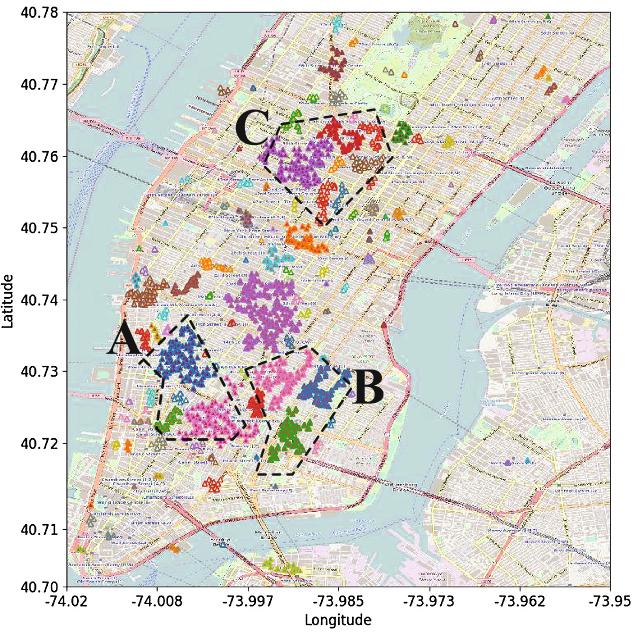 In the figure above, (a) shows standard spatial clusters, while (b) shows how social data partitions regions more meaningfully (Region A becomes two distinct social zones).
3. Greedy Preference Coverage
Because selecting the optimal points to represent a group is NP-hard, the authors leverage the submodular nature of their coverage function. They use a greedy algorithm (Algorithm 1) to pick POIs that provide the most "new" category information relative to the user's past preferences.
Experimental Insights
The research utilized Foursquare and Gowalla datasets to test the "Personalization Degree."
- The "Black Dot" Effect: The visualization in the paper reveals that the largest POI groups aren't always the best. The authors identify "feature POIs" (Personalized POIs) within groups. A group with fewer total points but more "black dots" (socially/preferentially aligned points) receives a higher recommendation rank.
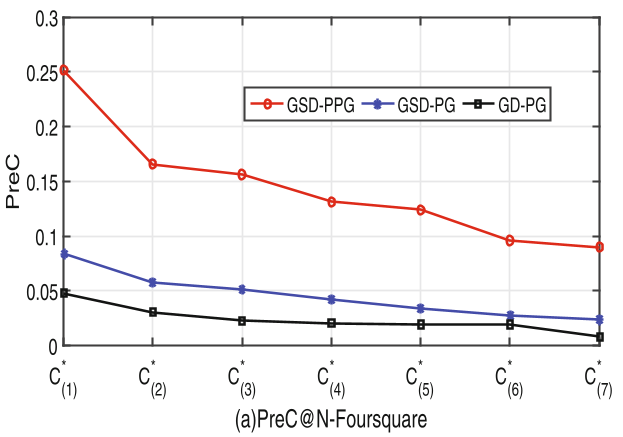 Figure: The black dots represent POIs that specifically trigger a user's preference within a broader spatial cluster.
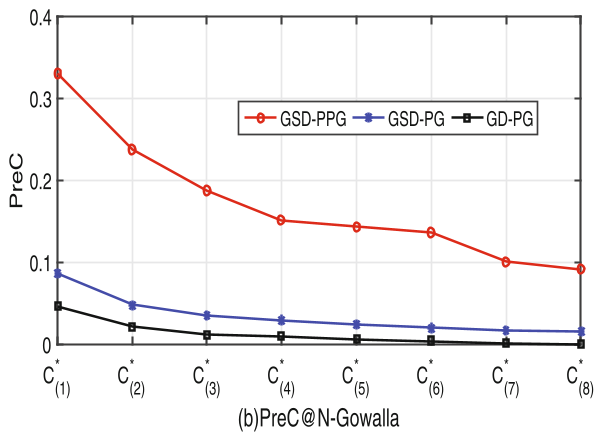
- Performance: The GSD-PPG method consistently beat baselines in Recall@K, proving that a "socially-aware" group is a more accurate reflection of where a user actually wants to spend their time.
Critical Analysis & Conclusion
Takeaway
The genius of this work isn't just the clustering—it's the recognition that a Group is a semantic entity. By treating group selection as a coverage problem, the authors provide a framework for "thematic urban exploration."
Limitations & Future Work
The current model is "static." It doesn't yet account for Temporal Dynamics (e.g., a group of POIs that are hot at night but dead during the day). The authors have noted that integrating time-series check-in data is the next frontier for making PPG-Rec even more responsive to a user's real-time needs.