
PPR: Mastering Long-Short Term Preferences in LBSNs via Joint Embedding and Sequence Learning
Personalized POI Recommendation: Spatio-Temporal Representation Learning with Social Tie
The paper introduces PPR (Personalized POI Recommendation), a unified spatio-temporal neural network framework for successive Point-of-Interest (POI) recommendation. It combines a heterogeneous graph embedding technique with a customized LSTM-based architecture to achieve State-of-the-Art (SOTA) performance across multiple LBSN datasets.
TL;DR
The "PPR" framework is a heavy-hitter in Location-Based Social Networks (LBSNs). By treating users, POIs, and social ties as a unified heterogeneous graph and processing the resulting embeddings through a personalized LSTM, the authors have set a new benchmark for "Successive POI Recommendation." It doesn't just ask "where people go," but "where this specific person will go next" by blending their social circle with their physical movement patterns.
Background & Motivation: The Sparsity Wall
Predicting the next stop in a user's journey is a nightmare for standard Collaborative Filtering. Unlike Netflix, where you can watch ten movies a weekend, you can only be at one physical Point-of-Interest (POI) at a time. This leads to extreme data sparsity.
Furthermore, existing SOTA models often fall into two traps:
- Static Embedding oversimplification: They capture the "check-in" but miss the "flow" (sequential transition).
- Impersonal Modeling: They see a "generic user" moving from A to B, ignoring that User A might be a foodie while User B is a tourist, even if they share a similar recent check-in.
Methodology: The PPR Architecture
The authors solve this through a sophisticated two-step pipeline.
1. The Heterogeneous Graph (Structure & Context)
Instead of a simple table, they build a graph where:
- User-POI edges: Weighted by frequency.
- POI-POI edges: Weighted by a product of Sequential Effect (how often people move from to ) and Geographical Influence (modeled via a power-law distribution of distance).
- Social Ties: Weighted by "social strength," calculated as the overlap of visited POIs between friends.
The Densifying Trick: To fight sparsity, they add edges to second-order neighbors for nodes with low degrees. This "pre-fills" the manifold for the embedding engine.
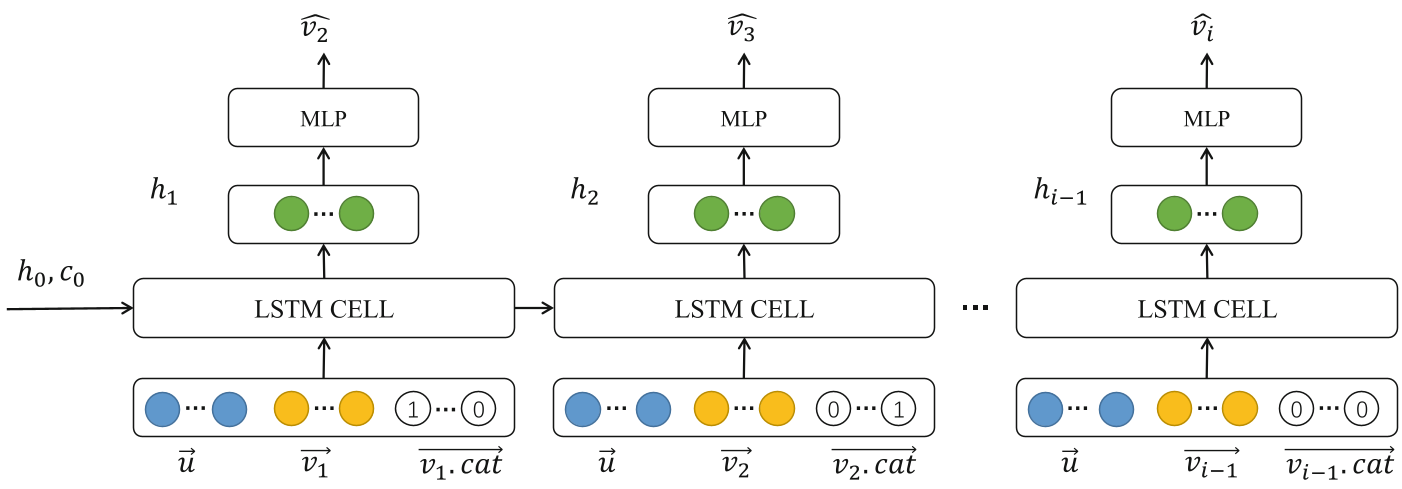
2. Spatio-Temporal LSTM (Dynamics & Personalization)
Once embeddings are learned via a LINE-inspired objective, they aren't just used for dot-product similarity. Instead:
- They concatenate User Embedding + POI Embedding + POI Category.
- This vector is fed into a multi-layer stacked LSTM.
- By including the User Embedding directly in each time step's input, the LSTM "remembers" the specific user's identity, effectively personalizing the sequence transition weights.
Experimental Battleground
The researchers tested PPR against five major baselines (Rank-GeoFM, ST-RNN, GE, PEU-RNN, and SAE-NAD) on three massive datasets.
| Metric | PPR (Foursquare) | PPR (Gowalla) | PPR (Brightkite) |
|---|---|---|---|
| Acc@5 | 0.3008 | 0.3835 | 0.8717 |
| Recall@10 | 0.3387 | 0.3430 | 0.8741 |
The results on Brightkite are particularly striking. As the dataset with the highest average check-ins per user, PPR was able to "supercharge" its learning, hitting over 87% accuracy. This proves that the PPR architecture scales beautifully with more data.
Ablation Insights: What actually matters?
The study conducted through PPR-Seq, PPR-Den, and PPR-RL revealed that:
- Graph Densification (
Den) is essential for sparse datasets like Foursquare. - Sequential Modeling (
Seq) is the backbone; without the POI-to-POI transition edges, performance drops significantly. - Personalization (adding user ID to the LSTM) ensures the model doesn't just recommend "popular" spots, but "personally relevant" ones.
Critical Analysis & Future Outlook
PPR is a robust framework, but it is computationally intensive. Building a densified heterogeneous graph and then running a stacked LSTM on top of high-dimensional embeddings requires significant memory.
Future Directions:
- Efficiency: Can we replace the LSTM with a more parallelizable Transformer block while maintaining the spatial-temporal gates?
- Cold Start: While the densifying trick helps, new users with zero check-ins still pose a challenge. Integrating cross-domain social data might be the next frontier.
Summary
PPR proves that in the physical world, "who you are" (User Embedding) and "who you know" (Social Ties) are just as important as "where you were" (Sequential Pattern). By unifying these into a single neural pipeline, PPR offers a definitive leap forward for the next generation of location-based services.