
P2CF: Solving the Graduate Job Search Cold-Start with Campus Big Data
Personalized Preference Collaborative Filtering: Job Recommendation for Graduates
The paper introduces P2CF (Personalized Preference Collaborative Filtering), a hierarchical job recommendation framework specifically designed for university graduates. By integrating campus big data for student clustering and incorporating Bayesian Personalized Ranking (BPR) with localized preferences, it achieves state-of-the-art accuracy in a cold-start scenario where historical employment data is absent.
TL;DR
Finding the first job is a high-stakes challenge for graduates who lack both work experience and social networks. P2CF (Personalized Preference Collaborative Filtering) solves this by leveraging "Campus Big Data"—objective records of grades and consumption—to cluster students and provide highly relevant job recommendations. It effectively bypasses the traditional cold-start problem, achieving a Hit Ratio of over 44%.
Background: The Cold-Start Crisis in Job Hunting
For most Recommendation Systems (RS), historical data is the engine. However, for a graduating senior, the "engine" is empty. They have no prior employment records, making traditional Collaborative Filtering (CF) useless. While some systems try to parse resumes, these are often subjective and lack the "hidden signals" that determine actual career success.
The authors argue that a student’s four-year campus life—how they performed in CS courses and even how often they ate at the canteen—provides a more objective "Behavioral Fingerprint" than a self-written CV.
Methodology: From Groups to Personalization
P2CF operates on a hierarchical logic: "Similar students tend to make similar career choices."
1. Objective Feature Extraction
The system identifies two primary drivers for job selection:
- GPI (Graduate Performance Index): A weighted score of grades, focusing on core major courses.
- GEI (Graduate Economic Index): Inferred from campus card consumption patterns (frequency and cost per meal) and hometown economic status.
2. The Hierarchical Model
Instead of individual-item interaction, P2CF creates a Group-Item Matrix.
- Clustering: Students are grouped via K-means based on GPI and GEI.
- BPR Optimization: The model learns a latent factor space where the group's preference for certain jobs is maximized.
- Attribute & Location Integration: P2CF doesn't just look at the job title; it adds two critical layers:
- Job Attributes (A): Technical vs. Non-technical, State-owned vs. Private.
- Location Preferences (P): Modeled using a multivariate Gaussian distribution, balancing Economic Index (REI) and Familiarity (RFI) (distance from hometown or school).
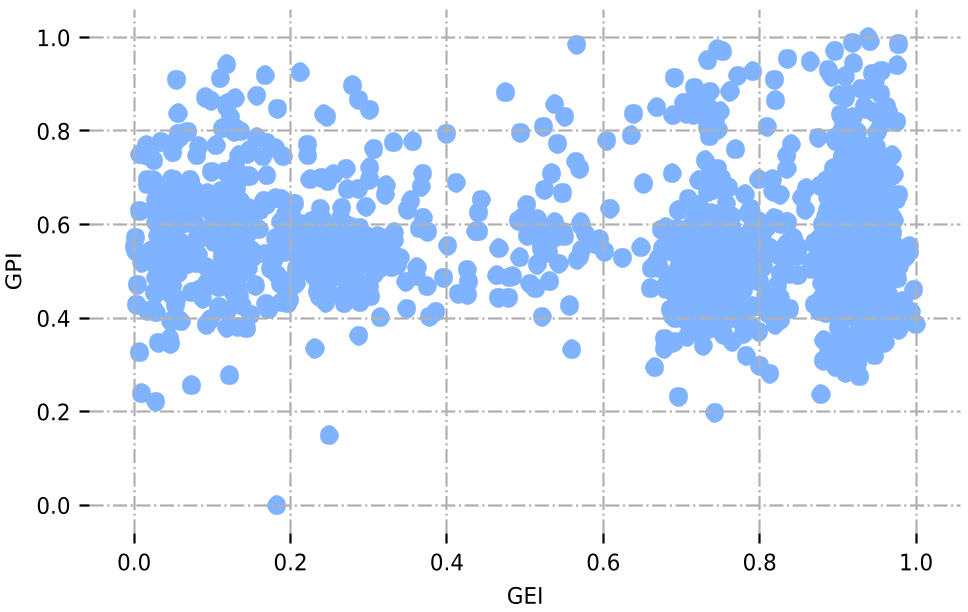 Figure 1: The hierarchical architecture of P2CF, bridging group behavior and individual preference.
Experiments & Deep Insights
The model was validated on a dataset of 1,389 graduates. The study finds a fascinating distribution: male and female students, as well as students from different economic backgrounds, show distinct "clusters" of job-seeking behavior.
SOTA Comparison
P2CF was compared against User-based CF, Item-based CF, and basic BPR. The results were clear:
- Accuracy: P2CF’s Hit Ratio at 50 (HR@50) hit 44.37%.
- Ranking Quality: The MRR was significantly higher than neighborhood-based methods, indicating that the jobs students actually took were ranked high in the recommendation list.
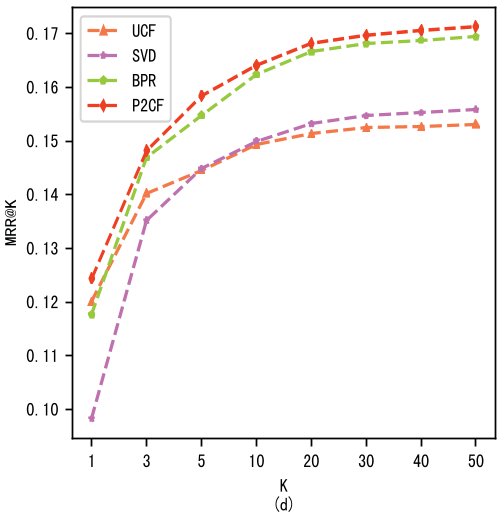 Figure 2: Performance of Top-K recommendations. P2CF maintains a steady lead as K increases.
Why does it work?
The ablation study revealed that Location Preference (P) is the most significant factor in boosting the Hit Ratio. For graduates, "Where am I going?" is often as important as "What am I doing?" By calculating the Regional Familiarity Index (RFI), the model captures the human tendency to stay near hometowns or schools—an Inductive Bias that standard CF misses.
Critical Analysis & Conclusion
The Takeaway: P2CF proves that we can build high-performance recommendation systems without historical "target" data, provided we have rich "proxy" data (campus records) and a sound hierarchical strategy.
Limitations:
- The model assumes that current graduates will follow the patterns of their predecessors. If the job market shifts (e.g., a sudden tech recession), the "group behavior" might lag behind reality.
- The reliance on consumption data for economic status might be less effective in an era of mobile payments (Alipay/WeChat) where campus card usage is declining.
In conclusion, P2CF provides a robust blueprint for career centers to transform "Campus Big Data" into actionable guidance, helping the next generation find their place in the workforce more efficiently.