
Personalized Recommendation: Cracking the Social Code with User Behavior and Entropy
Personalized Recommendation by Exploring Social Users’ Behaviors
This paper proposes a social-aware recommendation model that integrates two novel factors: Interpersonal Interest Similarity and Interpersonal Rating Behaviors Similarity into a Probabilistic Matrix Factorization (PMF) framework. Evaluated on the Yelp dataset, the approach significantly outperforms existing baselines like BaseMF and CircleCon by better modeling the latent connections between users and their social circles.
TL;DR
This research introduces a consolidated recommendation model that moves beyond simple social links. By exploring Interpersonal Interest Similarity and Interpersonal Rating Behaviors Similarity using category-level entropy, the authors successfully tackle the chronic issues of data sparsity and cold start, achieving superior accuracy on real-world Yelp datasets.
Background & Motivation: Beyond the Social Graph
Traditional Recommender Systems (RS) have hit a wall. Collaborative Filtering works well when data is abundant, but for new users or niche items (the Cold Start and Sparsity problems), the system fails.
The current SOTA has shifted toward Social Networks. However, the authors argue that just "having a friend" isn't enough information. Does your friend share your specific interests in Italian food? Do they have the same rating standards as you (e.g., are they a "harsh" rater while you are lenient)? Most existing models ignore these behavioral nuances.
Methodology: The Fusion of Interests and Behaviors
The authors propose a model based on Probabilistic Matrix Factorization (PMF), enhanced by two core social factors calculated within a user's "circle of friends."
1. Interpersonal Interest Similarity
Instead of broad preferences, the model looks at Category Distribution (). By analyzing a user's history across sub-categories (like "Steakhouses" vs. "Argentine" in Yelp), they calculate a weighted interest vector. The similarity between two friends () is then derived using Cosine Similarity.
2. Interpersonal Rating Behaviors Similarity (The Entropy Insight)
This is the "secret sauce." To understand how a user rates, the authors use Entropy.
- The Problem: Users rarely rate the exact same items, making direct comparison impossible.
- The Solution: They use the average ratings in the same sub-category to represent a user's "standard."
- The Formula:
 A higher entropy signifies lower similarity in behavior. By taking the reciprocal, they create a weight that pulls the latent features of "behaviorally similar" friends closer together.
3. The Objective Function
The final model merges these factors into a unified optimization problem:
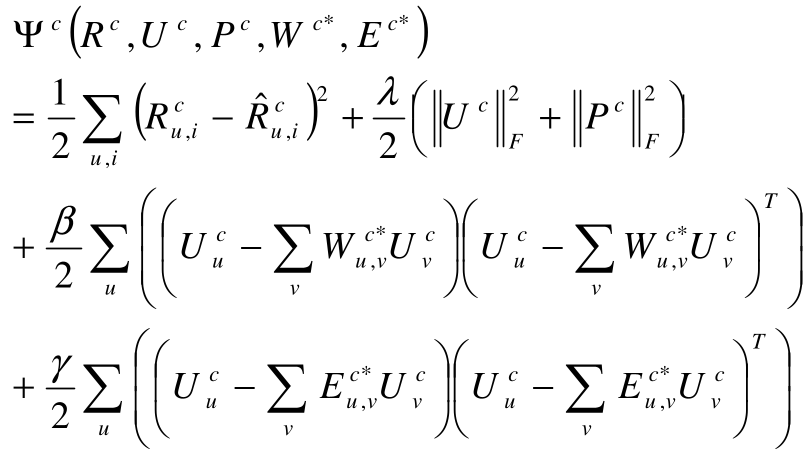
- First term: Standard prediction error.
- Middle terms: Regularization to prevent overfitting and enforce interest similarity.
- Final term: Regularization based on rating behavior similarity.
Experimental Validation
The model, termed URB (User Rating Behavior), was tested against three major baselines (BaseMF, CircleCon2b, and ContextMF) across five Yelp categories.
Performance Metrics
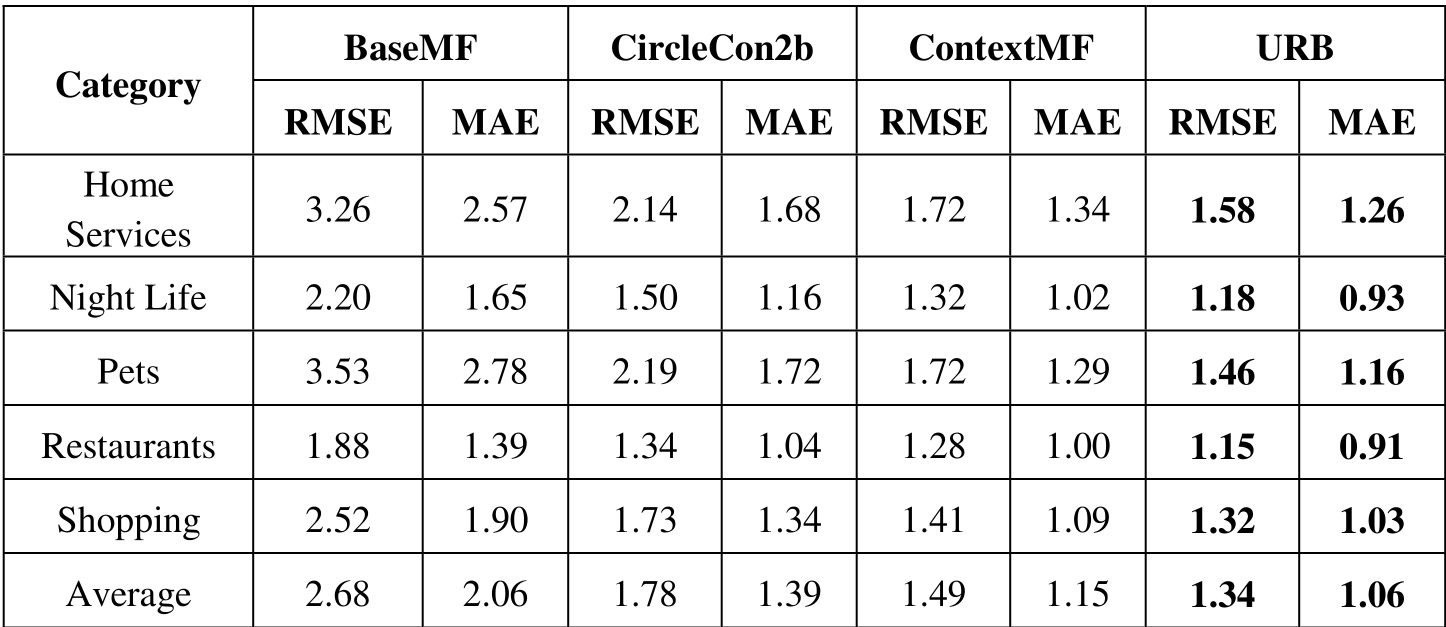
As shown in the table, URB consistently achieves the lowest RMSE and MAE. On average, it reduced the RMSE from 2.68 (BaseMF) to 1.34—a massive leap in prediction accuracy.
Ablation Study: What Matters More?
The authors also conducted an ablation study to see which factor carries the most weight:
- Interest Similarity Alone: RMSE 1.35
- Rating Similarity Alone: RMSE 1.24
- Both Combined: RMSE 1.14 The results confirm that while both help, understanding rating behavior (the "how") is actually more potent than just understanding interest (the "what").
Critical Insight & Conclusion
The brilliance of this work lies in the use of Category Entropy. By aggregating sparse individual ratings into category-level behaviors, the authors created a robust proxy for user personality that survives the sparsity of social data.
Takeaway: Future social RS shouldn't treat all "friends" as equal. The "inner link" in latent space must be weighted by both the topic of the interest and the style of the interaction (rating habits).
Limitations: The model relies heavily on high-quality category tags. In platforms where metadata is messy or user-generated (tags), the interest distribution () might become noisy.