
PITEX: Discovering Your "Selling Points" Through Personalized Social Influence
Discovering Your Selling Points: Personalized Social Influential Tags Exploration
This paper introduces Personalized Social Influential Tags Exploration (PITEX), a novel task aimed at identifying a size-k set of keywords/tags that maximizes a specific user's social influence within a network. The authors propose a sampling-based framework incorporating lazy propagation and index-based structures, achieving a approximation guarantee and outperforming traditional Influence Maximization (IM) baselines by orders of magnitude.
TL;DR
Standard social media analytics tells you who is influential. PITEX tells you what makes you influential. This paper introduces the Personalized Social Influential Tags Exploration (PITEX) problem: given a user, find the tags that maximize their reach. By leveraging Lazy Propagation and Index-based RR-Graphs, the authors provide a way to answer these complex queries in real-time with high theoretical guarantees.
Problem & Motivation: Beyond Seed Selection
For years, the gold standard in social network research was Influence Maximization (IM)—finding a small group of users to start a viral trend. But for political candidates, marketers, or "we-media" creators, the question is different: "I am already the seed; which topics should I talk about to reach the most people?"
This is inherently harder. In traditional IM, the graph's edge probabilities are fixed. In PITEX, every possible combination of tags creates a different probability distribution across the graph. This is not just NP-hard; it's practically impossible to approximate using ratios without clever optimization.
Methodology: The Core Innovations
1. Lazy Propagation Sampling
Standard Monte Carlo (MC) sampling is "wasteful"—it probes every edge to see if it's active. PITEX introduces Lazy Propagation. Instead of tossing a coin for every edge, it calculates a Geometric Random Variable to predict when (in which future simulation) an edge will next be active.
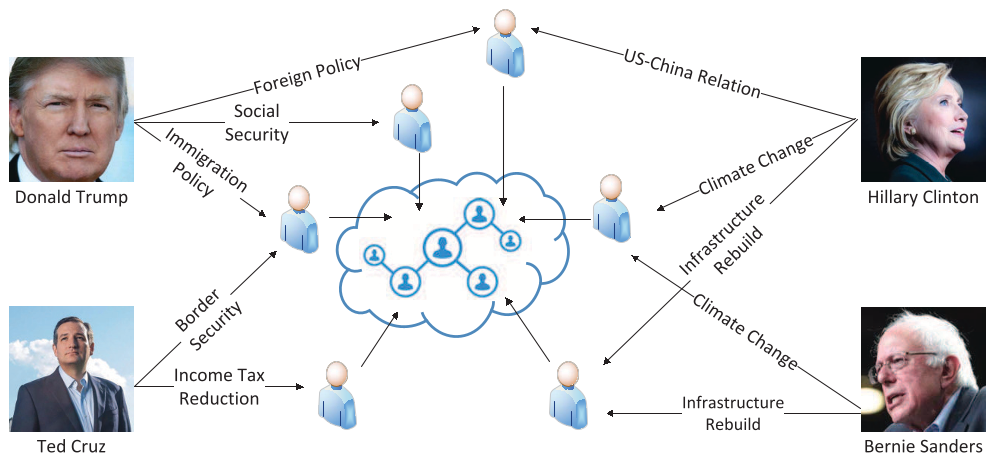 Figure 1: In the campaign network, different hashtags (tags) activate different diffusion paths.
2. Best-Effort Exploration
The search space for tags is exponential. The authors utilize a Best-Effort pruning strategy. By calculating the upper bound of influence for a partial set of tags, they can discard thousands of combinations without ever simulating them.
3. RR-Graph Indexing & Delay Materialization
To achieve sub-second response times, the authors move the heavy lifting offline. They pre-construct Reverse Reachable (RR) Graphs. However, storing these for every user is memory-intensive. Their Delay Materialization trick stores only the "influence signature" of a user and reconstructs the necessary graph structures on-the-fly during the query.
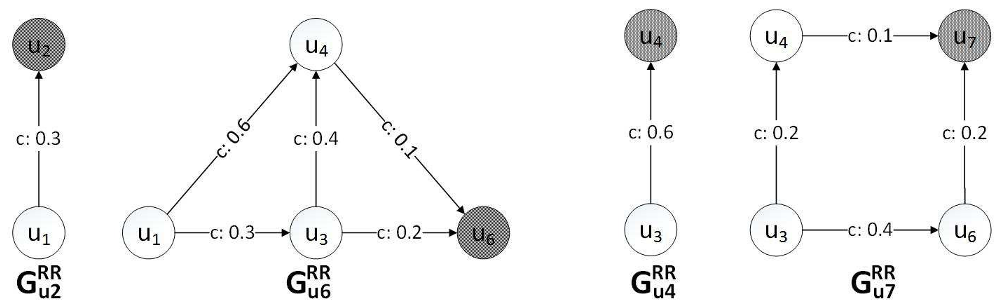 Figure 5: Examples of RR-Graphs used to estimate reachability efficiently.
Experiments & Performance
The framework was tested on massive datasets, including a 12-million edge Twitter graph.
- Efficiency: The proposed
IndexEst+method was often 3 orders of magnitude (1000x) faster than standard sampling. - Scalability: While brute-force methods explode as the number of available tags () increases, PITEX stays relatively flat thanks to its best-effort pruning.
- Case Study: Applying PITEX to the DBLP co-authorship graph accurately identified the "selling points" of famous researchers (e.g., "Data Mining" for Jiawei Han, "Distributed Systems" for Michael Stonebraker).
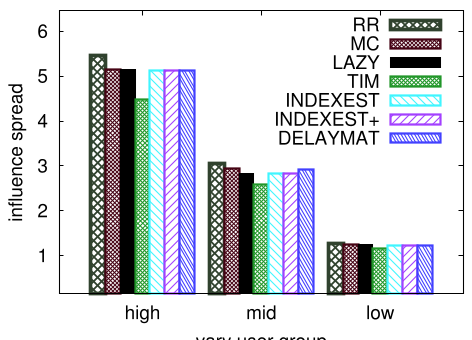 Figure 7: Efficiency comparison shows the Index-based methods dominating online sampling across all user groups.
Critical Insight: Why This Works
The brilliance of PITEX lies in realizing that social influence is topic-dependent. By bridging the gap between topic modeling (which is often too abstract for users) and tag selection (which is actionable), this paper creates a bridge between data science and marketing strategy.
Future Outlook
While PITEX is powerful, it currently assumes a static graph. Real-world social influence is highly temporal—what is a "selling point" today (e.g., #LLMs) might be old news tomorrow. Extending this to dynamic, time-evolving graphs is the next logical step for this research.
Conclusion
The project successfully demonstrates that personalized influence is not just about who you are in the network, but how you label your message. For anyone in the "attention economy," this research provides the mathematical foundation for finding your most influential voice.