
Personalized Social Search: Why Your Network is the Ultimate Search Filter
Personalized social search based on the user's social network
This paper presents a personalized social search framework that re-ranks results based on the searcher’s social network (SN). By leveraging an enterprise social tool (SaND), it introduces and compares three SN types—Familiarity-based, Similarity-based, and Overall—alongside a Topic-based baseline, achieving a significant performance leap (up to 16.9% NDCG improvement) over non-personalized search.
TL;DR
In the era of information overload, your coworkers' activities might be the best indicator of what you are looking for. This paper from IBM Research explores how personalizing search results using a user's Social Network (SN)—categorized by familiarity and activity similarity—outperforms traditional topic-based personalization. By re-ranking results based on social proximity, the researchers achieved up to a 16.9% boost in search precision in a real-world enterprise environment.
Problem & Motivation: The "Missing Context" in Search
Standard search engines often treat queries as vacuum-sealed requests. If two users type "IR," one might want "Information Retrieval" while another wants "Infra-red." While click-history and query logs try to fill this gap, they raise privacy red flags and fail "cold-start" users who haven't searched much yet.
The authors' core insight is that in a "Social Web" (Web 2.0), our social circles provide a rich, public, and safe-to-use proxy for our interests. If your close teammates are bookmarking a specific document about a project, there is a high probability that it is relevant to your search for the project name as well.
Methodology: Mapping the Social Graph
The researchers used a system called SaND (Social Networks and Discovery) to aggregate data from blogs, wikis, and bookmarking tools. They defined three distinct social network types:
- Familiarity-based: People you actually know (managers, direct reports, or co-authors).
- Similarity-based: People who act like you (those who use the same tags or comment on the same blogs), even if you've never met.
- Overall: A hybrid of both.
Architecture & Scoring
The system re-ranks results using a personalized score that combines the original engine's score with the "social strength" of people () and terms () related to the user ():
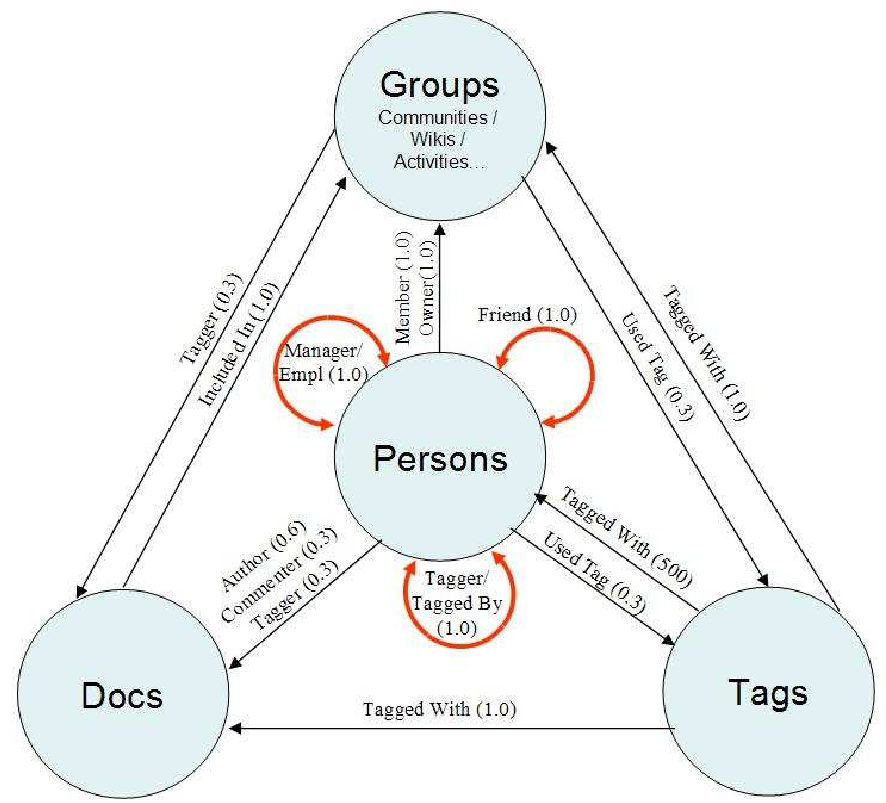 Above: The direct relations between entities. Red/bold lines indicate familiarity, while others indicate activity-based similarity.
The algorithm essentially "boosts" a document if it has been authored, tagged, or commented on by someone in your social circle.
Experiments & Results: The "Similarity" vs. "Familiarity" Battle
The study utilized two evaluation tracks: an offline study (using 2,000 bookmarks) and an online survey (240 employees judging 577 queries).
Key Findings:
- The "Similarity" Paradox: In offline tests, the Similarity-based network was the king of performance (highest MAP). This suggests that "people like us" are great predictors of our tagging behavior.
- The "Overall" King: In the real-world survey, however, users preferred the Overall SN (16.9% NDCG improvement). Humans seemingly find value in a mix of "what my friends know" and "what experts in my field are doing."
- Topic-Based Failure: Simply adding tags to a profile (Topic-based) was significantly less effective than using social connections.
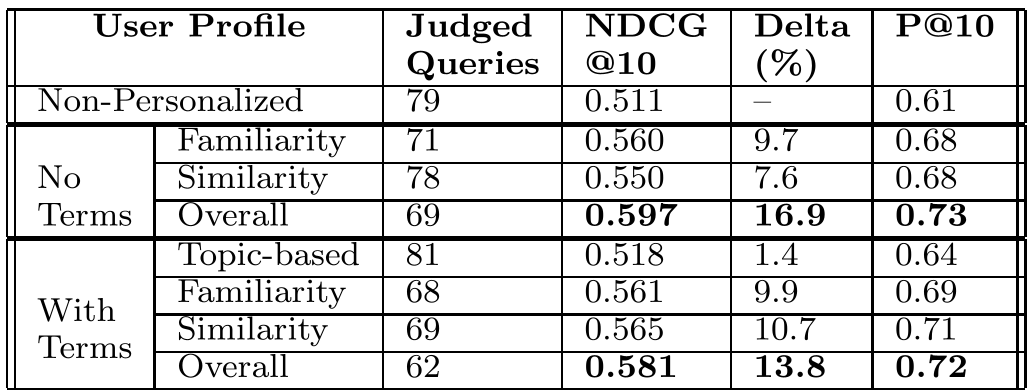 Table: The Overall SN strategy consistently yielded the highest NDCG and P@10 in user surveys.
Critical Analysis & Conclusion
Takeaway
The paper proves that social context is a superior signal to keyword history for enterprise search. It transitions search from a "cold" keyword-matching task to a "warm" social discovery process.
Limitations
- Bias in Judgment: Use survey participants were naturally biased toward people they already knew, potentially inflating the scores for familiarity networks in people-search tasks.
- Cold Start: While better than click-history, you still need a baseline of social activity (tags, comments) for the graph to be meaningful.
Future Work
The next frontier is Dynamic Policy Selection: automatically deciding when to personalize. As the authors admit, not every query (like "weather" or "internal cafeteria menu") needs a social bias. Integrating these social signals into a transformer-based reranker would be the modern evolution of this 2009 milestone.