
Beyond the "Brad" Standard: Using Personas to Disrupt Engineering Culture
Using Personas as Curricular Design Tools: Engaging the Boundaries of Engineering Culture
This paper introduces the use of Personas as a curricular design tool to drive large-scale reform in an Electrical and Computer Engineering (ECE) department. By creating five distinct student profiles (e.g., "Brad," "Mackenzie"), the researchers aimed to expand faculty perspectives beyond traditional stereotypes and foster a more inclusive, flexible curriculum.
TL;DR
The Electrical and Computer Engineering (ECE) field is facing a retention crisis, not just a recruitment one. This paper explores how "Personas"—a tool borrowed from Human-Computer Interaction (HCI)—can be used to challenge the rigid "gatekeeper" culture of engineering departments. By presenting faculty with fictional yet data-driven student profiles, the researchers exposed the cultural boundaries that define who is considered a "serious" engineer.
The "Middle Years" Wall: Why Engineering Identity is Stagnant
Most diversity efforts in engineering focus on the "bookends": recruitment at the start and capstone projects at the end. However, the "middle years" of the curriculum remain a black box of attrition. The authors argue that the curriculum isn't just a list of courses; it’s a cultural artifact that favors a specific type of student—the "Brad."
The Problem: Existing ECE cultures treat students as a "commodity," producing uniform graduates for defense contractors while alienating those interested in music, social justice, or smart technology.
Methodology: Engineering the Student Profile
To break this cycle, the RED (Revolutionizing Engineering Departments) executive team created five personas based on ethnographic data and faculty experience.
The Five Personas
| Name | Key Characteristics | Alignment with Status Quo |
|---|---|---|
| Brad | Traditional student, likes math/physics, avoids ambiguity. | Perfect Match |
| Mackenzie | Interested in electronic music/arts; comfortable with ambiguity. | Outlier |
| Gabrielle | First-gen student; wants to design smart homes for the elderly. | Outlier |
| Bethany | Rural background; interested in veterinary applications of ECE. | Outlier |
| Steven | International background; team-oriented; aims for "Big Tech." | Partial Match |
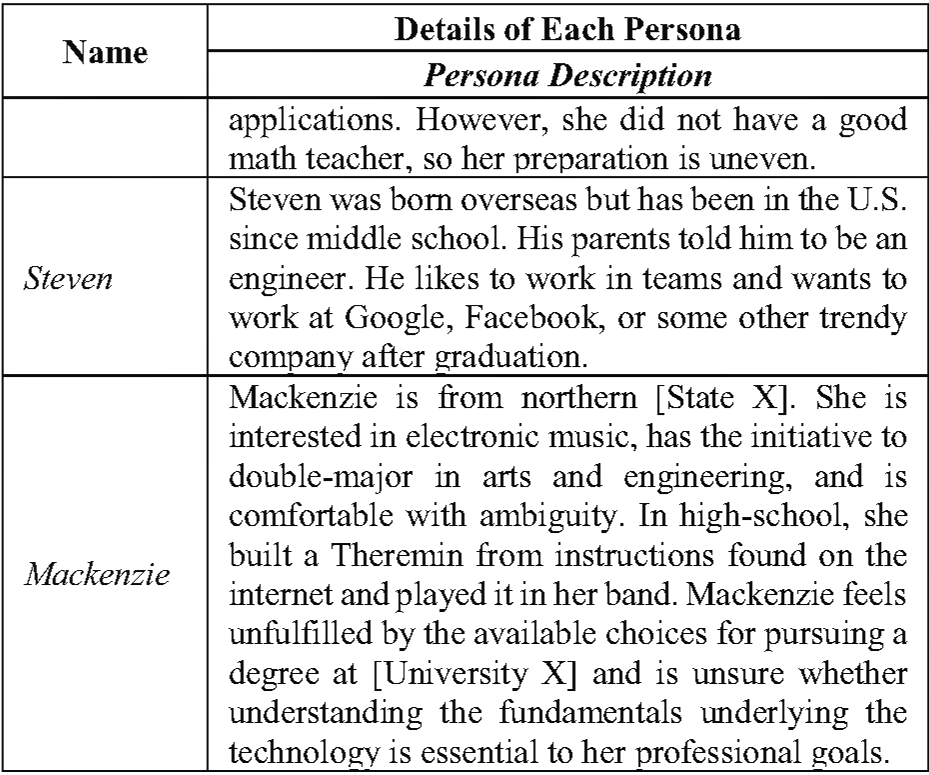 Note: Table represents the detailed qualitative bundles used to represent diverse student needs.
Key Insight: The "Tent" Problem
When these personas were presented to faculty, the reaction was a "Rorschach test" for departmental culture.
- The Recognition of Brad: Faculty immediately agreed the current system serves "Brad" perfectly.
- The Exclusion of Others: For personas like Mackenzie (Arts/ECE), faculty asked, "Is she even under the ECE tent?"
- The "Commodity" Bias: Some faculty viewed the university's role as producing "commodity" engineers, implying that any deviation from the standard path is a defect rather than a feature.
Discussion: Personas as Boundary Objects
The paper posits that personas function as Boundary Objects—tools that allow different groups (faculty, students, industry) to talk about the same thing (the curriculum) from different perspectives without necessarily agreeing on everything.
Results of the Implementation
- With Faculty: Personas revealed implicit biases and showed where "gatekeeping" happens.
- With the Industrial Advisory Board (IAB): Personas gained quick buy-in for reform, though employers remained skeptical of "multidisciplinarity" if it compromised technical rigor.
- With Donors: The personas became a compelling "storytelling" tool to attract funding for a more modern, flexible department.
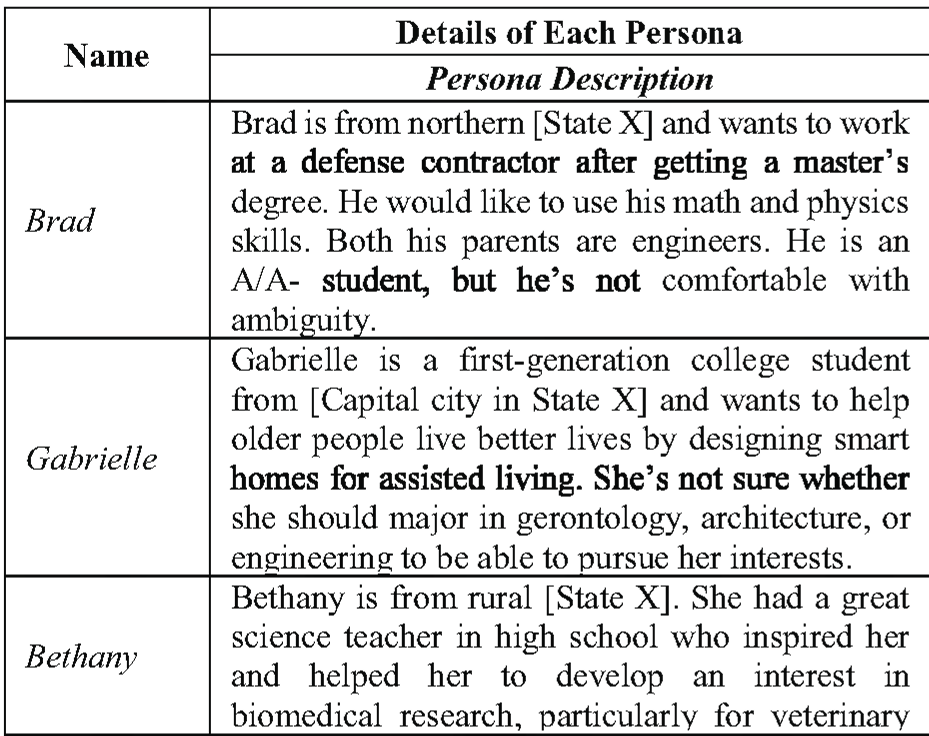 Note: The breakdown of student descriptions used to challenge faculty perceptions during the annual retreat.
Critical Analysis & Conclusion
Takeaway
The curriculum is not just a technical sequence; it is a support system. If a department only supports "Brads," it will only retain "Brads." This work demonstrates that for a curriculum to be inclusive, it must provide students with the "permission" to pursue non-traditional pathways without losing their identity as "real" engineers.
Limitations
- Stereotyping Risk: Fictional personas can accidentally reinforce stereotypes if not grounded in rigorous qualitative data.
- Faculty Resistance: Without a "faculty champion" for each non-traditional pathway, the personas risk being ignored in favor of the status quo.
Future Outlook
The goal is for "Mackenzies" and "Gabrielles" to no longer be outliers who survive ECE in spite of the department, but rather successful graduates who thrive because of its flexibility.