
Perspective Matters: The Cognitive Psychology of Viral Crisis Information
Perspective Matters: Sharing of Crisis Information in Social Media
The paper investigates the psychological mechanisms behind crisis information sharing on social media, specifically focusing on the Great East Japan Earthquake. Using experiments on Amazon Mechanical Turk, the authors demonstrate that perspective-taking (Self vs. Other) and emotional valence (Negative vs. Neutral) significantly modulate the intention to share disaster-related tweets.
TL;DR
In the wake of a disaster, why do some tweets go viral while others fade? This study reveals that it isn't just about the facts—it's about where you place yourself in the story. By imagining themselves at the heart of the crisis ("Self-perspective"), individuals are significantly more likely to share information, driven largely by intense negative emotions like fear and worry.
The "Self-Distance" Paradox
Social media is a double-edged sword during emergencies: it saves lives through coordination but endangers them through rumors. The authors identify a gap in our understanding: Social Distance. Leveraging Construal Level Theory, the research posits that how we mentally represent an event (abstractly vs. concretely) changes our decision-making.
The core intuition is that when an event is physically or socially distant, its relevance drops. But what happens if we force a shift in perspective?
Methodology: Mapping the Mind in Fukushima
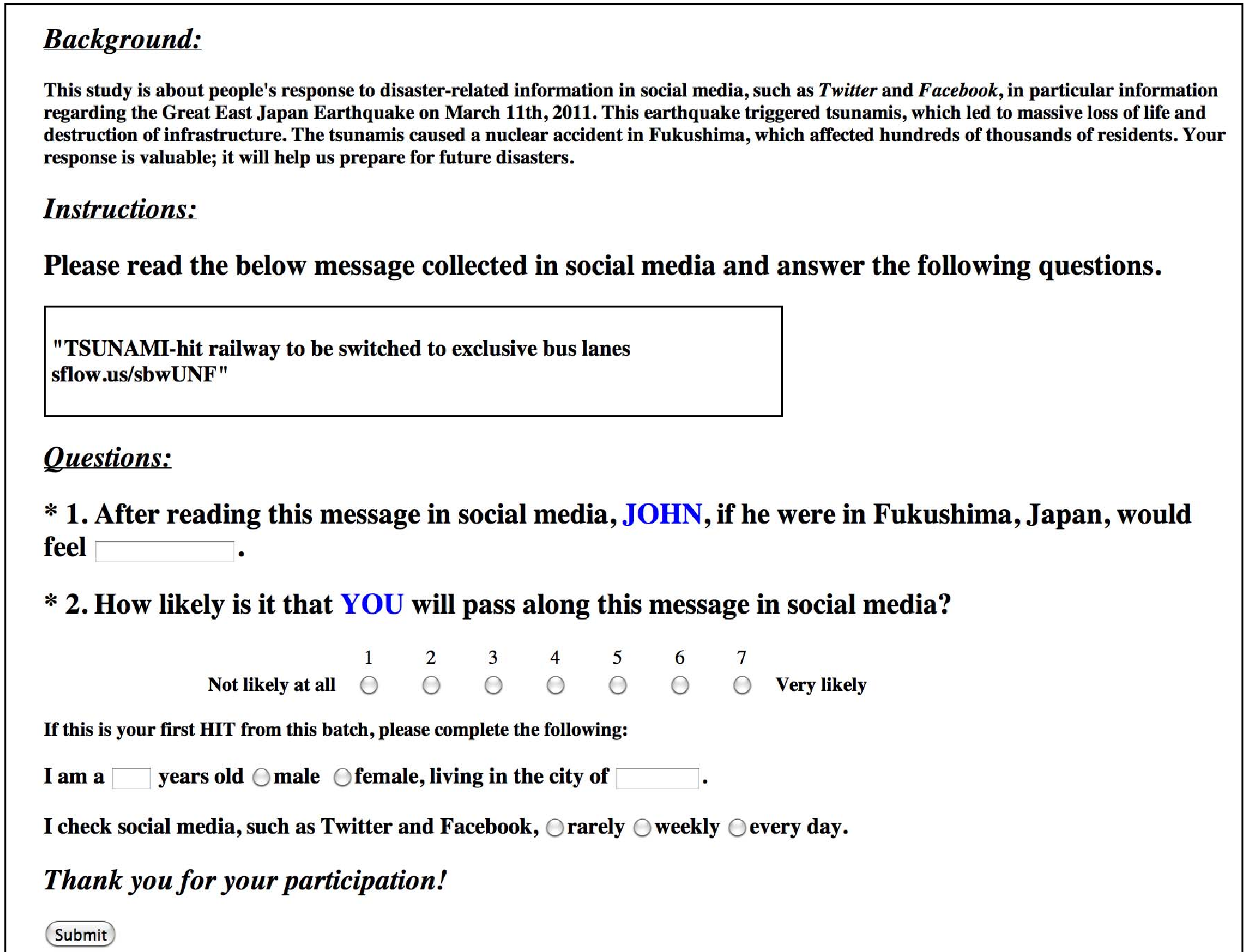
The researchers conducted three experiments with 468 participants, using real tweets from the 2011 Great East Japan Earthquake. They manipulated how participants engaged with the content:
- Control: Read the tweet normally.
- You in Fukushima: Imagine you are at the disaster center.
- John in Fukushima: Imagine a person named John is at the disaster center.
Key Finding 1: The "Self" Boosts Virality
The results were striking. When participants took the perspective of "John" (Other), their intent to share remained at the baseline level of the control group. However, when they took the perspective of "Self," the sharing intent surged.
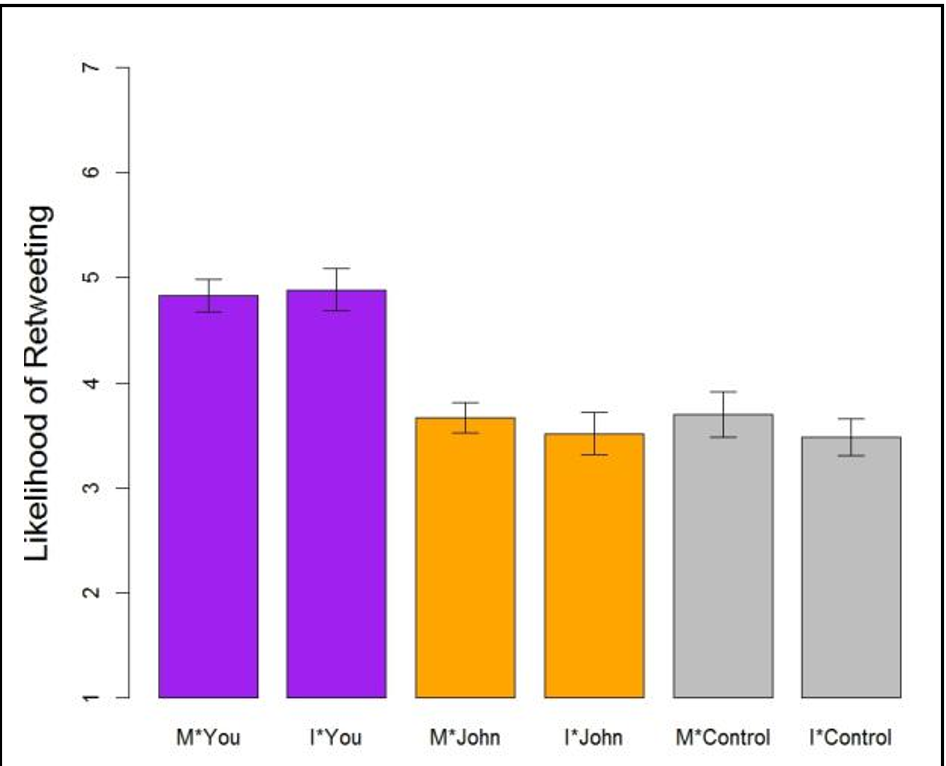
Critical Insight: Our default mode when reading distant news is actually an "Other-perspective." We don't automatically feel the fire unless we are nudged to imagine ourselves in the flames.
Key Finding 2: Emotions as the Engine
The study categorized 2,000 affective responses. It found a clear divide:
- High-Sharing Triggers: Fear, Worry, Anxiety, Alarm.
- Low-Sharing Triggers: Confusion, Boredom, Indifference, Neutrality.
Interestingly, when thinking about "Self," participants experienced more "dominating" negative feelings, whereas they perceived "John" as having more "diverse" but less intense emotions. This intensity in the "Self" condition acts as the primary driver for the increased likelihood of passing on information.
Critical Analysis & Conclusion
Takeaway
The paper effectively argues that information sharing is not a purely rational process of "fact-checking" but an emotional response grounded in social and physical proximity.
Practical Applications (System Design)
- Priming for Sanity: Social media platforms could potentially slow down rumor spread by prompting users to take a distant perspective (e.g., "Think about how people in other regions might view this") before they click 'retweet'.
- Emotional Balancing: Official government accounts should recognize that while negative framing can ensure an important message is shared, it can also induce panic. Strategic use of positive "framing" (e.g., success stories in rescue) can mitigate the "negativity bias" that fuels rumors.
Limitations
A notable limitation is that all subjects were in the USA, far removed from the actual event. As the authors admit, testing local residents vs. distant observers in a real-time setting would provide even deeper insights into the "Knowledge Gap" between local and global agencies.
Final Thought: In an era of digital misinformation, understanding that "Perspective Matters" allows us to build better tools—not just to filter content, but to help users filter their own impulsive emotional reactions.