
PAC Model: Bridging Social Psychology and Influence Maximization
Persuasion driven influence propagation in social networks
This paper introduces the Persuasiveness Aware Cascade (PAC) model, which enhances the traditional Independent Cascade (IC) model by incorporating social psychology principles. It estimates user-to-user influence probabilities using three dimensions: tie strength, peer conformity, and social authority, outperforming standard constant-probability models in predicting real-world information diffusion.
TL;DR
The "Persuasion Driven Influence Propagation" paper introduces the Persuasiveness Aware Cascade (PAC) model. Moving beyond the simplistic assumption that influence is a fixed coin-toss, this work integrates social psychology—specifically tie strength, conformity, and authority—to calculate influence probabilities. Tested on real-world data from Digg and Flixster, the model proves that behavioral "persuasiveness" is a far better predictor of viral cascades than traditional graph-theoretic metrics.
Problem & Motivation: The "Constant Probability" Fallacy
In the classic Influence Maximization (IM) problem, we aim to find seed nodes to maximize information spread. Most researchers rely on the Independent Cascade (IC) model, where an edge has a fixed probability .
However, the industry faces a major hurdle: Where do these probabilities come from? In reality, influence isn't a static property of a graph; it's a psychological interaction. Influencing a close friend is different from influencing a stranger (Tie Strength), and some people are simply more likely to follow the crowd (Conformity). Static models like Weighted Cascade (WC) or IC fail because they ignore the human element of persuasion.
Methodology: The Three Pillars of Persuasion
The authors refine the IC model by defining through three distinct psychological lenses:
- Tie Strength (Social Proof): Based on the Jaccard similarity of neighbors. If you and I share many friends, there is more "Social Proof" to validate an action.
- Peer Conformity: This measures how often user followed user in the past. It captures the specific "copycat" behavior between dyads.
- Social Authority: Using a PageRank-like algorithm, the authors calculate an authority score. Influence flows from high-authority "experts" to leur followers.
 The Authority calculation: A PageRank-inspired approach to finding social leaders.
Experiments: Digg vs. Flixster
The authors tested PAC against the standard IC and WC models using two distinct datasets: Digg2009 (news voting) and Flixster (movie ratings).
Key Findings:
- Conformity is King in News: In Digg, PAC-Conformity achieved an AUC of 0.81, crushing the baseline WC (0.5). This suggests that in fast-moving news environments, the "peer pressure" of seeing what others vote for is the primary driver of diffusion.
- Authority is Harder Online: Surprisingly, Authority performed worse than expected in computer-mediated environments. This aligns with the "equalization phenomenon," where the lack of face-to-face cues reduces the perceived status of "experts."
- Context Matters: In Flixster, the persuasion effects were less salient. The authors suggest this is because movie choices are often influenced by external factors (e.g., watching a movie in a theater with friends) that aren't captured by the online social graph.
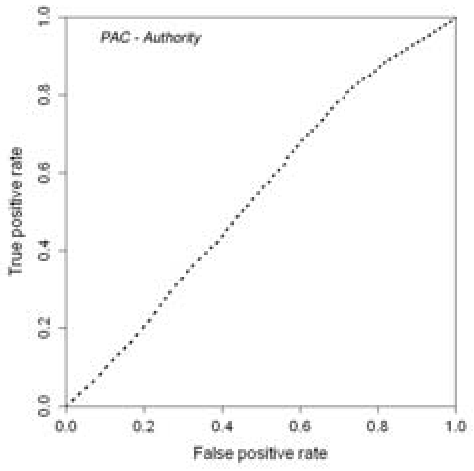 Fig 2: ROC curves showing PAC-Conformity significantly outperforming other models in the Digg dataset.
Critical Analysis & Conclusion
The PAC model is a significant step toward Explainable AI in social network analysis. By moving from "black-box" probabilities to "persuasion scores," it provides marketers with actionable insights: don't just target the most connected person; target the person users actually conform to.
Limitations & Future Work
- The "External Influence" Gap: As seen in the Flixster results, the model struggles when influence happens offline.
- Model Fusion: The current paper tests the three persuasions separately. A hybrid model combining all three could likely achieve even higher SOTA results.
- Linear Threshold Evolution: The authors suggest that applying these persuasiveness metrics to the Linear Threshold (LT) model is the next logical frontier.
Takeaway: In the era of viral marketing, understanding the graph is not enough; you must understand the psychology of the nodes within it.