
Decoding Persuasion: How Peer Support Drives Behavior Change in Digital Health Networks
Identifying Persuasive Qualities of Decentralized Peer-to-Peer Online Social Networks in Public Health
This study presents a novel framework integrating the Persuasive Systems Design (PSD) model with behavior change theories (SCT, TTM) to analyze peer-to-peer communication in health-oriented social networks. Applying this to "QuitNet," the researchers identified key persuasive qualities like Social Learning and Tailoring as drivers for smoking cessation.
TL;DR
This research investigates the hidden mechanics of persuasion within decentralized peer-to-peer (P2P) social networks. By mapping "QuitNet" communication themes to the Persuasive Systems Design (PSD) model, the authors reveal that social learning and tailoring are the most potent tools for helping users quit smoking, shifting the focus from system-led triggers to organic, peer-driven influence.
Context & Positioning
In the landscape of public health, we are moving away from Centralized Support (where a system sends automated triggers) toward Decentralized Support (where peers motivate peers). While we know these networks work, we haven't always known why. This paper fills that gap by providing a rigorous methodology to slice through the "noise" of social media chat and identify the specific persuasive gears turning under the hood.
The Core Problem: The Black Box of Peer Discourse
Most social network analysis (SNA) treats user interactions as nodes and edges in a graph—focusing on who talks to whom. However, this ignores the Persuasive Content—the what and how of the message. Existing behavioral theories like the Transtheoretical Model (TTM) explain stages of change but don't translate easily into the design requirements of a digital system. The authors identified a need for a framework that connects human conversation to technical system design.
Methodology: Bridging Behavioral Science and System Design
The authors propose a robust two-step pipeline:
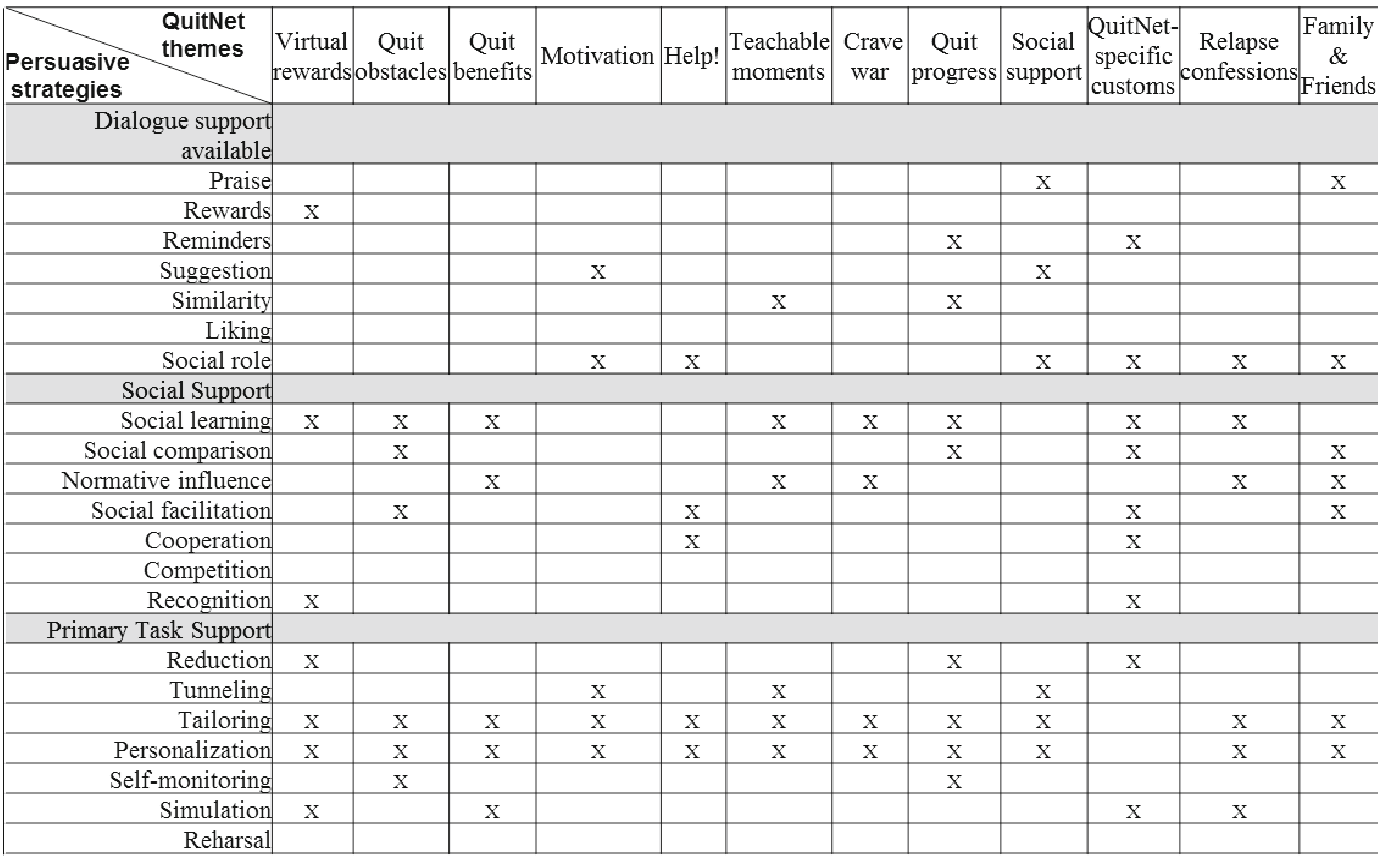
- Grounded Thematic Analysis: 16,492 messages were collected from QuitNet, with a subset of 550 undergoing qualitative coding. This identified themes like "Virtual Rewards," "Crave Wars," and "Relapse Confessions."
- The PSD Mapping: These themes were then mapped onto the Persuasive Systems Design (PSD) model, categorizing them into:
- Primary Task Support: Helping the user perform the behavior (e.g., tailoring, self-monitoring).
- Dialogue Support: Interaction between system/peer and user (e.g., praise, reminders).
- Social Support: Leveraging the power of the crowd (e.g., social learning, normative influence).
Key Insights from QuitNet
The analysis yielded several fascinating "Battlefield Reports" from the smoking cessation front:
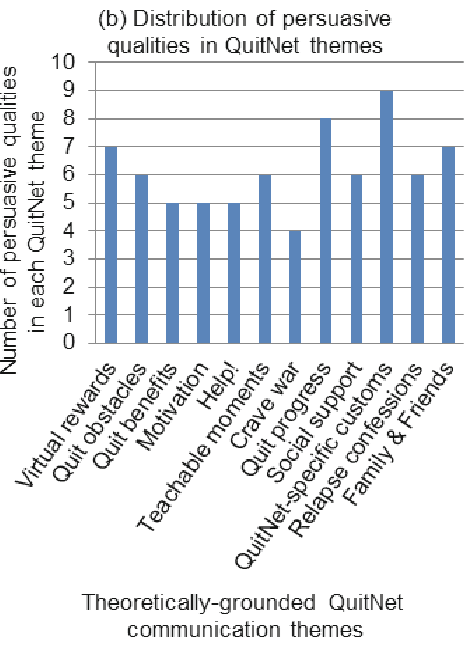
- The Power of Custom: The theme "QuitNet-specific customs" (unique community rituals) contained the highest density of persuasive qualities, including reminders and social learning.
- Social Learning is King: This was the most common persuasive quality. Seeing others succeed (observational learning) provides a stronger "nudge" than a generic system prompt.
- Tailoring and Personalization: Because peers respond to specific questions, the persuasion is naturally tailored to the individual's context, making it far more effective than "one-size-fits-all" advice.
Scientific Impact & Future Outlook
The study proves that persuasive qualities can be quantified in decentralized environments. By looking at the exposure levels (Fig. 2), the authors demonstrate that different user groups (Smokers vs. Ex-Smokers) utilize different persuasive tools.
Limitations: The study relies on a relatively small manual sample (550 messages) and self-reported smoking status.
Future Work: The logical next step is the implementation of Automated Persuasion Detection. Using this framework, we could build AI that recognizes when a conversation is losing its "persuasive edge" and help re-engage users through more targeted peer-matching or specific prompts.
Final Takeaway
Persuasion in the digital age isn't just about what the app tells you; it's about how the community models success. By understanding the "QuitNet-style" persuasive qualities, developers can build more resilient, self-sustaining behavior change support systems (BCSS).