
Decoding Persuasion: How Crowdsourcing and Multimodal Cues Reveal Why We Listen
Persuasiveness in Social Multimedia: The Role of Communication Modality and the Challenge of Crowdsourcing Annotations
The paper introduces a comprehensive framework for studying persuasiveness in social multimedia using the OCTAB tool and the MM-Eval procedure. It demonstrates that crowdsourcing can produce micro-level behavior annotations comparable to experts and identifies the visual modality as the most influential factor in human perception of persuasiveness.
TL;DR
Understanding why certain social media content is "persuasive" requires analyzing split-second human behaviors. This paper introduces OCTAB, a tool for crowdsourcing these micro-level annotations, and MM-Eval, a metric to ensure they are as accurate as expert work. The key finding: Visual modality dominates text and audio in shaping how persuasive we perceive a speaker to be.
Background & Motivation: The Bottleneck of Behavioral Science
In the era of YouTube and TikTok, social influence is moving faster than our ability to analyze it. While we know that verbal and non-verbal cues (like speech rate or eye contact) affect persuasion, studying them at scale is nearly impossible because:
- Annotation Speed: Manual coding of every shrug or pause by experts is extremely slow.
- Cost: Hiring specialists for micro-level (frame-by-frame) analysis is prohibitively expensive.
- The Crowd Gap: Standard crowdsourcing tools (like basic surveys) aren't designed for precise temporal tracking of "events" in a video.
The author's insight was to treat behavioral annotation as a computational problem—designing an interface and a mathematical framework to make "non-expert" crowd workers as reliable as "experts."
Methodology: OCTAB and MM-Eval
The core contribution lies in two synergistic components:
1. OCTAB (Online Crowdsourcing Tool for Annotations of Behaviors)
Unlike full-fledged video editing software which has a steep learning curve, OCTAB is a lightweight, HTML-based interface. It allows workers on platforms like Amazon Mechanical Turk to navigate videos with frame-level precision to mark the exact start and end of behavioral events.
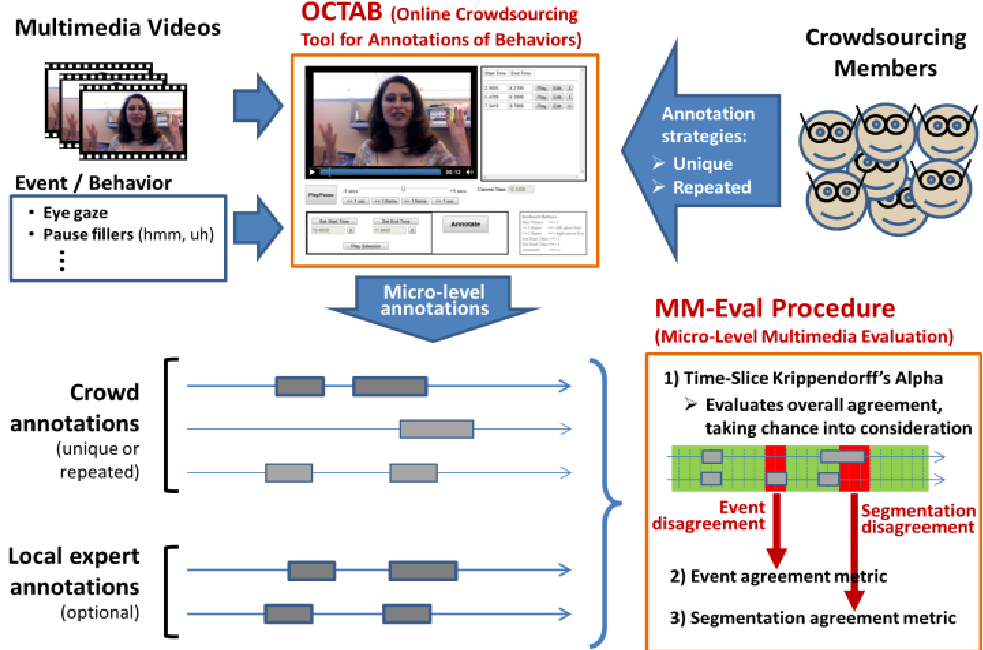
2. MM-Eval (Micro-level Multimedia Evaluation)
Agreement between workers is measured using Krippendorff’s alpha. The author proposes using "time-slice" (frame-based) and "event-based" metrics. By taking a majority vote from multiple crowd workers, the system achieves a "wisdom of the crowd" effect that rivals expert accuracy.
Experimental Insights: Modality Matters
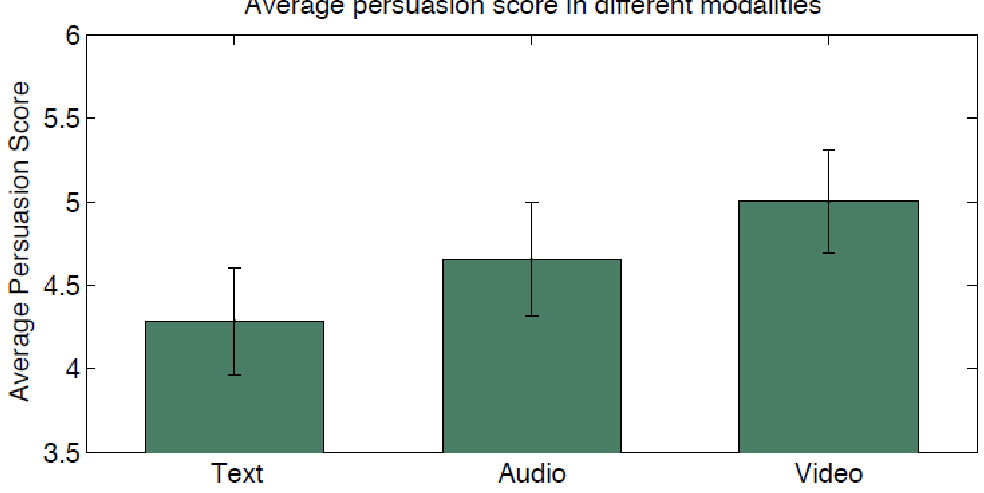
To test the system, the author analyzed 86 movie review videos from YouTube. They isolated communication modalities to see which one "sold" the review best: Text, Audio, or Video.
The results were striking. As shown in the performance comparison below, the visual modality significantly outperformed text. This suggests that "how you look and move" provides more persuasive weight in social media than "what you say" or "how you sound" in isolation.
Analysis & Takeaways
This research provides a roadmap for the transition from qualitative psychology to quantitative data science. By democratizing the annotation process, we can now build massive datasets of human influence.
- Scientific Value: It proves that crowdsourcing is a viable, high-quality alternative for professional behavioral coding.
- Practical Value: For creators and marketers, the data highlights that technical polish in video production (visual cues) may be more vital for persuasion than the script itself.
- Limitations: The study uses movie reviews; persuasiveness in other high-stakes domains (like political or medical advice) might rely more heavily on the text modality or source credibility.
Future Outlook
The logical next step is combining these high-quality human annotations with Automatic Feature Extraction. By training machine learning models on OCTAB-annotated data, we are moving toward a future where AI can predict the "persuasiveness score" of a video before it is even published.