
Hotent: Decoding Human Mobility Entropy for Efficient Opportunistic Forwarding
Pervasive and mobile computing
This paper introduces Hotent (HOTspot-ENTropy), a lightweight data forwarding metric for Opportunistic Social Networks (OSNs). It leverages human mobility patterns—specifically public and personal hotspots—and information entropy to quantify node centrality, similarity, and personality, achieving superior packet delivery ratios (PDR) and lower hop counts compared to metrics like SimBet and PeopleRank.
TL;DR
Researchers have developed Hotent, a routing metric that transforms how devices share data in "disconnected" social networks. By analyzing human "hotspots" through the lens of Information Entropy, the protocol identifies the best data carriers based on their social status and movement habits, boosting packet delivery by up to 35% while slashing network congestion.
The Problem: Why Traditional Social Routing Fails
In Opportunistic Social Networks (OSNs), such as people sharing data via WiFi/Bluetooth in a park, there is no stable path. Most existing protocols try to use Social Network Analysis (SNA) to find "popular" nodes.
However, two main issues arise:
- Computational Overhead: Calculating "Betweenness Centrality" usually requires global knowledge or complex matrix operations—impossible for a smartphone in a fleeting encounter.
- The Homogeneity Trap: Over time, as nodes meet more people, their contact lists start looking identical. Traditional metrics lose their ability to distinguish a "high-value" carrier from an average one.
The Insight: Hotspots and Entropy
The authors observe two stable phenomena in human walks: Public Hotspots (popular landmarks) and Personal Hotspots (home, office). These are far more stable than transient contact events.
1. Centrality as "Distribution Divergence"
Instead of counting friends, Hotent uses Relative Entropy (Kullback-Leibler Divergence). If a node’s personal movement distribution closely matches the community's public hotspot distribution, that node is "central" because it spans the network's most vital areas.
2. Similarity and Personality
- Similarity: Measured by the "distance" between two people's mobility profiles. If you visit the same coffee shop as the destination, you’re a great relay.
- Personality: A novel metric using entropy to identify "Roamers" (nodes visiting many spots) vs. "Homers" (nodes staying put). Roamers are the "fast tracks" for data.
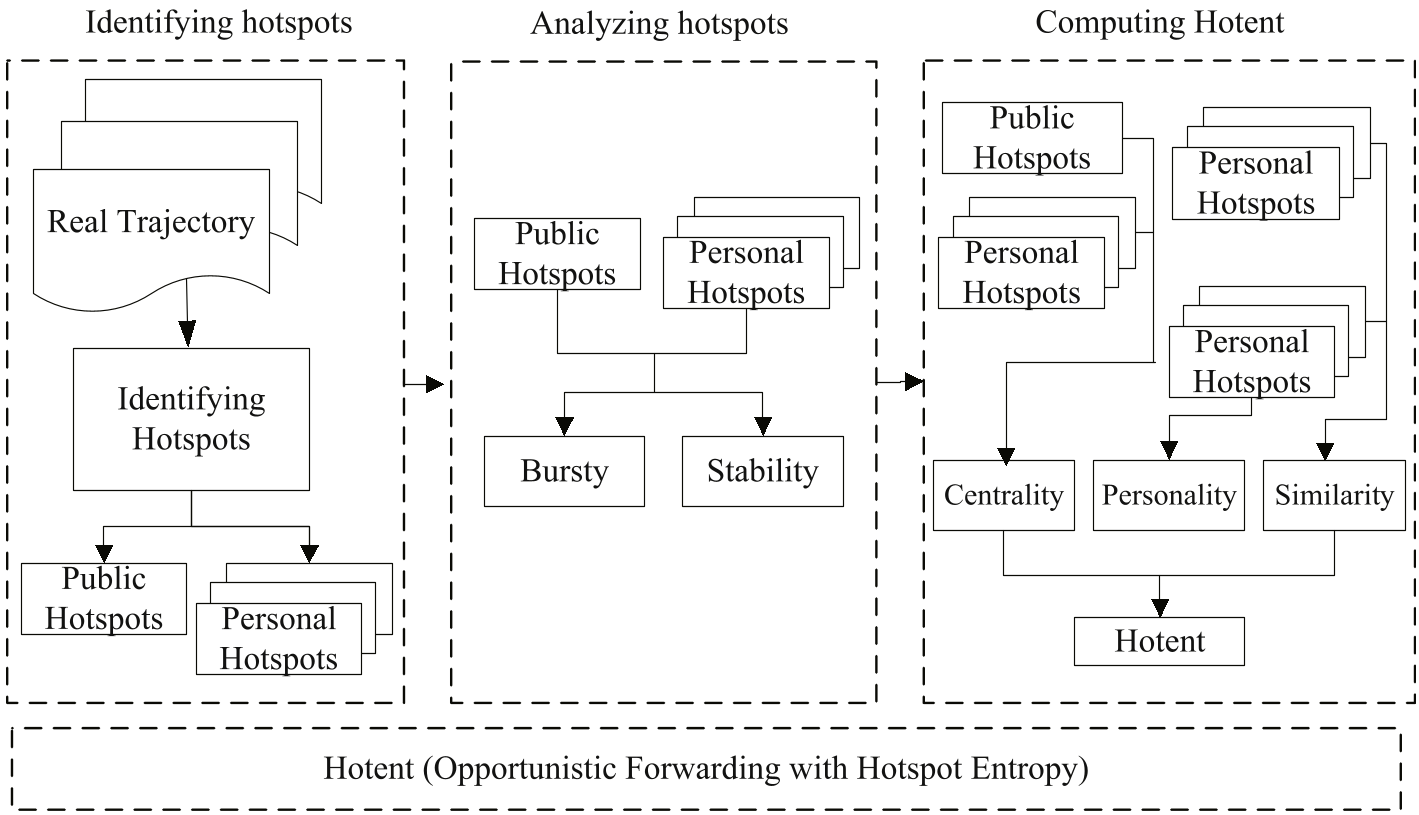 Figure: The Hotent architecture focuses on identifying hotspots from GPS traces to drive entropy-based metrics.
Methodology: The Gravity of Data
To fuse these social attributes into a single decision, the authors look to physics: Newton’s Law of Universal Gravitation.
In this metaphor:
- Mass = Node Centrality.
- Distance = Social Similarity (inverse).
- Force = The "attraction" or likelihood that node i can deliver a message to node j.
By multiplying this "gravitational force" by the node's Personality score, they create a robust ranking for data forwarding.
Experimental Results
The researchers tested Hotent against SimBet and PeopleRank using real-world traces (KAIST and NCSU).
- Delivery Power: Hotent achieved significantly higher Cumulative Packet Delivery Ratios (CPDR), particularly in sparse networks where choosing the right relay is critical.
- Efficiency: In the KAIST dataset, Hotent reduced the average hops from 36 (SimBet) to just 6—a massive reduction in redundant transmissions and battery drain.
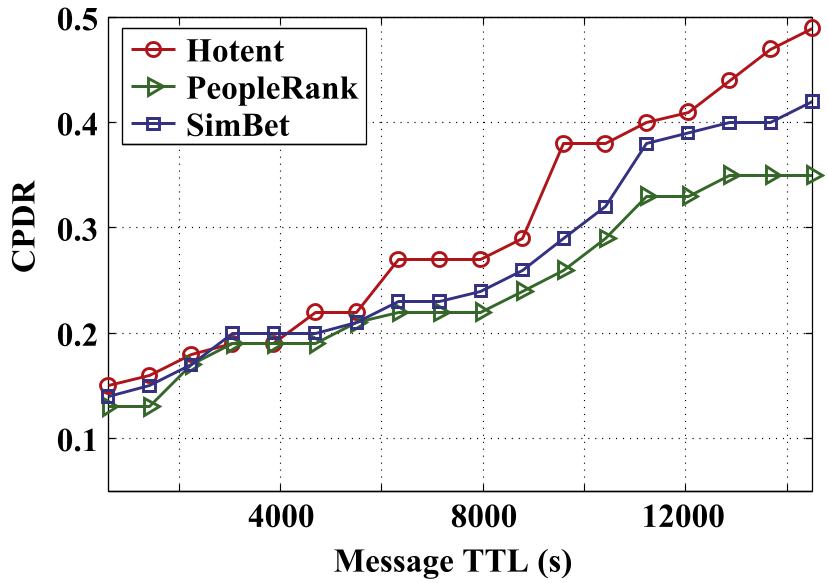 Figure: Hotent (top line) consistently maintains a higher delivery ratio as time (TTL) increases compared to previous SOTA methods.
Deep Insight & Conclusion
Hotent proves that spatial stability is a better predictor for routing than temporal contact frequency. While our social contacts are unpredictable, our destinations (hotspots) are remarkably consistent.
Limitations: The method relies on an initial "learning phase" to identify hotspots. In extremely dynamic environments where people never revisit the same place, the entropy scores might become noise.
Future Outlook: Combining Hotent’s entropy approach with modern Machine Learning could allow for "predictive hotspots," where the protocol anticipates where a person will go based on early-day movement patterns, further reducing latency.