
KAILOS: Towards a Global "Indoor GPS" through Crowdsourcing and Sound Analysis
Pervasive and mobile computing
This paper introduces KAILOS, a comprehensive system for Global Indoor Positioning (GIPS) and Navigation (GINS) using crowdsourced Wi-Fi fingerprints. It features an unsupervised HMM-based radio map construction method, an Extended Viterbi Algorithm (EVA) for tracking, and a novel sound-based indoor/outdoor detector.
Executive Summary
TL;DR: KAILOS is a pioneer system that solves the "last mile" of global navigation—indoors. By combining unsupervised machine learning to auto-generate radio maps, a robust probabilistic tracking algorithm (EVA), and an ingenious sound-based indoor/outdoor detector, the researchers have created a system that rivals manual surveys in accuracy while requiring near-zero human maintenance.
Academic Positioning: This work bridges the gap between theoretical SLAM (Simultaneous Localization and Mapping) and practical LBS (Location-Based Services). It is a "system-building" paper that moves beyond isolated algorithms to provide a globally deployable infrastructure for integrated in-and-outdoor navigation.
Problem & Motivation: The Scalability Wall
For decades, the "Indoor GPS" dream has been hindered by a single bottleneck: Radio Map Construction.
- The Manual Pain: Point-by-point calibration is accurate but takes weeks for a single mall.
- The Sensor Trap: Many researchers turned to Inertial Measurement Units (IMUs like gyroscopes). However, sensor drift on cheap smartphones is massive, and keeping sensors active drains battery, discouraging user "crowdsourcing."
- The GPS Blindspot: Most crowdsourcing methods use GPS for labeling, which is useless the moment you step deep into a concrete building.
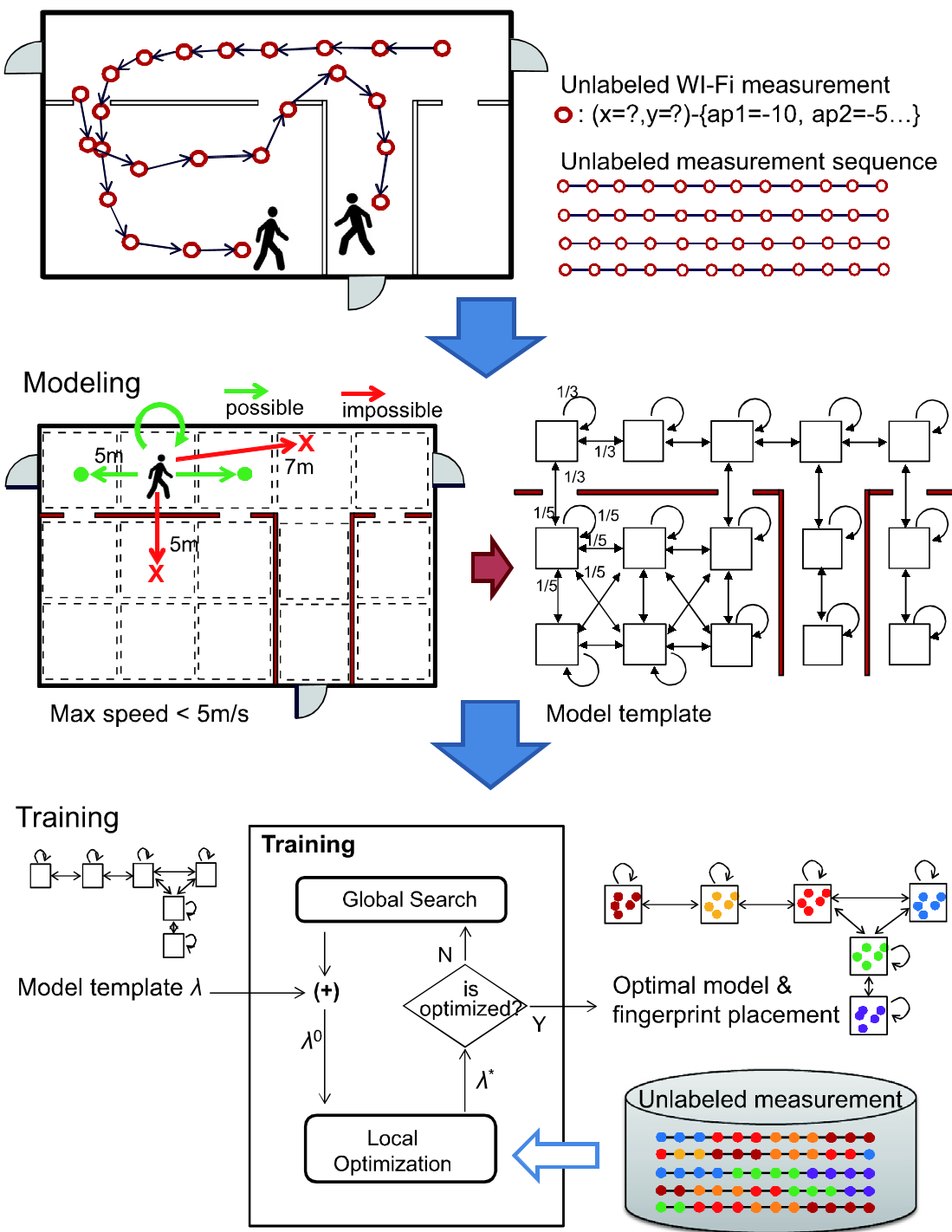
The authors’ core insight is to treat the building's physical layout as a topological constraint on an unsupervised Hidden Markov Model (HMM), allowing the system to "figure out" where signals were collected simply by matching human movement patterns to the floor plan.
Methodology: The Three Pillars of KAILOS
1. Unsupervised Radio Map Construction
Instead of asking users where they are, KAILOS collects "sequences" of Wi-Fi fingerprints. The building is divided into discrete states (grid squares). By using a Memetic Algorithm (an advanced Genetic Algorithm), the system searches for a signal propagation model that best fits the collected data within the constraints of the floor plan (e.g., you can't walk through walls).
2. Extended Viterbi Algorithm (EVA)
To handle the "noisy" nature of crowdsourced data (where you might only have 1 or 2 samples per spot), the authors extended the standard Viterbi Algorithm:
- ED-based Emission: Uses Euclidean Distance of mean RSS values, which is more robust than complex histograms when samples are sparse.
- Dynamic Transitions: Instead of a fixed speed assumption, the transition probability is adjusted based on how much the Wi-Fi signal changed between two time steps.
3. The "Sound" of the Environment
How does the app know when to switch from GPS (outdoor) to Wi-Fi (indoor)? Most systems wait for GPS signal loss, which is slow. KAILOS emits a 50ms inaudible chirp.
- Indoors: The sound bounces off walls, creating a high reverberation score.
- Outdoors: The sound dissipates, resulting in a "cleaner" signal. This allows for near-instant switching between navigation modes.
Experiments & Results: Real-World Dominance
The system was stress-tested at the KAIST Campus and COEX (Asia's largest underground mall).
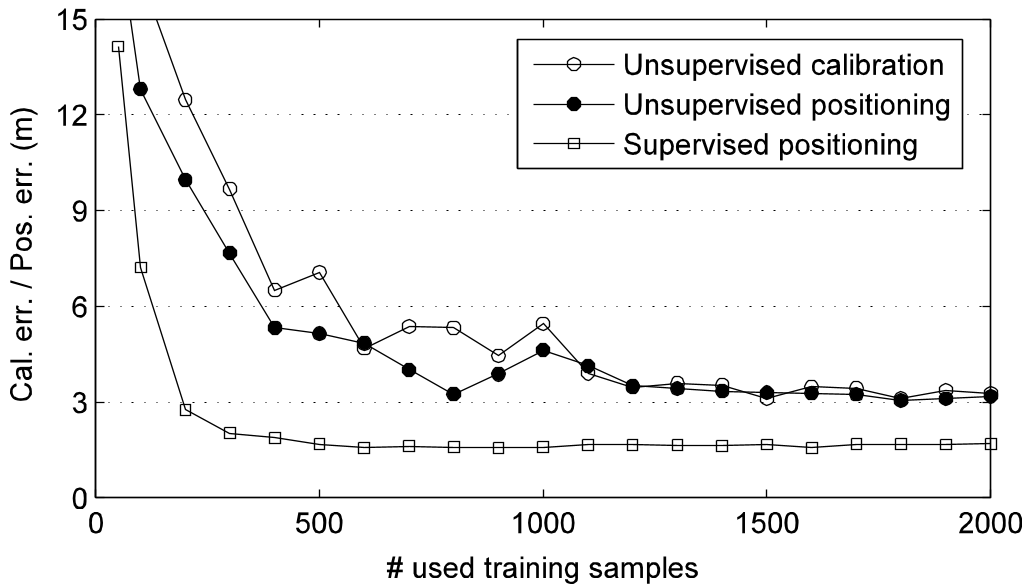
- Accuracy vs. Effort: The unsupervised method achieved 3-4m accuracy. While a manual survey is slightly better (2m), the labor cost of the unsupervised method is virtually zero, making it the only viable choice for a global system.
- Tracking Performance: The EVA (with multiple k-best trajectories) outperformed standard kNN positioning by 30%.
- Switching Speed: Unlike GPS-based detection which takes ~15 seconds to realize you've entered a building, the sound-based method works in under 2 seconds with 97% accuracy.
Critical Analysis & Conclusion
Takeaway
KAILOS proves that we don't need expensive new sensors to solve indoor positioning. The "infrastructure" is already there (Wi-Fi APs) and the "mapping labor" is already there (users walking with phones). The secret sauce is the probabilistic logic that binds them together.
Limitations
- Floor Plan Dependency: The system still requires an indoor map (image or CAD) to set topological constraints.
- Acoustic Noise: While chirp analysis is clever, extreme ambient noise or specialized wall materials (sound-absorbing foam) might degrade the environment detector.
Future Outlook
This work sets the stage for a "World-Wide Radio Map." As more users participate, the HMM becomes more refined, eventually creating a self-healing, self-updating global positioning layer that finally brings "Blue Dot" accuracy to every corner of the planet.