
From Pervasive to Social Computing: Bridging the Gap Between Logic and Human Connection
From Pervasive To Social Computing: Algorithms and Deployments
The paper introduces Pervasive Social Computing (PSC), a paradigm shifting from individual-environment interaction to socially-aware task fulfillment in mobile environments. It proposes a semantic middleware utilizing FOAF ontologies and specific matching algorithms (FIFO, Local-Satisfaction, Nearly-Overall-Satisfaction) to facilitate user activities based on social preferences.
TL;DR
This seminal work by Sonia Ben Mokhtar and Licia Capra redefines pervasive computing by shifting the focus from "smart objects" to "social connectivity." The paper introduces the Pervasive Social Computing (PSC) middleware, which uses semantic ontologies and social-based matching algorithms to help users find the best people—not just the best resources—to perform tasks with while on the move.
Positioning: This paper serves as a bridge between the "Web 2.0" social phenomena and the "Ubiquitous Computing" vision, proposing a structured way to handle the volatility of mobile tasks and the complexity of human social links.
Problem & Motivation: Beyond the Individual
Historically, pervasive computing was all about the "Self." The goal was to make your environment react to your needs (e.g., the lights turn on when you enter). However, the authors argue that many human activities—playing tennis, sharing a taxi, or having a meal—are inherently social.
The pain points they identified in 2009 are still relevant today:
- Semantic Ambiguity: "I want to play tennis" can mean different things to different systems.
- Social Sparsity: In a physical location (like a campus), your social network is often too sparse to find a direct friend for every task.
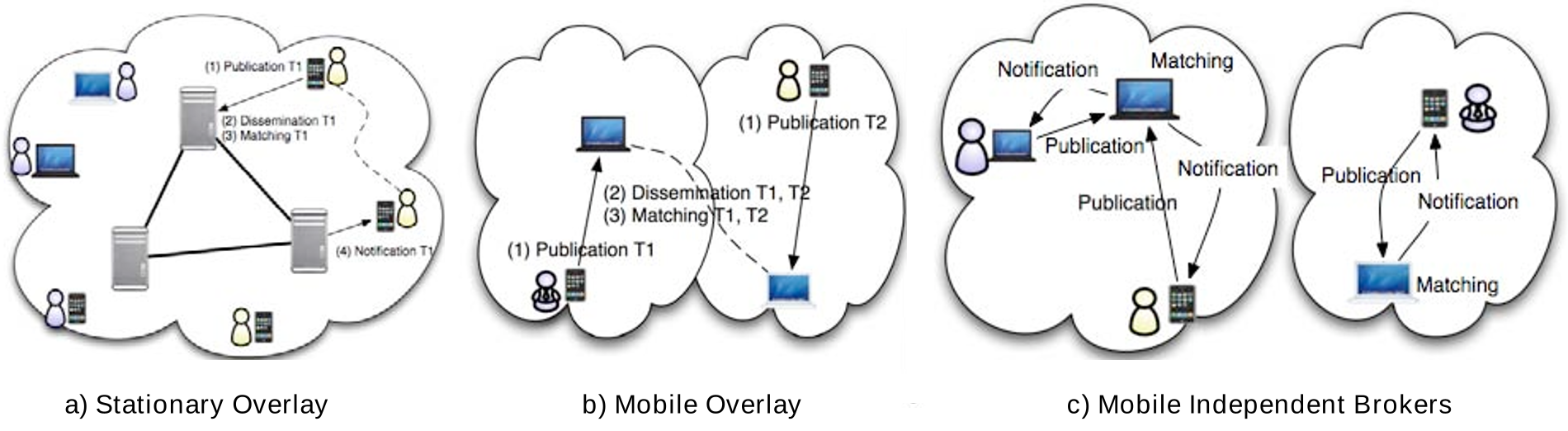
- The Infrastructure Gap: Constant cloud connectivity isn't always a reality; we need systems that work via "brokers" in a local, mobile environment.
Methodology: The Core of PSC
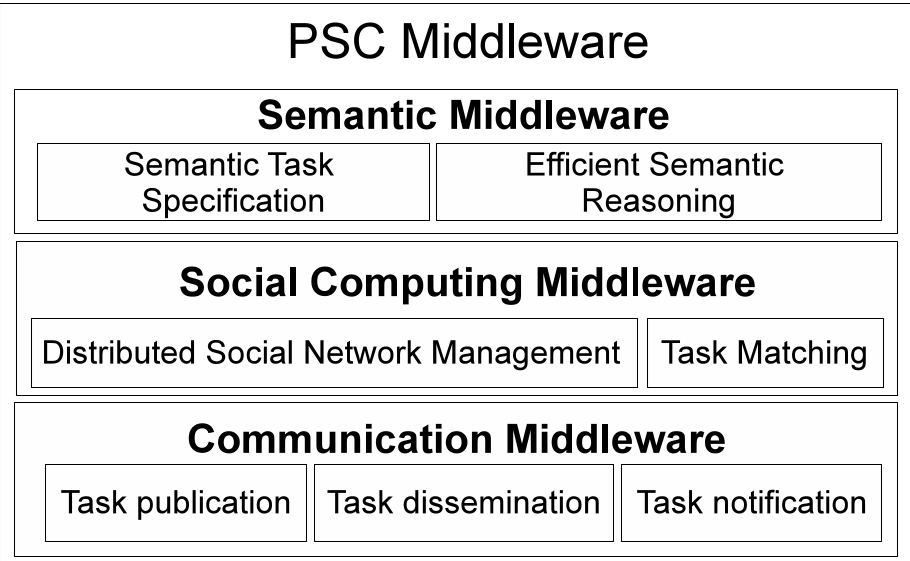
The authors propose a multi-layered middleware architecture designed to balance semantic richness with the resource constraints of mobile devices.
1. The Semantic Layer
They extended the FOAF (Friend Of A Friend) ontology. This allows the system to understand that a user interested in "Racket Sports" might be a good match for someone interested in "Badminton."
2. Matching Algorithms: The Social Logic
The paper analyzes four algorithms with varying tradeoffs between User Satisfaction and Computational Overhead:
- FIFO: First-in, first-out. Fast () but ignores social ties.
- Local-Satisfaction: Maximizes the utility for the person whose request is expiring ().
- Nearly-Overall-Satisfaction: An approximation of the optimal global matching (). This strikes the best balance by trying to satisfy the most people in the system.
Experiments & Results: Real-World Traces
The authors validated their system using the MIT Reality Mining and Cambridge Mobility datasets.
Key Findings:
- Algorithm Performance: Local-Satisfaction and Nearly-Overall provided a massive jump in utility compared to basic matching.
- The Deployment Factor: Stationary brokers (fixed hotspots) provide the best results because they have a global view of all requests. However, Mobile Overlays (using popular nodes as brokers) were found to be remarkably efficient, generating high satisfaction with very little communication overhead.
- Sparse Networks: A major realization was that real social networks (like Advogato or Last.fm) are very sparse. The authors suggest that Trust Propagation (e.g., "A likes B, and B likes C, so A might like C") is essential to making these systems work in the real world.
 The chart above illustrates how "Nearly-Overall" satisfaction scales effectively as individual tasks are allowed to stay in the system longer (higher TTL).
Critical Analysis & Conclusion
Takeaway
PSC makes a compelling case that social context is a primary "sensor" in pervasive environments. The transition from Service-Oriented (persistent services) to Task-Oriented (volatile human interests) is a critical shift for mobile developers.
Limitations
- Scalability of Reasoning: While they used "offline ontology encoding," complex semantic reasoning remains heavy for 2009-era mobile hardware.
- Privacy: The paper acknowledges privacy as an afterthought. In today’s world, sharing your "social preferences" and "real-time location" with local brokers would require robust Zero-Knowledge Proofs or Differential Privacy.
Future Outlook
This work laid the groundwork for what we now see in "Hyper-local" social apps and decentralized social protocols. The next step for this research lineage is likely the integration of Federated Learning to predict user social satisfaction without ever exposing the raw social graph to a broker.