
PHIS: Engineering the Next Generation of Social Hubs Across Networks
PHIS: A system for scouting potential hubs and for favoring their “growth” in a Social Internetworking Scenario
This paper introduces PHIS (Potential Hub Interceptor and Supporter), a novel system designed to identify current hubs and scout potential hubs across multiple social networks in a Social Internetworking Scenario (SIS). PHIS utilizes a hypergraph model and a multi-dimensional "hub parameter" to detect users who bridge communication between different platforms and implements a "training" campaign to accelerate the growth of promising users into active hubs.
TL;DR
Social networks no longer exist in isolation. Users jump between platforms, creating a complex Social Internetworking Scenario (SIS). This paper presents PHIS, a system that doesn't just find current "hubs" (influential users bridging different communities) but identifies "promising" users and "trains" them to become hubs. By utilizing a multi-factored hub parameter and proactive stimulation, the system increased the success rate of turning regular users into influential bridges by nearly 160%.
Problem & Motivation: The Gap Between Networks
Most influencer detection algorithms (like HITS or PageRank) treat a social network as a closed island. However, a user might be a trusted expert on a medical forum but a silent observer on a general news site.
The authors identify a major missed opportunity: Potential Hubs. These are users who have the right "bones" (reputation and profile) but lack the "muscles" (centrality and active information flow). Existing systems ignore them, but the authors argue that with the right stimulations—friend recommendations and content suggestions—these users can be groomed to facilitate cross-network information diffusion.
Methodology: The Anatomy of a Hub
PHIS uses a Hypergraph model to represent the SIS, allowing it to track everything from resource evaluations to cross-platform friendships.
The Four Pillars of Influence
To calculate if a user is a hub between networks and , PHIS calculates a weighted Hub Parameter:
- Trust & Reputation: A deep-dive metric that looks at how others evaluate a user's comments and resources, propagated through a multi-hop trust graph.
- Information Flow: Measures the user's "epidemic" potential—how much they take from network A and effectively seed into network B.
- Centrality: Uses a specialized PageRank to see if a user sits at the strategic center of interactions.
- Profile Wideness: A semantic analysis of tags to see if the user’s interests act as a "linguistic bridge" between the two communities.

Training Potential Hubs
When PHIS identifies a "Potential Hub" (someone with high reputation but low centrality), it initiates a Stimulation Campaign:
- To boost Centrality: It recommends "Power Users" to the potential hub.
- To boost Information Flow: It pushes trending content from the source network that aligns with the user's interests in the target network.
- To boost Profile Wideness: It recommends diversified content to expand the user's topical footprint.
Experiments & Results: Does Training Work?
The authors tested PHIS on a real-world SIS of four university social networks.
Precision vs. Recall
The study found a clear trade-off:
- If you want Precision (finding only the absolute best hubs), focus on Reputation.
- If you want Recall (finding as many potential connectors as possible), focus on Centrality.
The Power of Stimulation
The most striking result came from the growth experiment. Over 8 weeks, the authors compared a "stimulated" group of potential hubs to a control group.
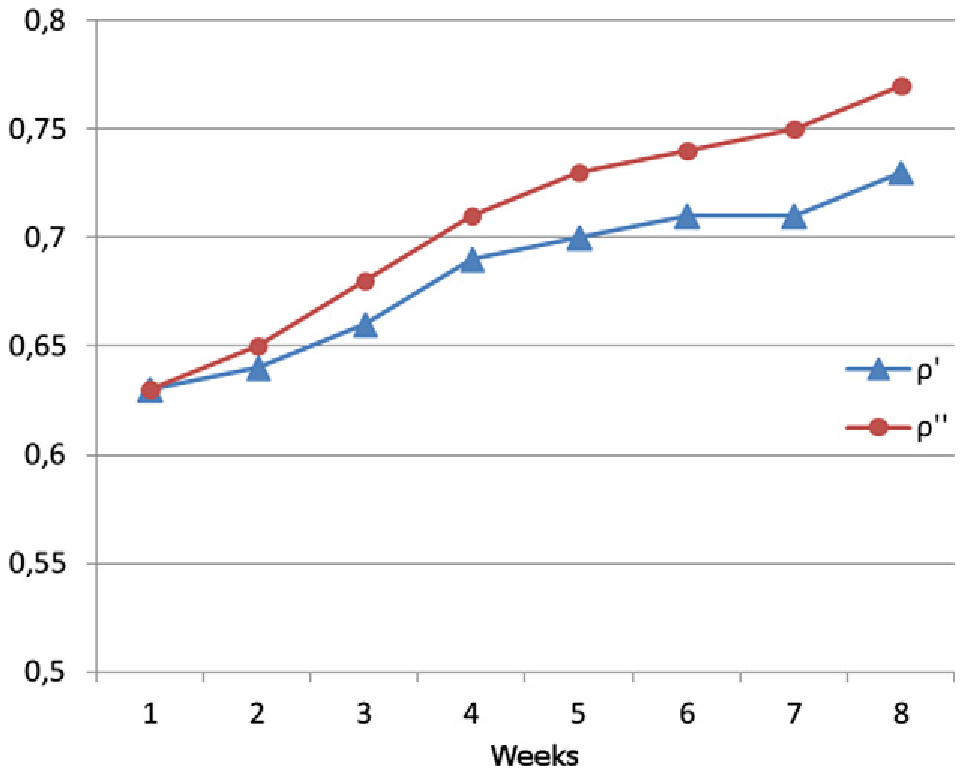 Fig: The "Hubness" (h'') of stimulated users grew significantly faster than the control group (h').
| Milestone | Stimulated Group Growth | Control Group Growth |
|---|---|---|
| Hub Conversion Rate | 64% | 25% |
| Centrality Increase | +0.28 | +0.14 |
| Profile Wideness | +0.22 | +0.02 |
Deep Insight & Conclusion
This paper is a pioneer in active network orchestration. While most research is content with observing network dynamics, PHIS proves that social structures are malleable. By identifying users at the cusp of influence and providing them with the "social capital" (friends and content) they lack, platform managers can consciously design a more interconnected and efficient information ecosystem.
Limitations: The system relies heavily on having access to user accounts across different platforms, which poses privacy and data-sharing challenges in today’s "walled garden" social media landscape. Future work using Intelligent Agents could further personalize the "training" process.