
Precise Prosody: Optimizing Phone Duration Modeling for Emotional Speech
Phone duration modeling: overview of techniques and performance optimization via feature selection in the context of emotional speech
The paper presents a comprehensive study of phone duration modeling for emotional speech synthesis in Modern Greek, evaluating ten machine learning algorithms across four categories (decision trees, linear regression, lazy-learning, and meta-learning). The researchers demonstrate that applying feature selection techniques like RReliefF and CFS significantly optimizes prediction accuracy, with the M5p model tree emerging as the top-performing architecture.
TL;DR
High-quality Text-to-Speech (TTS) synthesis depends on accurate prosody, where phone duration is a key pillar. This paper benchmarks ten machine learning models on a Modern Greek emotional database and proves that Feature Selection—specifically RReliefF and CFS—is the "secret sauce" for improving prediction accuracy across diverse emotional states like anger, fear, and sadness.
Perspective: The Challenge of Emotional Synthesis
In the quest for "natural" synthetic speech, the timing of individual sounds (phones) is not constant. A "neutral" phone duration differs drastically from an "angry" or "sad" one. Traditionally, phoneticians manually tuned rules, but as linguistics became more complex, these rules hit a ceiling. This paper shifts the focus to a data-driven paradigm, asking a critical question: Of the nearly 100 features we can extract from text, which ones actually matter for emotional timing?
The "Feature Selection" Insight
Machine learning models are often "garbage in, garbage out." Including irrelevant features like vowel frontness or lip rounding might actually confuse a model when it's trying to predict the elongated duration of a stressed syllable in an "angry" utterance.
The authors employed two sophisticated selection strategies:
- RReliefF: A distance-based approach that estimates the quality of features based on how well they distinguish between near-neighbor instances.
- CFS (Correlation-based Feature Selection): A strategy that searches for subsets of features that are highly correlated with the target (duration) but have low redundancy among themselves.
Methodology: Benchmarking the Giants
The study doesn't just look at one model; it pits ten different algorithms against each other, categorized into:
- Decision Trees: M5p, REPTrees.
- Linear Regression: The classical baseline.
- Lazy-Learning: K-Nearest Neighbors (IBk).
- Meta-Learning: Bagging and Additive Regression.
Model Architecture and Comparison

The M5p Model Tree stood out. Unlike standard regression trees that predict a constant value at each leaf, M5p fits a linear regression model at each leaf. This provides the best of both worlds: the hierarchical structure of trees and the mathematical precision of regression.
Experimental Battleground: The Modern Greek Emotional Database
The models were tested on a rich dataset featuring five emotional categories: Anger, Fear, Joy, Neutral, and Sadness.
Key Results & Visualization
The impact of feature selection was undeniable. By removing noise, the models became more specialized.
- Dimensionality Reduction: CFS reduced the feature set from 93 down to as few as 27 features for certain emotions.
- Accuracy Boost: In almost every category, the error (RMSE) dropped when feature selection was applied. Only "Joy" remained an outlier, likely due to its already low standard deviation in duration.
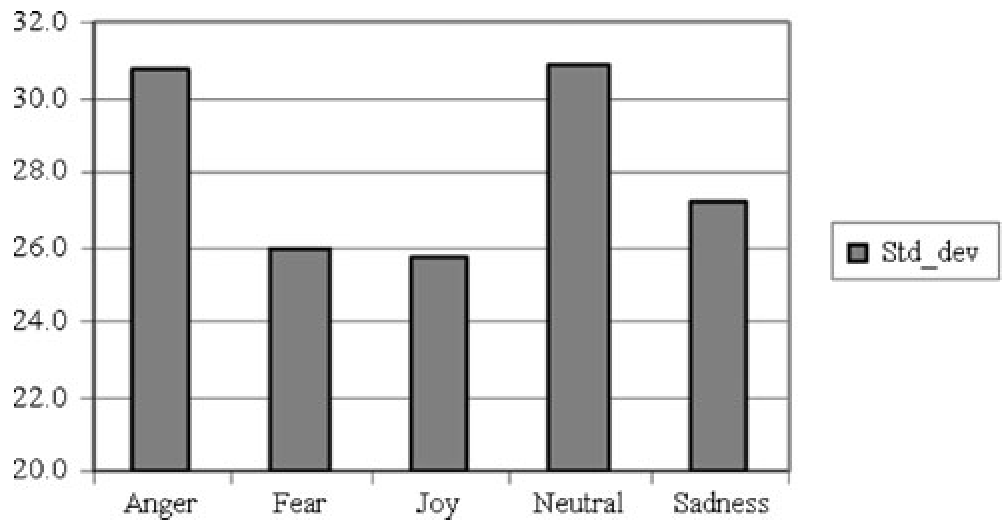 Fig 1: The variance in duration across emotions. "Joy" shows lower variance, explaining why it was less sensitive to feature optimization.
Deep Insights: Which Features Matter?
The study revealed that certain features are "universal" for duration:
- ToBI Accents and Boundary Tones: Crucial for phrasing.
- Stressed vs. Unstressed Syllables: The primary driver of rhythm.
- Syllable Break Indices: Marking the pauses that define emotional "pacing."
Interestingly, phonetic details (like manner of articulation) were often discarded by CFS, suggesting that global prosodic context (syllable and phrase level) is more influential than local phonetic identity when it comes to emotional timing.
Critical Analysis & Conclusion
Takeaway
The research proves that "more data" isn't always "better data." In the context of emotional TTS, the M5p algorithm combined with RReliefF/CFS features selection provides a high-efficiency path to more natural-sounding speech.
Limitations
The study is focused on Modern Greek and a single female speaker. To achieve industry-scale robustness, these findings need to be validated across multiple speakers and languages with diverse rhythmic structures (e.g., tone languages like Mandarin vs. stress-timed languages like English).
Future Outlook
As we move toward neural TTS (like Tacotron or FastSpeech), the "Feature Selection" logic remains relevant. Even in end-to-end deep learning, understanding which linguistic inputs drive prosody can help in designing more efficient attention mechanisms and duration predictors.