
Phook: Unveiling the "Transitive Agreement" Trap in Social Media Privacy
Are photos on Social Networks really private?
2013-05-01
Summary
Problem
Method
Results
Takeaways
Abstract
This paper introduces Phook (Photo-Book), a Facebook-based search engine designed to audit and explore the exposure of private user data. The authors demonstrate how third-party application permissions and "transitive agreements" allow for the mass harvesting of non-public photos, successfully collecting over 70 million private images from just 450 initial users.
## TL;DR
Is a photo on a social network truly private if only your friends can see it? This paper proves the answer is a resounding "No." By building a simple web application called **Phook**, researchers demonstrated that through legal API calls and misleading permission structures, they could harvest **70 million private photos** in just 60 days from a tiny seed group of 450 users. The study exposes the "transitive agreement"—a privacy loophole where your friends' actions compromise *your* data.
## The Depth of the Problem: The Weakest Link
Users generally believe that privacy settings are a contract between them and the platform. However, the authors argue that in the era of third-party ecosystems (apps, games, and quizzes), privacy is social, not individual.
The core issue is twofold:
1. **Over-privileged Permissions**: Apps often request "User basic info" or "Photos shared with you," which sound benign but grant sweeping access to data the app doesn't actually need to function.
2. **The Transitive Leak**: If you share a photo with a friend, and that friend authorizes a malicious or data-hungry app, that app can now see *your* photo. You never signed the contract, but your data is gone.
## Methodology: Phook’s Architecture
The researchers designed **Phook** as a search engine for friends' photos. The backend leverages the **Facebook Query Language (FQL)**, a SQL-like interface that allowed for high-speed, complex data retrieval.
### The Crawling Logic
Phook operates in three distinct phases:
* **User Data Crawling**: When a user logs in, Phook uses nested multi-queries to fetch all album IDs, photo links, and metadata from the user's entire friend list in a single batch.
* **Update Mechanism**: To maintain a real-time database, Phook uses timestamps to only fetch photo additions made since the user's last login, significantly reducing overhead.
* **Indexing & Search**: All links (not the images themselves, to save space) are stored locally, allowing users to search through millions of "private" photos using keywords like name, caption, or location.
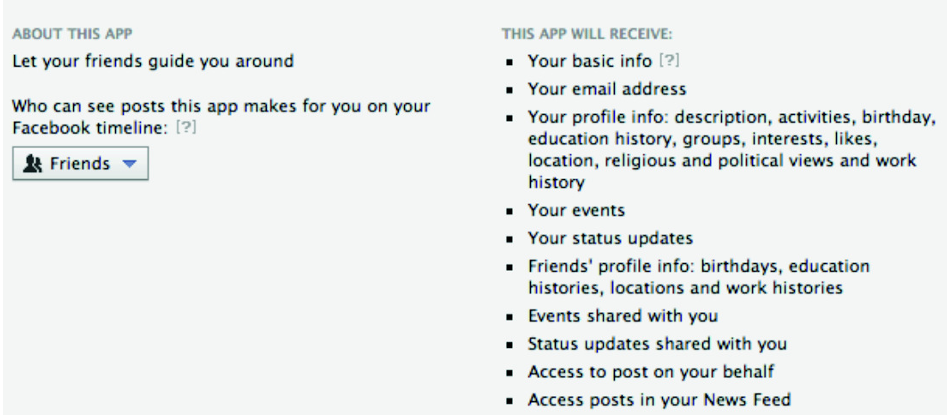
*Figure 1: The standard permission request screen that users often ignore, leading to mass data exposure.*
## Experimental Results: An Exponential Explosion
The scale of the data leak discovered by the authors is staggering:
* **Rate of Ingest**: Phook can retrieve **100,000 photos per minute**. At this rate, a single server could index 1 billion private photos in less than a week.
* **The Multiplier Effect**: 450 users led to the exposure of data from **450,000 individuals**. That is a 1,000x expansion of the target surface through social connections alone.
* **Extreme Cases**: A user with 4,000 friends (common for "social butterflies" or influencers) provides an entry point to search through over **2,000,000 photos** belonging to roughly **50,000 different people**.
| Metric | Average User | Power User |
| :--- | :--- | :--- |
| Accessible Photos | 170,000 | 2,000,000+ |
| Accessible People | 6,000 | 50,000 |
| Collection Time | < 2 Minutes | ~20 Minutes |
## Critical Insights & Future Outlook
The paper concludes that current social media privacy models are "scary." The "transitive agreement" effectively eliminates individual agency; your privacy is only as strong as the most tech-illiterate person in your friend group.
### Key Takeaways:
- **UI Deception**: Facebook uses "soft" language (e.g., "Photos shared with you") instead of "Your friends' photos" to reduce user friction during app installation.
- **Systemic Vulnerability**: This isn't a "hack"—it's the system working exactly as designed for developers, which is the most dangerous part.
- **The Path Forward**: The authors propose a "rating system" for apps based on their permission hunger, similar to nutritional labels, to help users make informed choices.
As we move deeper into the age of AI and facial recognition, the ease with which private photo datasets can be built—as shown by Phook—remains a haunting reminder that once a photo is uploaded, its "privacy" is largely an illusion maintained by the platform's API policy of the day.