
Phrase Detectives: Turning Language Annotation into a Global Game
11002_Phrase detectives Utilizing collective intelligence for internet-scale language resource creation.
The paper introduces "Phrase Detectives," a Game-With-A-Purpose (GWAP) designed for internet-scale creation of anaphorically annotated language resources. By framing corpus annotation as a detective game, the authors successfully recruited over 8,000 players to produce over 2.5 million linguistic judgments, achieving performance comparable to trained student annotators.
TL;DR
Building massive, high-quality datasets for Natural Language Processing (NLP) usually requires millions of dollars and thousands of expert hours. Phrase Detectives flips this model by turning "Anaphora Resolution" (the task of identifying what pronouns refer to) into a competitive online game. By leveraging the collective intelligence of over 8,000 players, the researchers created a high-quality corpus at a fraction of the cost of traditional methods, while revealing that linguistic ambiguity is far more common than experts usually admit.
The Resource Bottleneck: Why HLT is Stuck
Human Language Technology (HLT) has undergone a statistical revolution, but its progress is tethered to the availability of annotated data. For tasks like Anaphora Resolution—deciding that "it" refers to "Wivenhoe" and not "the river"—the costs are staggering:
- Expert Annotation: ~100 million.
- Crowdsourcing (AMT): Faster, but still costs roughly $380k per million words and often struggles with the cognitive complexity of semantic tasks.
The authors argue that the "desire to be entertained" is a more powerful and sustainable incentive than altruism (Wikipedia) or micro-payments (Mechanical Turk).
Methodology: The Detective Metaphor
Phrase Detectives uses a "Detective" metaphor to guide non-experts through complex semantic decisions. The system is split into two primary loops:
1. Name-the-Culprit (Annotation)
Players are presented with a text segment. Their goal is to find the "culprit" (the antecedent) for a highlighted "markable" (a phrase). They must categorize it as:
- Discourse-New (DN): First time this entity is mentioned.
- Discourse-Old (DO): Find the previous mention.
- Non-referring (NR): e.g., "It is raining."
- Property (PR): e.g., "Sam is a fireman."
2. Detectives Conference (Validation)
Instead of just trusting one player, the game enters a validation phase. Players see a peer's interpretation and vote "Agree" or "Disagree." This creates a self-correcting ecosystem where "Game Interpretations" are derived from aggregated consensus.
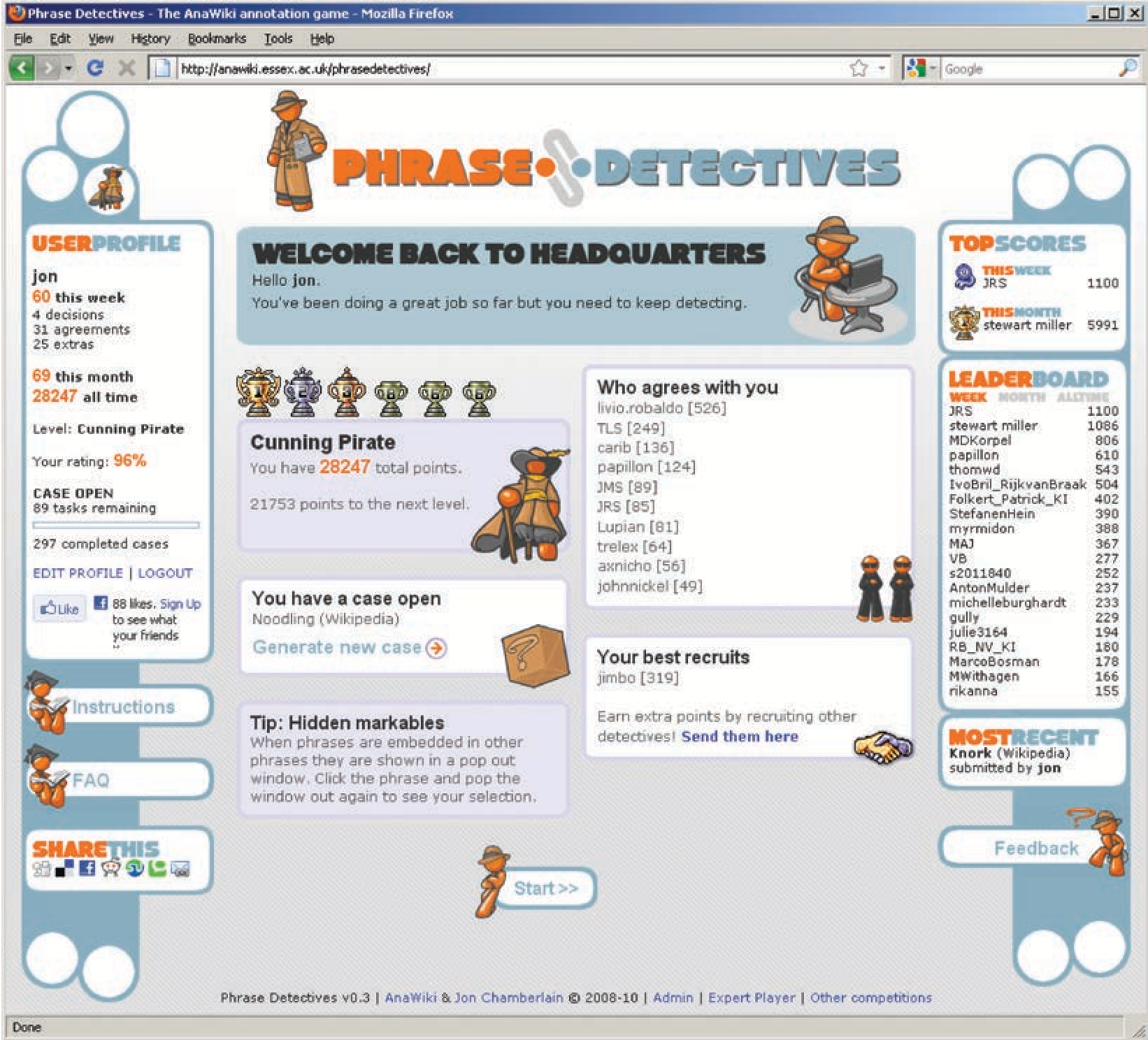 Figure 1: The Detective Metaphor interface where players resolve "cases" of anaphora.
Quality Control & Player Profiling
How do you prevent players from just clicking randomly?
- Gold Standard Traps: New players must pass a threshold by annotating text where the answers are already known by experts.
- The Validation Formula: . If many players disagree with an interpretation, its score drops to zero or negative, effectively filtering noise.
- Response Timing: While not used to pressure players, the system monitors "Time per Annotation" to spot bot-like behavior or low-effort scrolling.
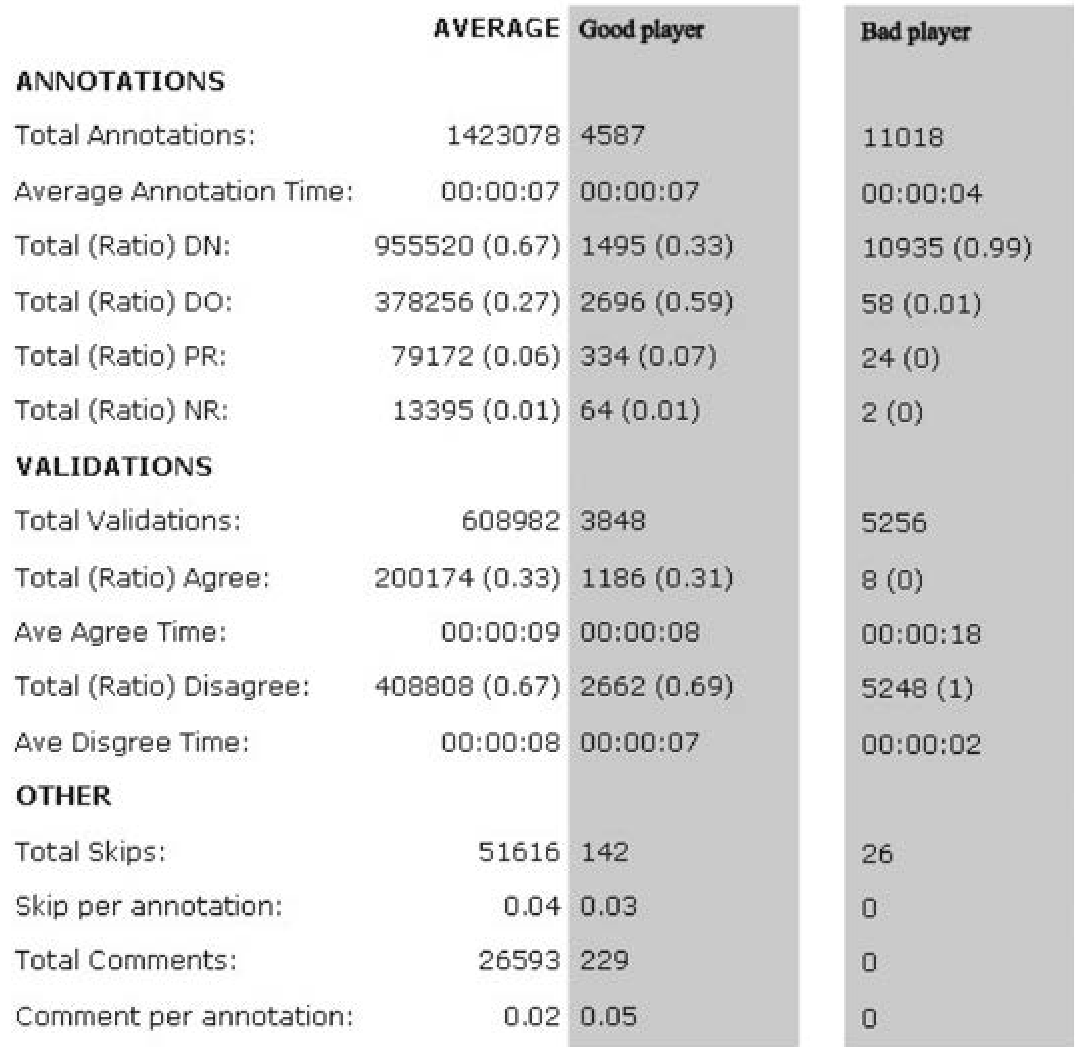 Figure 2: Statistical profiling used to distinguish "Good" players from "Bad" (outlier) players.
Experimental Results: Performance and Cost
The results prove that collective intelligence is a viable replacement for traditional lab-based annotation:
- Expert vs. Game: The "Game Interpretation" (the winner of the crowd vote) matched experts in 84% of cases. For context, two experts only agree with each other 94% of the time on this task.
- Training Utility: Data from the game was used to train the BART resolver, achieving an F-score of 0.58, on par with models trained on professional datasets.
- Cost Efficiency: The projected cost for 1M words via GWAP is **400,000 for standard student annotation or $1,000,000 for expert professional work.
Deep Insight: The Value of Ambiguity
Perhaps the most significant finding is that 41.4% of noun phrases have more than one valid interpretation supported by multiple players. Traditional annotation usually forces a "Gold Standard" which deletes this signal. Phrase Detectives preserves these "ambiguity anchors," providing a dataset that actually reflects the inherent uncertainty of human language.
Conclusion & Future Outlook
Phrase Detectives demonstrates that gamification can successfully navigate the "Resource Bottleneck." However, the authors note a crucial bottleneck: Preprocessing. If the automated parser (Berkeley/TULE) incorrectly identifies phrases, the player experience suffers.
As we move toward even larger AI models, the "Phrase Detectives" model offers a blueprint for Human-in-the-loop training that is not only cheaper but also captures the rich, ambiguous texture of human communication. The next frontier? Expanding to social platforms like Facebook and mobile smartphones to reach the "100,000 player" milestone.