
Beyond Sensors: Tapping into the Smart City's Social Pulse via Hybrid MV-RBM
Physical-cyber-social similarity analysis in smart cities
This paper introduces a hybrid Physical-Cyber-Social (PCS) framework for real-time smart city monitoring, integrating Twitter streams, IoT road sensors, and Web data. By leveraging a Multi-View Restricted Boltzmann Machine (MV-RBM), the system correlates social media "human probes" with official city data to enhance situational awareness.
TL;DR
Researchers from the University of Surrey have unveiled a hybrid system that merges Internet of People (Twitter), Internet of Things (Road Sensors), and Web of Data (Time Out/Wikipedia). By using a novel Multi-View Restricted Boltzmann Machine (MV-RBM), they proved that "human probes" on social media often report traffic incidents 5 hours earlier than official authorities.
Contextualizing the Problem: The Silo Effect
Traditional Smart City frameworks rely heavily on physical sensors (IoT) and official reports. However, these systems are often reactive and expensive to deploy city-wide. While social media (Twitter) offers a "cyber-social" alternative, existing NLP models for extracting city events often suffer from geographical bias—they are fine-tuned for one city (e.g., San Francisco) and fail when moved to another (e.g., London).
Methodology: The Power of Multiple Views
The core innovation lies in treating a tweet not just as a string of words, but as a combination of Semantic (what it means) and Syntactic (how it's structured) perspectives.
The Multi-View Architecture
The researchers developed an MV-RBM energy model. Instead of a simple classifier, they used:
- Semantic View: A Conditional Random Field (CRF) trained on city-independent dictionaries to recognize entities like "accident" or "concert."
- Syntactic View: A Convolutional Neural Network (CNN) to extract Part-of-Speech (PoS) tags, providing grammatical context.
By concatenating these views into an RBM, the model can resolve ambiguities—for instance, distinguishing whether "parking" refers to a Location or a Transportation Event based on its grammatical role in the sentence.
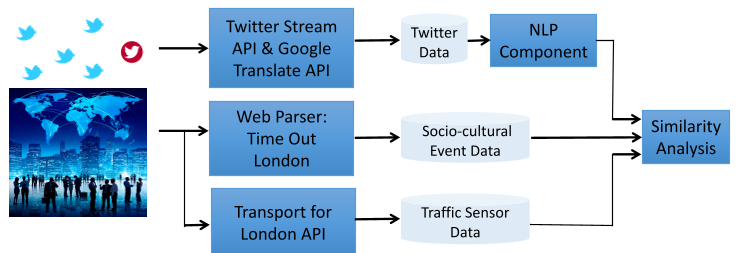 Figure 1: The proposed hybrid Physical-Cyber-Social pipeline
Experimental Insights: Early Warning Potential
The team tested their framework on datasets from London and San Francisco. The findings were striking:
- Portability: Their CRF-NER model, despite using generic dictionaries, performed on par with state-of-the-art models specifically tuned for San Francisco (95% precision for locations).
- The "5-Hour Lead": By performing a similarity analysis between Twitter timestamps and "Transport for London" (TfL) sensor data, they found that nearly half of social media reports preceded official records by an average of 297.5 minutes.
- Sociocultural Impact: The study found that transportation and cultural events are 31.75% more likely to influence Twitter traffic patterns than weather or crime, suggesting that city authorities should monitor event calendars to predict traffic surges.
 Table 1: Evaluation results showing MV-RBM performance boost and similarity measures.
Critical Analysis & Future Outlook
While the 5-hour lead time is a massive win for city management, the model still struggles with certain event classes like "Food" or "Social" due to overlapping dictionary terms.
Takeaway: This research proves that the "Social" layer of a city isn't just noise; it's a high-velocity sensor network. For future smart cities, the "Cyber-Physical" model must evolve into a "Physical-Cyber-Social" triad. Future work likely involves moving toward Online Learning to allow the model to adapt to new slang and urban trends in real-time.
Conclusion
This paper shifts the paradigm of urban monitoring from purely hardware-centric (IoT) to a human-centric hybrid. By bridging the gap between what people say (Cyber-Social) and what sensors detect (Physical), we can move closer to a truly "Real-Time City."