
Beyond the Cosine Angle: Reimagining Profile Similarity for Ad-hoc Social Networks
Piecewise Maximal Similarity for Ad-hoc Social Networks
This paper introduces Piecewise Maximal Similarity (PMS), a novel metric designed to measure user profile similarity in Mobile Ad-hoc Social Networks (MASNs). Evaluated against real-world Facebook and Bluetooth proximity data, PMS achieves a 6% improvement in predictive effectiveness over the industry-standard Cosine Similarity.
TL;DR
In the world of social networking, "similarity" is the currency of connection. While Cosine Similarity has long been the gold standard for comparing user profiles, it often misses the mark in Ad-hoc Social Networks (ASNs) where interest intensities vary. This paper proposes Piecewise Maximal Similarity (PMS), a new metric that outperforms traditional methods by 6% by focusing on the "minimal shared interest" across profile attributes.
The Problem: Why Cosine Similarity Fails the "Intuition Test"
In Mobile Ad-hoc Social Networks (MASNs), we need to suggest connections instantly based on proximity and shared interests. Standard L1-Norm and L2-Norm (Cosine) metrics fall into a mathematical trap:
- L1-Norm inconsistency: It varies wildly even if two users have identical interest patterns.
- Cosine Scaling Issues: If User A has interests (10, 1, 1) and User B has (10, 10, 10), Cosine Similarity yields a relatively low score (0.69) despite a perfect match on the primary interest. Conversely, it might give a perfect score (1.0) to (1, 1, 1) and (10, 10, 10) simply because the vectors point in the same direction, ignoring the massive gap in engagement levels.
The authors argue that in social contexts, similarity should be piecewise. If two people both like "Cricket," their shared similarity is the amount of interest they both possess—the minimum of their individual weights.
Methodology: The Piecewise Maximal Approach
The core innovation, Piecewise Maximal Similarity (PMS), moves away from angular distance to a summation of shared attribute "volumes."
The Formula
The similarity is defined as:
By using the min function for each keyword and normalizing by the average total weight, the metric ensures that:
- Exact matches yield a score of 1.0.
- Partial overlaps are rewarded based on the actual shared magnitude, not just the vector direction.
 Table showing how Cosine Similarity (0.69) can lead to counter-intuitive results compared to common-sense matching.
Experiments: Validating with Real-World Connections
The researchers didn't just rely on math; they used the SocialBlueConn dataset, which tracks:
- Interests: Survey-based keyword weights.
- Facebook Friendships: Hard truths of social connections.
- Bluetooth Contacts: Real-world proximity data.
Using Contingency Tables, they measured Percent Correct (PC) and Probability of Detection (POD).
Key Findings
- Superior Accuracy: PMS consistently showed higher POD and lower False Alarm Ratios (FAR) compared to Cosine Similarity at a 50% matching threshold.
- Consistency: Whether compared against Facebook's digital social graph or Bluetooth's physical proximity graph, PMS proved more reliable in identifying "true" potential connections.
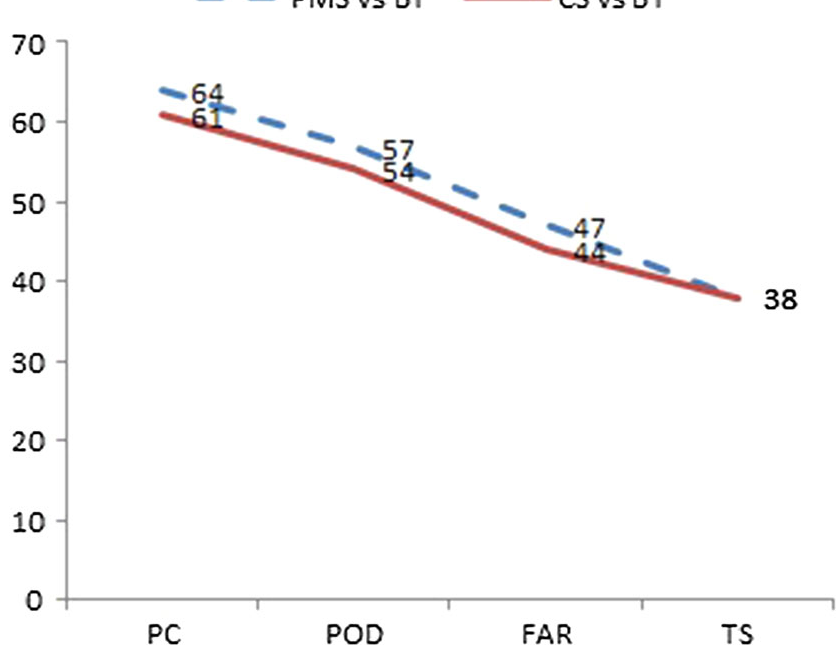 Experimental results showing PMS outperforming Cosine Similarity across verification measures.
Critical Analysis & Conclusion
The strength of PMS lies in its Inductive Bias: it assumes that if two people share an interest, the connection is bounded by the person with the lesser interest, rather than being a ratio of their total vector lengths.
Limitations
The study notes that at very high similarity thresholds (e.g., 75%), both metrics struggle. This is likely due to the inherent sparsity and diversity of human interests—few people are 75% identical even in close-knit academic environments.
Takeaway
For developers building Peer-to-Peer (P2P) or Ad-hoc social apps, moving away from "Angular Similarity" to "Mutual Volume" (PMS) could lead to significantly higher user acceptance rates for friendship suggestions.
Keywords: Ad-hoc Social Networks, Profile Similarity, Mobile Computing, Cosine Similarity, PMS.