
PISCES: Breaking the Synchronization Barrier in Multi-Job MapReduce
PISCES: Optimizing Multi-Job Application Execution in MapReduce
PISCES is a specialized optimization framework for multi-job MapReduce applications that introduces inter-job data pipelining and critical chain scheduling. It achieves SOTA performance by breaking the synchronization barriers between dependent jobs, improving execution speed by up to 52%.
TL;DR
PISCES (Pipeline Improvement Support with Critical chain Estimation Scheduling) is an architectural extension for MapReduce designed to accelerate multi-job workflows. It eliminates the "wait-until-finished" bottleneck between dependent jobs through an innovative data-pipelining mechanism and a sophisticated critical-chain scheduler driven by Locally Weighted Linear Regression (LWLR).
The "Synchronization Barrier" Problem
In modern big data stacks, a single high-level query (e.g., a Hive or Pig script) is often decomposed into a Directed Acyclic Graph (DAG) of multiple MapReduce jobs. Standard Hadoop, however, is dependency-blind.
Current systems suffer from two major inefficiencies:
- Blockage: Job B cannot start its Map phase until Job A has completely finished and moved its output to a final HDFS directory.
- Ignorance: Schedulers view jobs as a flat list, often failing to prioritize the "Critical Chain"—the sequence of jobs that actually dictates the total completion time.
Methodology: The PISCES Architecture
PISCES introduces three key modules into the MapReduce Application Master: a Dependency Analyzer, a Job Time Estimator, and a Job Scheduler.
1. Inter-Job Data Pipelining
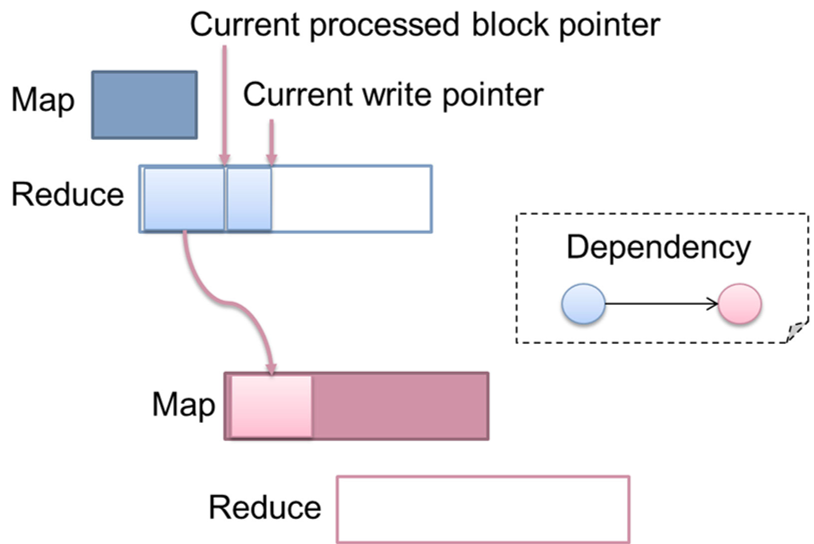
The most radical shift in PISCES is the ability to stream data between jobs. By tapping into the temporary output directories of HDFS, PISCES allows downstream Map tasks to spawn as soon as an upstream Reduce task flushes a single data block (64MB).
To ensure correctness and fault tolerance, PISCES utilizes a Hard Link feature in HDFS. This ensures that even if an upstream job finishes and tries to move its temporary files, the downstream Map tasks still have a valid reference to the data blocks.
2. Critical Chain Scheduling with LWLR
Not all jobs are created equal. PISCES uses Locally Weighted Linear Regression (LWLR) to predict job runtimes based on historical data. Unlike traditional linear models, LWLR gives more weight to recent and "size-similar" job executions, allowing it to accurately predict both linear and super-linear (e.g., ) workloads.
The scheduler then identifies the Critical Chain—the longest path of execution in the DAG—and ensures these jobs receive priority resource allocation to minimize the total Makespan.
Performance Benchmarks
The authors tested PISCES using PageRank (iterative) and PigMix (database queries) workloads.
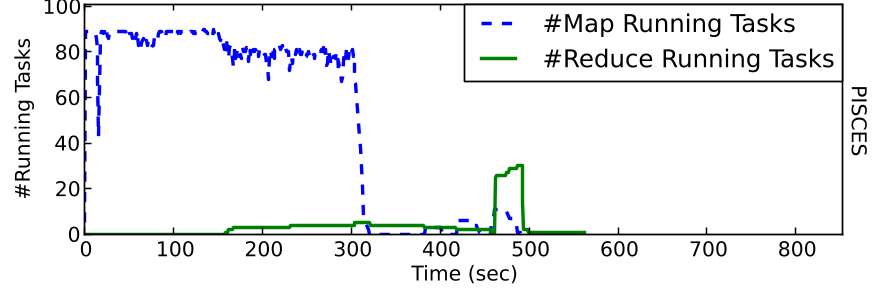
- Parallelism Boost: PISCES increased the degree of system parallelism by 68% in database operations.
- Speedup: Iterative applications like PageRank ran 41% faster because the system effectively eliminated the "dead time" between iterations.
- Resource Efficiency: By pipelining data, PISCES kept more data in the OS file cache, reducing expensive disk I/O and swap operations compared to standard Pig.
Critical Insight & Conclusion
The genius of PISCES lies in its "bottom-up" approach. While tools like Pig and Hive try to optimize the logical plan, PISCES optimizes the physical execution by making the MapReduce engine itself dependency-aware.
Takeaway: For any system managing job graphs, the ability to overlap the "Producer's Finish" with the "Consumer's Start" is the single most effective way to reclaim lost cluster cycles. While PISCES was built for MapReduce, its logic of LWLR-based estimation and hard-link-enabled pipelining remains highly relevant for modern cloud-native orchestrators.
Limitations
- Cold Start: The LWLR estimator requires historical data to be accurate; performance on unique, one-off jobs may revert to standard heuristics.
- HDFS Modifications: The requirement for "Hard Link" support in HDFS means PISCES isn't a "plug-and-play" library but requires a modified filesystem layer.