
Beyond Coordinates: Leveraging Semantic Hierarchies for Smarter Place Recommendations
Place Recommendation from Check-in Spots on Location-Based Online Social Networks
2012-12-01
Summary
Problem
Method
Results
Takeaways
Abstract
This paper introduces a semantic-aware location recommendation system for Location-Based Online Social Networks (LOSNS). It proposes the Semantic Hierarchical Category-graph Framework (SHCF), which combines density-based spatio-temporal clustering with hierarchical category propagation to outperform naive SVD-based collaborative filtering in recommendation accuracy.
## TL;DR
Location-based social networks often recommend places based on where you are, not who you are. This paper proposes the **Semantic Hierarchical Category-graph Framework (SHCF)**, which moves beyond raw GPS data by clustering check-ins and mapping them to a taxonomy of interests (e.g., "Nightclub" → "Entertainment"). By calculating similarity across clusters and semantic categories, it improves recommendation Precision by **21.5%** and Recall by **56.7%** over traditional SVD methods.
## The Motivation: Geography is Not Destiny
Most legacy recommendation engines suffer from a "neighborhood bias." They assume that if two users live in the same area or visit the same park, they are similar. However, a person visiting a park for a marathon has different interests from someone visiting a park to read at a cafe. The **insight** of the authors is that true user similarity lies in the *semantics* of their activities—the "Why" and "What" behind the "Where."
## Methodology: The Three-Layer Interest Discovery
The researchers developed the **Semantic Hierarchical Category-graph Framework (SHCF)** to bridge the gap between coordinates and intentions.
### 1. Spatio-Temporal Preprocessing
Raw GPS data is noisy. One user might check in at five different spots within the same mall. The authors use **DBSCAN** (a density-based clustering algorithm) to group these into "clusters." Each cluster is then annotated using a POI database (like Foursquare) to attach a label like "Starbucks" or "KTV."
### 2. The Shared and Personal Framework
The logic follows a three-layer hierarchy:
* **Layer 1 (Clusters):** Precise geographical spots.
* **Layer 2 (Specific Categories):** Specific labels like "Fast Food" or "Bar."
* **Layer 3 (General Categories):** Broad interests like "Food" or "Entertainment."
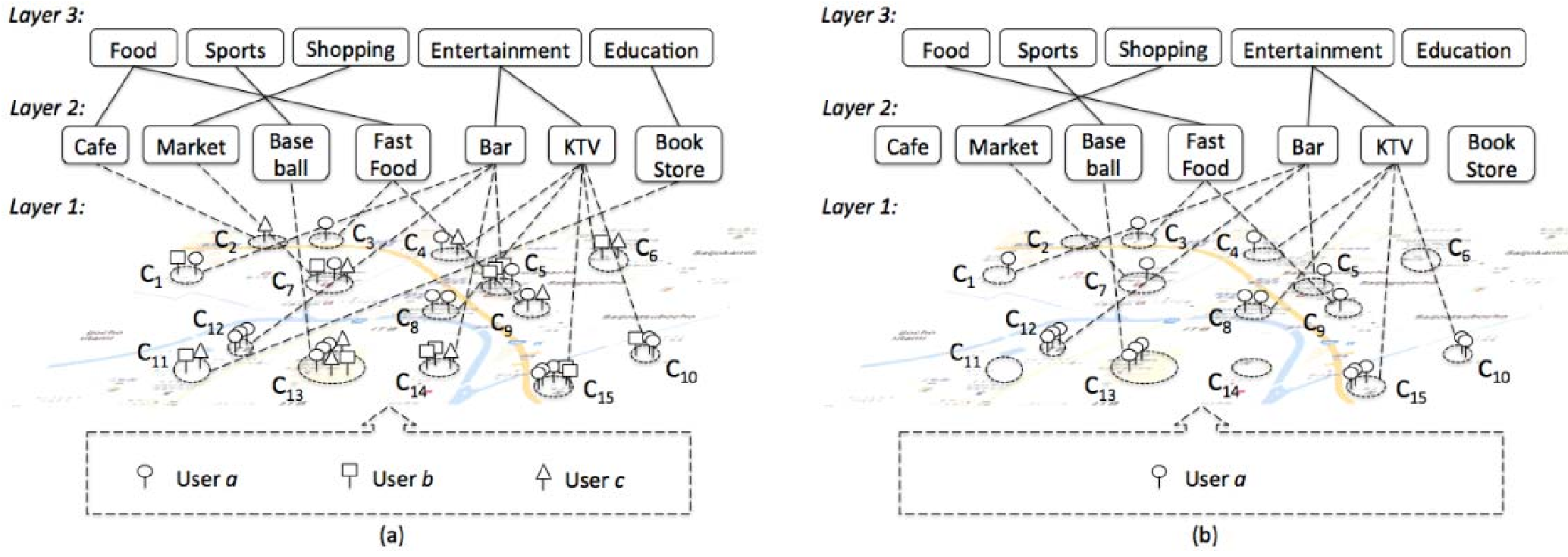
As shown in the architecture above, a user's "Personal Framework" is carved out of the shared global taxonomy. If a user spends 70% of their time in "KTV" and "Bars," their **Significance Score** for the "Entertainment" category increases.
### 3. Similarity via IDF and Pearson Correlation
To prevent popular spots (like airports) from skewing results, the authors apply **Inverse Document Frequency (IDF)**. If a location is visited by everyone, it carries less weight in proving that two specific users are similar. The similarity is then calculated using Pearson Correlation across all three layers of the hierarchy.
## Experimental Evidence
The authors tested their framework using 30,515 real-world check-ins from SINA Microblog. They compared their SHCF against **SVD-CF** (Singular Value Decomposition), a standard high-performance baseline in recommendation systems.
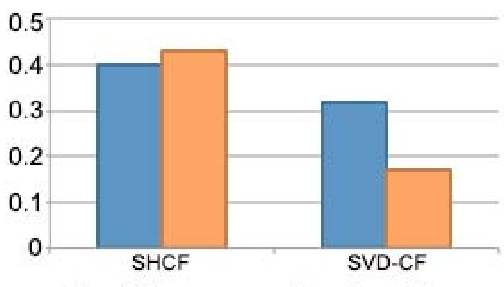
The results demonstrate a clear dominance:
* **Precision:** Consistent gains of over 20% by effectively filtering out "unlikely" categories (e.g., not recommending a bookstore to someone who only visits bars).
* **Recall:** Massive improvement (56.7% average), suggesting that the semantic approach finds relevant places that coordinate-based methods miss.
## Critical Analysis & Conclusion
**Takeaway:** The SHCF successfully demonstrates that semantic context is a powerful inductive bias for recommender systems. By organizing human behavior into a hierarchical graph, we can model "intent" much better than by using spatial proximity alone.
**Limitations:**
* **Cold Start:** While the authors mention content-based methods could solve the cold start problem, the current paper primarily relies on existing check-in history.
* **Temporal Dynamics:** The paper does not heavily focus on *when* people check in (e.g., a person visiting a bar at 10 PM vs. a cafe at 10 AM).
**Future Work:**
Integrating real physical distance as a final filter (to ensure recommendations are reachable) and combining these semantic graphs with modern deep learning embeddings could be the next frontier for location-based services.