
Lands of Fog: Bridging the Social Gap in Autism Through Embodied Full-Body Interaction
A Play Therapy Based Full-Body Interaction Intervention Tool for Children with Autism
The paper introduces "Lands of Fog," a full-body interaction system designed for children with Autism Spectrum Disorder (ASD). It utilizes a 6-meter circular floor projection to facilitate non-directed, collaborative play between ASD children and neurotypical peers to foster social initiation and joint attention.
TL;DR
"Lands of Fog" is a specialized intervention tool that transforms a 6-meter circular floor into a collaborative virtual world. Designed for children with Autism Spectrum Disorder (ASD), it uses full-body movement and "butterfly net" controllers to encourage spontaneous social initiation. Experimental results show significant improvements in collaborative behavior and social flexibility, proving that technology can move beyond the screen to foster real-world human connection.
The Challenge: Why Traditional Play is Hard for ASD
For children with ASD, the playground can be an overwhelming space of unspoken rules and unpredictable social cues. Research indicates that these children often engage in solitary, nonsocial play, struggling with "social-emotional reciprocity."
While many Information and Communication Technology (ICT) tools have attempted to help, they often fall into two traps:
- Overly Rigid Structures: They focus on linear tasks that don't reflect the creative, open-ended nature of real play.
- Physical Limitation: Traditional mouse/keyboard setups ignore the "Embodied Cognition"—the idea that our brains learn best when our bodies are moving and interacting with space.
Methodology: The Magic of the "Peephole" and Embodied Cognition
The researchers developed Lands of Fog based on the principles of humanistic non-directed play therapy. Instead of giving children a list of chores, the system invites them to explore.
1. The Fog and the Peephole
The virtual world is initially obscured by a dense fog. As children move, they "open" part of the world (the peephole). This strategy reduces sensory overload by limiting the information visible at any one time, forcing children to focus on their immediate surroundings and their partner.
2. Cognitive Offloaders
Children carry physical, glowing butterfly nets. These serve as "cognitive offloaders"—tangible objects that bridge the gap between the physical and virtual worlds, making the interaction intuitive and reducing the mental effort required to understand the system.
3. Creatures as Social Models
As children catch fireflies, magical creatures appear. These creatures aren't just pets; they are social scaffolds. If a child is passive, the creature waves to get attention. If two children bring their creatures together, the creatures merge to form a new, rarer species. This rewards collaboration without forcing it.
 Figure 1: The large-scale circular projection environment allowing for free movement and serendipitous social encounters.
Experimental Evidence: Beyond the Laboratory
The system was tested in both a controlled lab in Barcelona and an integrated school in London. The results were categorized into three key metrics:
- Increased Activity: The time children remained "still" decreased significantly (p = .022 by the third session), indicating higher engagement.
- Collaborative Growth: Interactions like "manipulating virtual elements together" saw a sharp rise through the sessions (ANOVA: F=22.9, p < .05).
- Perceptions of Peers: Perhaps most importantly, 65% of neurotypical children expressed a greater desire to get to know their ASD partners better after playing in the system.
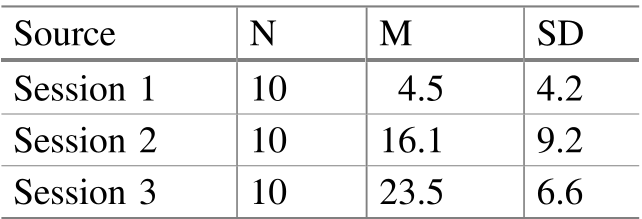 Table 1: Significant increase in collaborative interactions over successive sessions.
Critical Insight: Why This Works
The genius of Lands of Fog lies in its "Open-Endedness." By removing strict goals, the authors allowed children to negotiate their own rules for play. This mimics the "DIR model" (Floortime), where the child leads. The system doesn't teach social skills from a textbook; it creates a context where social skills are the natural byproduct of seeking fun and discovery.
Conclusion & Future Outlook
While the study's duration (three sessions) is a limitation for claiming lifelong neurodevelopmental changes, the immediate behavioral shifts are undeniable. This work demonstrates that Full-Body Interaction is not just for fitness or gaming—it is a powerful therapeutic medium.
Future research should focus on "Generalization": Does the confidence a child gains in the Lands of Fog carry over to the school cafeteria or the neighborhood playground? As we move toward more inclusive classroom technologies, "Lands of Fog" stands as a pioneering example of how to build digital bridges for the autistic mind.