
PLUTUS: Driving ROI through Social, Spatial, and Opinion-Aware Recommendations
PLUTUS: Leveraging Location-Based Social Networks to Recommend Potential Customers to Venues
PLUTUS is a specialized marketing framework designed for Location-based Social Networks (LBSNs) that recommends potential customers to businesses like restaurants or gyms. It integrates social ties, spatial proximity, and user opinions into a unified profit calculation model, significantly outperforming traditional popularity-based marketing strategies.
TL;DR
PLUTUS is a marketing framework for physical venues (restaurants, gyms, malls) that identifies the most "valuable" customers to target. Unlike traditional viral marketing, it doesn't just look at who is popular; it calculates a holistic profit score based on Social Influence, Physical Distance (Spatial), and Predicted Interest (Opinions). Results on Foursquare data show up to 180x more profit than standard marketing benchmarks.
Contextual Positioning
In the hierarchy of recommendation systems, PLUTUS sits at the intersection of Viral Marketing and Location-Aware Systems. While social networks like Twitter focus on information spread, LBSNs (Foursquare, Yelp) deal with physical foot traffic. PLUTUS moves beyond the "What" (will they like it?) to the "Where" (are they close enough to visit?) and the "How Much" (what is their total network value?).
Problem: The Limits of Social Popularity
Marketing to a celebrity might seem like a win, but if that celebrity lives in New York and your restaurant is in Minneapolis, the "Influence" is physically wasted. Existing methods fail because:
- Spatial Damping: Influence decays over distance.
- Negative Profit: High-cost influencers might cost more to acquire than the revenue they generate through their network.
- Homophily vs. Reality: Just because a friend visits doesn't mean the user has the same tastes or proximity.
Methodology: The Anatomy of Profit
The core innovation of PLUTUS is its unified Profit Function (). It breaks down the value of a customer into three components:
- Static Profit (): How much the customer themselves will likely spend.
- Network Profit (): The recursive value of all the friends this customer will influence to visit.
- Damping Factors:
- (Travel Penalty): Decreases as the distance between the user and the venue increases.
- (User Opinions): Uses Item-based Collaborative Filtering to predict if a user will actually enjoy the venue.
Architecture Overview
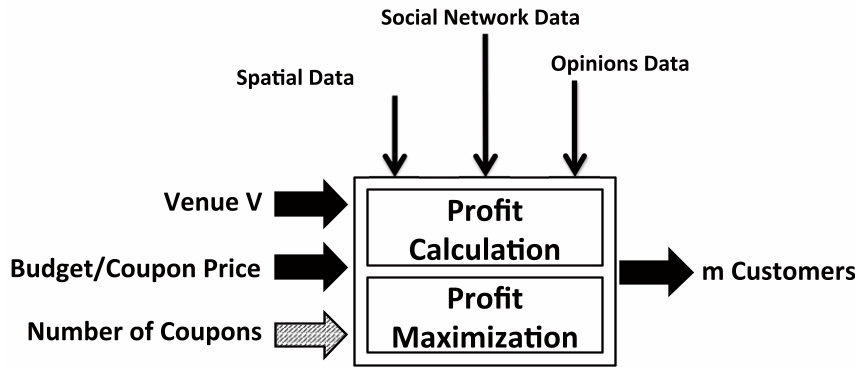
The framework converts raw check-in and friendship data into a directed graph where edges are weighted by "Influence Probability" (the likelihood visits given visited).
Optimization Strategies
PLUTUS handles two business scenarios via specialized algorithms:
- Celebrity-based: "I have $50,000. Give me the best mix of people." This is hit with a Greedy Hill Climbing approach to solve the Knapsack-style optimization.
- Coupon-based: "I have 100 coupons for $10 off." This uses an Incremental K-Nearest-Neighbor (KNN) search. It processes users by proximity and uses an "Early Termination" threshold to stop searching as soon as it's mathematically impossible for remaining (distant) users to beat the current top candidates.
Experimental Results
The researchers crawled Foursquare data (4,392 users, 36,963 venues) to validate the model.
Profit Breakthroughs
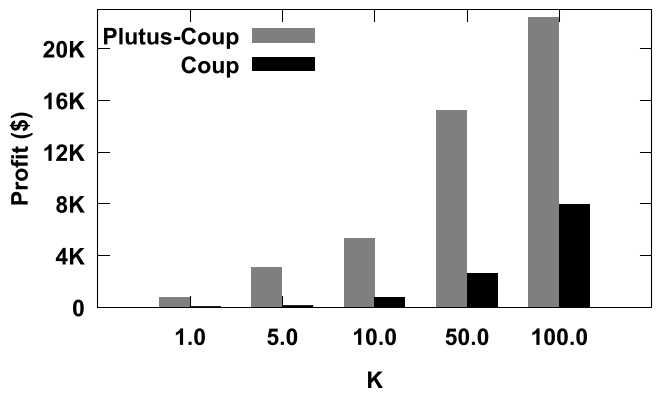
The most striking result is the difference in estimated profit. By filtering for spatial relevance and social reach simultaneously, PLUTUS-Celeb outperformed standard popularity metrics by massive margins (40x-180x).
Quality and Efficiency
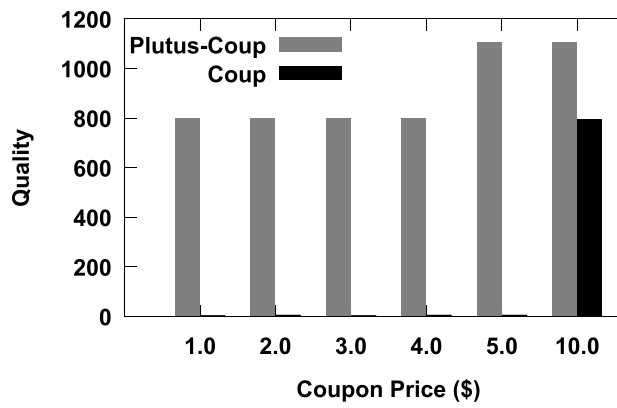
PLUTUS-Coup (Coupon) consistently achieved higher "Quality" (meaning the recommended users actually showed up in the test dataset) compared to baseline "Coup" methods. While the calculation is more complex than simple popularity sorting, the early termination strategy keeps the processing time within reasonable "online" limits (seconds).
Critical Insight & Conclusion
Takeaway: The "Network Value" of a customer is not a static property. It is a dynamic variable determined by their physical location relative to the product. PLUTUS proves that in the physical world, proximity is a stronger filter than popularity.
Limitations: The model currently assumes a static "Influence" value based on historical check-ins. Future iterations could benefit from considering temporal factors (e.g., a user might be influential for lunch spots but not for late-night bars) and road-network distance instead of simple Euclidean distance.