
PodCastle & Songle: Building a Positive Spiral Between AI and the Wisdom of Crowds
PodCastle and songle: Crowdsourcing-based web services for spoken document retrieval and active music listening
This paper introduces PodCastle and Songle, two pioneering web services that leverage crowdsourcing to enhance spoken document retrieval and active music listening. By integrating state-of-the-art Automatic Speech Recognition (ASR) and music information retrieval (MIR) with a social correction framework, the services allow anonymous users to correct AI errors, which are then used to iteratively improve model performance.
TL;DR
Researchers from AIST Japan have pioneered a unique "Social Correction" framework through two platforms: PodCastle for speech and Songle for music. By providing users with immediate utility—such as searchable podcasts and visualized music structures—they incentivize anonymous users to correct AI errors. This "Positive Spiral" creates a self-improving ecosystem where the community benefits from better tools as they contribute data back to the system.
The Motivation: Moving Beyond "Games with a Purpose"
In the mid-2000s, concepts like "Human Computation" and "Games with a Purpose" (GWAPs) grew popular. However, these systems often lacked a direct utility loop; users participated because it was a "game," not because they needed a service.
The authors identified a critical bottleneck: AI errors are inevitable. Whether it is a misunderstood word in a podcast or a missed beat in a song, machine learning models eventually hit a ceiling. Their insight was to treat these errors not as failures, but as opportunities for Crowdsourcing. By making the correction process incredibly easy (e.g., picking from a list of candidates), they transformed passive consumers into active "collaborative trainers."
Methodology: The Social Correction Framework
The core contribution is the "Positive Spiral" architecture. The process follows three distinct steps:
- Experience: Users use a search engine (PodCastle) or a music visualizer (Songle) based on AI.
- Contribute: Users fix errors they encounter while using the service for their own benefit.
- Amplify: The system uses these corrections to retrain models, leading to better performance and attracting more users.
PodCastle: Correcting Speech in the Wild
PodCastle provides a full-text search for podcasts. When the ASR fails, users can click on a word and see a list of competitive candidates generated by the system.
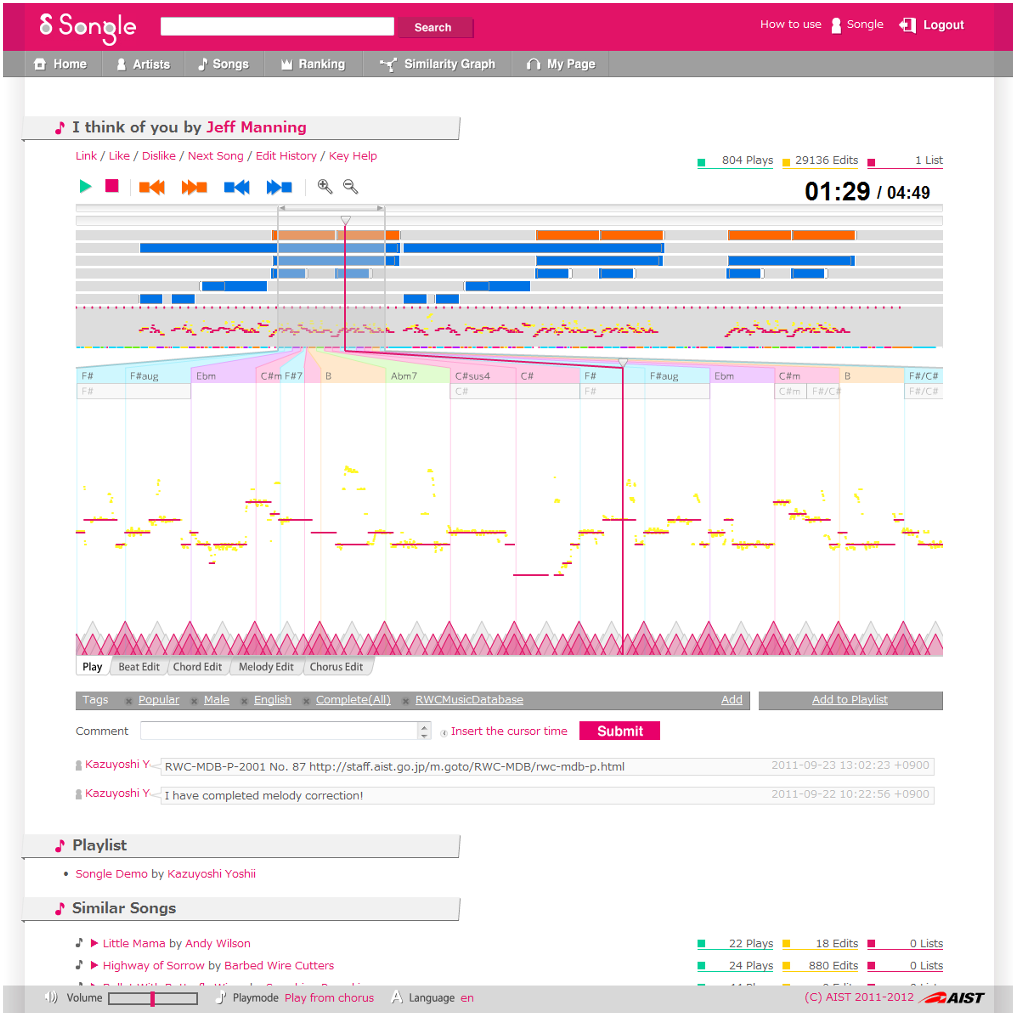 Fig 1. The PodCastle interface allows users to correct ASR errors by selecting from alternative candidates, directly improving the searchable index.
Songle: Active Music Listening
Songle takes signal processing to the web, visualizing hierarchical beat structures, melody lines (F0), and chorus sections. Since music analysis is subjective and complex, Songle provides a specialized editor for users to "nudge" the AI's estimations.
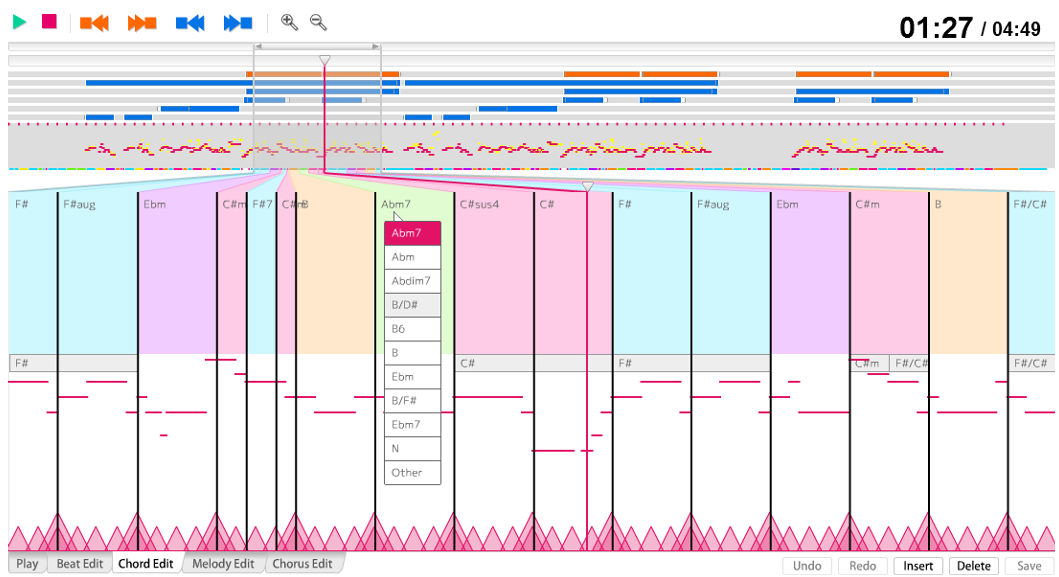 Fig 2. Users can adjust "Chorus" segments and repeated sections, which are then used to improve the music-understanding algorithm.
Experimental Results: Five Years of Collective Intelligence
The impact of this approach is staggering when viewed through the lens of data volume:
- Scalability: Over 580,000 corrections were voluntarily submitted by anonymous users.
- Data Diversity: Corrections spanned over 140,000 different speech data files.
- Model Improvement: The researchers confirmed that these corrections directly improved the speech retrieval performance and the accuracy of the underlying acoustic models.
Instead of hiring expensive experts for labeling, the authors created a self-sustaining system where the "cost" of data labeling is subsidized by the utility provided to the end-user.
Critical Analysis & Conclusion
Takeaway
The genius of PodCastle and Songle lies in Inductive Bias for UX. By presenting the user with "competitive candidates" instead of a blank text box, the cognitive load of correction is minimized. This work proves that if you provide a "State-of-the-Art" experience that is useful but imperfect, users will naturally help you perfect it.
Limitations & Future Work
While highly successful, the paper points to a few challenges:
- Quality Control: Relying on anonymous users requires robust mechanisms to prevent malicious edits or "crowd-bias."
- Incentive Decay: As the AI gets better, there are fewer errors to fix, which might paradoxically slow down the further improvement of the system.
The legacy of these services can be seen today in platforms that allow users to "edit captions" or "suggest a fix" on maps. The AIST team successfully demonstrated that social cooperation is the ultimate "optimizer" for signal processing research.