
SGFM: Mastering the Trinity of Social, Geographical, and Behavioral Insights for POI Recommendation
Point of interest recommendation with social and geographical influence
This paper introduces the Social and Geographical Fusing Model (SGFM), a unified recommendation framework for Point of Interest (POI) services in Location-Based Social Networks (LBSNs). By integrating check-in history, friendship networks, and geographical popularity, SGFM achieves state-of-the-art performance on the Gowalla dataset.
TL;DR
Recommending the "next place to visit" is notoriously difficult due to the extreme sparsity of check-in data. This paper presents SGFM (Social and Geographical Fusing Model), a framework that breaks the sparsity barrier by fusing three critical dimensions: user check-in history, social friendship networks, and geographical constraints. By applying PageRank to rank user authority and utilizing a distance-decay popularity model, SGFM delivers a significant boost in recommendation precision.
The "Sparsity" Bottleneck
In Location-Based Social Networks (LBSNs) like Foursquare or WeChat, the User-POI matrix is emptier than almost any other recommendation domain. Why? Because a user can only be in one physical place at a time, resulting in a tiny fraction of "visited" cells. Previous works often focused on a single signal:
- User-based CF: Only looks at shared history (suffers if you've only visited 2 places).
- Social-based CF: Only looks at friends (suffers if your friends haven't visited local spots).
- Geographical Models: Only looks at distance (ignores individual taste).
The authors argue that a truly intelligent system must understand that you visit a place because you’ve been nearby before AND your trusted friends like it AND the place is globally popular.
Methodology: The Fusion Architecture
SGFM operates through a sophisticated three-step pipeline:
1. The Social-Behavioral Hybrid
Instead of choosing between check-in similarity (Cosine) and social similarity (Jaccard), the authors fuse them: This ensures that even if you have no mutual check-ins with a friend, their influence is still captured.
2. Global Authority via PageRank
Not all users are created equal. Some are "local experts" whose check-ins carry more weight. SGFM uses the PageRank algorithm to calculate a global impact factor () for every user. A user who influences many others (high out-degree in the similarity graph) is treated as a more authoritative source for recommendations.
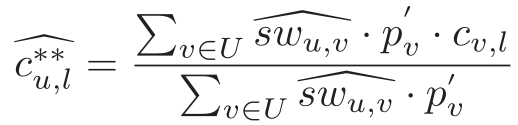 The enhanced probability model incorporating Global Impact Factors.
3. Geographical and Popularity Influence
The model acknowledges two physical realities:
- Distance Decay: You are more likely to visit a POI near your previous locations.
- Popularity Bias: If all other factors are equal, people flock to "hotspots." The geographical score is calculated as the product of a POI's global popularity and the inverse of the minimum distance to the user's history.
Performance Benchmarks
The model was tested on the Gowalla dataset, focusing on New York and Washington D.C. regions.
Key Findings:
- Superior Precision: SGFM consistently outperformed User-based CF and Social-based CF.
- Stability: As the recommendation list () grows, SGFM maintains a much more stable precision curve compared to baselines like US-BCF.
- Sensitivity Analysis: The "Sweet Spot" for the trade-off parameter was found to be 0.9, suggesting that while social influence is vital for cold-starts, actual check-in behavior remains the strongest predictor of future intent.
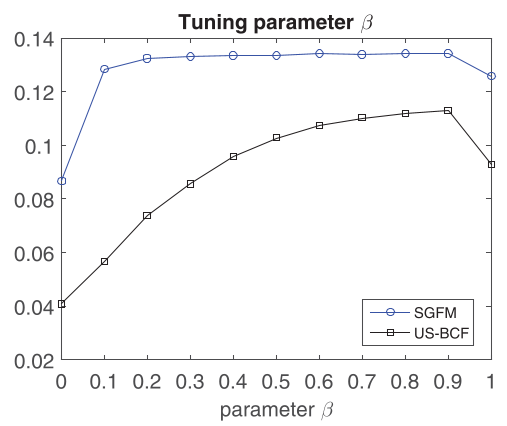 Precision and Recall results on Gowalla: SGFM (Top line) demonstrates a clear margin over traditional CF methods.
Critical Insights & Future Outlook
The brilliance of SGFM lies in its PageRank-weighted similarity. By treating the user similarity network like the World Wide Web, the authors effectively identify "influencers" in the LBSN ecosystem.
Limitations: The current model uses a static geographical measurement. In reality, geographical influence is dynamic—a user's "reach" might be different on a workday (commuting) vs. a weekend (traveling). Furthermore, integrating temporal slots (morning vs. night) as mentioned in the related works could refine the model further, though it risks increasing data sparsity.
Conclusion: SGFM proves that in the sparse world of LBSNs, "Fusion is King." By blending social trust with physical proximity and behavioral history, we can move closer to a truly personalized "concierge" experience.